




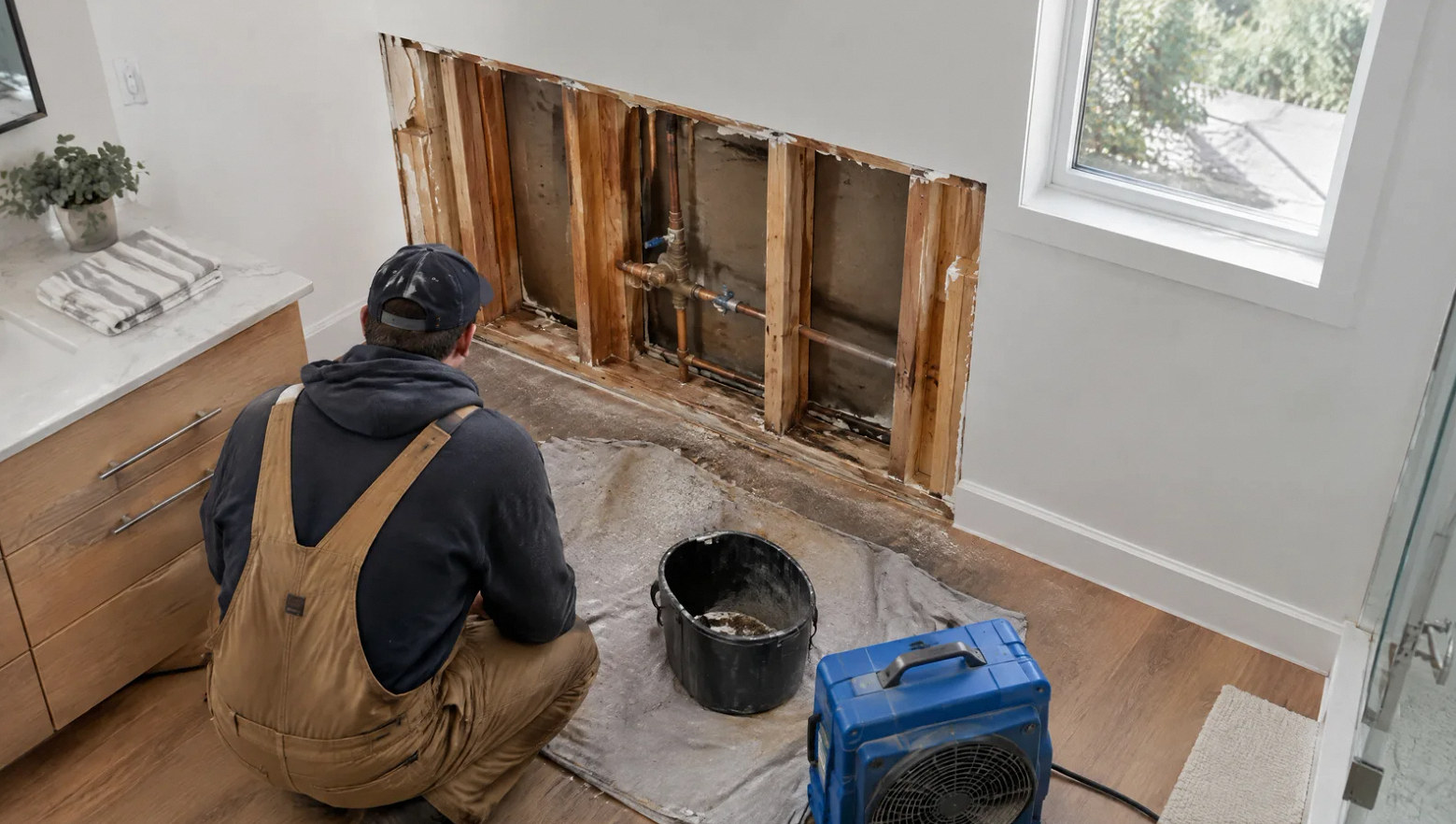
Failed copper supply line inside a wall cavity

Burst Pipe

Find The Shutoff. Then Call Us.

Everything after the valve can wait a few minutes. The valve cannot. Below is where it usually sits in each kind of Bay Area house, so you are not searching a garage wall with a flashlight while the ceiling fills.

Free inspection on restoration work · Licensed C-10 & General B · Answered 24/7

Where the shutoff is, by kind of house.

These are possible locations, not a map of your property. Have the customer shutoff identified before an emergency and ask how to operate it safely. Do not force an old or unfamiliar valve.

Post-war ranch, 1945 to 1970

Front yard, in a concrete or plastic meter box near the sidewalk. There is usually a second valve on the street-facing exterior wall near the hose bib.

Ask the water utility or a plumber to identify the customer shutoff and explain its operation. Do not assume a valve in a meter box is yours to operate or open utility equipment without permission.

Eichler and slab-on-grade

Exterior wall or the utility closet. There is no crawl space to hide it in, and supply lines run in or under the slab.

Slab construction is why a leak here shows up as a warm patch of floor or a meter that spins with everything off. Radiant heat is a separate system with its own manifold.

San Francisco Victorian and Edwardian

Basement or garage level, on the wall facing the street, usually within a few feet of where the supply comes through the foundation.

These have been re-plumbed in sections over a century, so the valve may be an old gate valve nobody has turned in decades. Turn it slowly.

Condominium or apartment

Inside the unit: a laundry closet, the water heater closet, or behind an access panel in the bathroom. Building mains belong to the HOA and are usually locked.

Shut the unit valve, then call the HOA emergency line. A leak in a stack or a shared wall becomes an association matter, and the sooner that is on record the better.

Anything with a water heater

A cold-water valve sits on top of the heater on the inlet side. Closing it isolates the heater without shutting the whole house.

If the heater itself is the source, close that valve and also cut its power or gas. Electric means a breaker; gas means turning the control knob to off.

Know the location and operation of your property’s shutoff before an emergency. If a valve resists, stop. Use an accessible fixture shutoff only if it is safe and suitable for the source; otherwise contact your water utility or a plumber.

Why pipes fail here, where it barely freezes.

Freezing is the national story and it is near the bottom of the list locally. Knowing what actually failed also tells you what else in the house is the same age.

Pinhole leaks in copper

The most common call we take. Copper installed from the 1960s onward develops pinholes from the inside out, and the first sign is often a fine mist inside a wall rather than a drip. Homes on the Peninsula running original copper are now well past the age where this starts.

Street pressure above 80 psi

Parts of the Peninsula and the hill neighborhoods of the South Bay carry high static pressure because the mains have to serve houses uphill. Without a working regulator that load sits on every joint, supply line, and appliance valve in the house, continuously.

Braided supply lines past their life

The flexible connectors behind toilets and under sinks are consumables with a service life measured in years, not decades. A failed one delivers full pressure until somebody finds the valve, which is why so many total-loss floods start in a half bath nobody uses.

Slab leaks

Supply routed under the foundation, common in flat-lot construction across Santa Clara County. The symptoms are indirect: a warm spot underfoot, a water bill that jumped for no reason, the sound of running water with every fixture off.

Brittle CPVC and polybutylene

Used widely in certain build years, both grow brittle with age and tend to fail at the fittings rather than mid-run. When one lets go, the rest of that plumbing is the same age and the same batch.

The rare freeze

Real but limited here, and almost always in the parts of a house that are effectively outdoors: an exposed crawl space, an unheated garage, a hose bib without a frost-proof valve, or an attic run in the Santa Cruz Mountains during a cold snap.

Once the valve is closed, the job is finding where it went.

A pipe that failed inside a wall has been feeding water into a cavity, and cavities connect. Water runs down the back of the drywall, pools on the bottom plate, travels along that plate into the next room, then wicks upward into material that looks perfectly dry from the hallway.

So the first thing that happens is not demolition. It is a thermal camera and a moisture meter working outward from the source until the readings come back to normal, which is what tells us where the wet area actually ends. Opening walls on a guess costs you drywall you did not need to lose.

A wet wall cavity may also contain electrical wiring, boxes and devices. Keep clear of affected equipment and arrange assessment by a qualified electrician. The project scope should identify electrical hazards, responsibility for isolation and the checks needed before reuse.

Wall opened back to sound framing after a supply line failure — illustrative service image

Opened only as far as the readings required, then dried and rebuilt.

Burst pipe questions

Do not force a stuck valve. If the source is a fixture, use its accessible shutoff only when safe. For a concealed pipe leak or an uncertain valve, contact a plumber and your water utility for assistance. Do not operate utility equipment without the utility’s direction.

Keep clear of the sagging ceiling and keep others out. Do not puncture it. Stop the water only from a safely accessible valve, and have qualified professionals assess the ceiling and affected electrical systems.

Possibly not, and this is the most common denial in the category. Most policies cover sudden and accidental discharge and exclude gradual seepage. Some still cover the resulting damage where the leak itself is excluded, which turns on wording specific to your policy. We document what we find and leave the characterization to the adjuster. What we can tell you is that the physical evidence matters, so keep the failed section of pipe.

The written scope should identify who handles source control, permanent plumbing repair, electrical assessment and reconstruction, including any specialty contractors and required inspections. Confirm the responsible contacts and schedule for each stage before authorizing work.

Whoever can act fastest shuts the water off, then the owner or property manager owns the repair decision and the claim on the building. A renters policy covers the tenant’s contents, not the structure. We work with owners, managers, and HOAs regularly and will scope it to whoever is responsible for the part in question.

Close the wall only after the source repair, cleanup, documented drying assessment and required specialist checks are complete. The duration depends on materials, access and site conditions. Surface readings do not establish that every concealed layer is ready.

Next on the same job.

24/7 Emergency Response

A pipe that failed on a mild night was already failing. The rest of that plumbing is the same age.

Licensed C-10 & General B · CSLB #1158693 · General Liability Insured

Burst pipes & slab leaks · Detailed answers

Questions worth resolving before work begins.

Does a high water bill prove I have a slab leak?

No. Compare actual consumption and billing periods, account for known uses, and ask a qualified plumber to investigate unexplained flow. A meter observation can support further investigation but does not locate a leak beneath the slab.

Read the full guide: High Water Use but No Visible Leak: What to Verify First →
Is rerouting a slab leak always better than repairing it in place?

No. Compare the confirmed defect, feasible routes, remaining piping and all access and finish work. Ask a qualified plumber to explain why each option fits the building and what uncertainty remains.

Read the full guide: Slab Leak Repair, Reroute or Repipe: Compare the Whole Scope →
Does a second slab leak mean every pipe must be replaced?

Not automatically. Ask a qualified plumber to compare the actual failure locations, examine relevant system conditions and explain what supports a localized or broader scope. Two events raise a useful assessment question but do not establish the cause by themselves.

Read the full guide: A Second Slab Leak: What to Review Before Another Repair →
Is a wet wall after a repair proof that the pipe still leaks?

No. It may reflect retained moisture, continuing water entry or a measurement that needs interpretation. Review the plumber’s verification alongside repeated material readings and any new observations before deciding what further investigation is needed.

Read the full guide: The Pipe Is Repaired but the Wall Is Still Wet →
What date should I report if I do not know when a hidden leak started?

Report the discovery date and clearly state that the onset is unknown. Provide earlier observations and records separately, with their dates and limits. Ask the insurer how it wants uncertainty recorded rather than selecting an unsupported start date.

Read the full guide: A Slow Leak With an Unknown Start: Build an Honest Record →

All burst pipes & slab leaks guides

Water damage • Homeowner resources

Practical help for the decisions ahead.

01 / KEEP IN MIND

Keep the source repair in the project record

Write down where the water appeared, who investigated the cause, and what was repaired. Ask what remains unresolved before finishes are replaced. A plumbing repair and a drying assessment answer different questions: stopping new water does not establish the condition of materials that are already wet.

Read the explanation

02 / KEEP IN MIND

Get clear instructions for windows and temperature

Ask the team to write down the intended window, door, HVAC, and thermostat settings for your current drying plan. Tell them if those conditions make the home difficult to use. Agree on an adjustment and record it, so the next monitoring visit can account for what actually happened.

Read the explanation
03 / KEEP IN MIND

Record an interruption instead of guessing its effect

If a machine stops, alarms, or leaks, follow the response instructions provided for that equipment and contact the team. Record the approximate time and unit location. Do not reset electrical protection or rearrange machines to troubleshoot. The technician needs the interruption history when interpreting the next set of readings.

Read the explanation

Contact Us

Request A Consultation

Local Services

We're in your city.

Choose your city and tell us what you need. We'll plan the project around your location.

Choose your city to include it with your project details.

Or call us to discuss your project:

(650) 550-0819

Send your project details to YKCA.

Project: Find The Shutoff. Then Call Us.

Request received

Thank you. Your request has been received.

×

Contact Us

For More Info!