
Burst pipe · 6 min read
The Pipe Is Repaired but the Wall Is Still Wet
Separate a continuing water source from residual moisture and measurement uncertainty before deciding to close or reopen a wall.
YKCA · References checked 2026-10-03
Start with the essentials
A practical decision sequence
At a glance
Three things to keep in view.
Verify the source
Understand what the plumber repaired and checked.
Compare the trend
Use consistent material readings and observed changes.
Release the assembly
Document the condition required before closing or refinishing.
The key point
A completed plumbing repair does not prove that surrounding materials are dry. Review source verification and a consistent material-moisture trend together before deciding whether more investigation or continued drying is needed.
The plumber repaired an upstairs leak, but a downstairs wall still feels damp. One person says the wall is simply holding old water; another says the repair must have failed. A handheld meter gives a high number, yet nobody has recorded how that number changed over time.
The next step is to separate three questions: whether water is still arriving, whether retained moisture is leaving and whether the measurement is meaningful for that material. Those questions require coordinated findings, not a fixed number of days after the invoice was paid.
Related service: Burst pipe questions and planning
Ask what the plumbing repair actually verified
Request a description of the failed component, repair performed and checks completed afterward. Clarify whether the affected supply or drain was returned to normal use during verification and what limitations remained. The appropriate tests belong to the qualified plumber; do not reproduce unfamiliar procedures or run fixtures that have been restricted.
Share current observations with that plumber: new dripping, a stain extending beyond earlier photographs or dampness associated with particular use. Avoid translating every wet reading into a claim that the repair failed. A verified source repair and a still-wet assembly can coexist. Equally, a repair invoice with no explanation of the checks performed may not answer the question the restoration contractor needs resolved.
Map the damp area before comparing opinions
Have the restoration assessor identify the materials and accessible areas being evaluated. Mark repeat measurement locations on a room sketch or photographs. Note the relationship to the repaired pipe, nearby exterior surfaces and any concealed space that remains unexamined. A damp foundation wall and a wet drywall panel are different materials with different assessment needs.
Preserve the earlier map if one exists, then show what has changed. New affected areas may justify investigation, but the reason must be assessed rather than guessed from a photograph. Water movement, another source and measurement limitations are all questions for the professionals to distinguish. The homeowner's useful contribution is an accurate sequence of observations and access information, not exploratory demolition to settle the argument.
Check what the meter number means
Protimeter explains that non-invasive measurements use a relative scale and that concealed metal can affect readings. Its guidance calls for confirmation with appropriate pin measurements or probes. A number from an unspecified mode should not be presented as a universal moisture percentage for drywall, plaster, wood and masonry alike.
Ask the assessor to identify the instrument, mode, material and measurement location. Request comparison with an appropriate unaffected area and repeated readings under a consistent method. Do not insert probes into walls yourself where concealed services may be present. The purpose is to make the professional record interpretable, including limitations, so a high reading can be investigated instead of being used alone to approve demolition or declare a hidden leak.
Sources for this section
Protimeter: Frequently Asked Questions About Moisture Meter Function
Review a trend instead of one reassuring snapshot
Ask for the dates and values from the same locations, along with relevant changes in equipment, access and room conditions. A single lower reading does not show the entire assembly is ready to close, while an isolated higher reading may need checking before it is treated as evidence of new water.
Have the restoration lead explain whether the observed pattern fits the current drying plan. If progress stalls, ask what will be reassessed and when. That review may involve concealed material access, the drying arrangement, another possible moisture source or the reliability of the measurement itself. A useful plan names the next observation that would change the approach rather than leaving equipment running without a scheduled decision.
Consider other sources without diagnosing them remotely
EPA's moisture guidance treats fixing water problems as essential to controlling mold. If the known plumbing source is verified but dampness continues, ask whether the assessor needs to evaluate exterior water entry, condensation or another building condition. The presence of one repaired defect does not establish that every remaining symptom shares that cause.
Record any association with rain, appliance use or changes in the indoor environment, while leaving causal conclusions to the assessment. Do not assume that a wall described as sweating is necessarily condensation. The term describes an appearance, not a diagnosis. Provide the plumber and restoration lead the same observations so each understands the limits of the other's work and any additional specialist can be given a specific question.
Sources for this section
Avoid sealing in an unresolved condition
EPA advises against painting or caulking moldy surfaces before cleanup and drying. More generally, ask the responsible contractor to explain the conditions required before affected assemblies are enclosed or refinished. Cosmetic improvement should follow the relevant moisture and material decisions rather than substitute for them.
If an opening is proposed, clarify its diagnostic purpose, boundaries and any assessment needed before disturbing older finishes. A moisture concern does not authorize unlimited exploratory removal, and a dry surface does not prove the concealed assembly meets the agreed criteria. Ask who documents the final material condition and who releases the work for reconstruction. Keep that decision separate from a plumber confirming that its own repair is complete.
Sources for this section
End with two connected completion records
The plumbing record should describe source correction and verification. The restoration record should describe evaluated materials, final findings, inaccessible areas and any continuing recommendation. Ask each contractor to acknowledge the information it relied on from the other, particularly if one company finishes substantially earlier.
Set a practical follow-up trigger, such as renewed dripping or a visible change, with the project lead and retain the contact details. This article cannot determine whether a particular wall contains residual water, a new leak or another moisture source. It can prevent a common gap: treating “pipe repaired” as “building dry,” or treating one high reading as proof of repair failure without checking the evidence that distinguishes those possibilities.
Common questions
Is a wet wall after a repair proof that the pipe still leaks?
No. It may reflect retained moisture, continuing water entry or a measurement that needs interpretation. Review the plumber’s verification alongside repeated material readings and any new observations before deciding what further investigation is needed.
Sources for this section
Protimeter: Frequently Asked Questions About Moisture Meter Function
How many days should I wait before closing the wall?
Use documented material criteria and any required inspections, not a universal waiting period. Ask the restoration lead to explain the final findings and remaining concealed-area limits, then coordinate reconstruction with the plumbing verification.
Sources and further reading
References checked 2026-10-03. Guidance depends on the loss, affected materials, scope of work and property conditions.
The homeowner question behind this guide
These public discussions informed the questions addressed here. Personal experiences and comments are not technical findings or proof of insurance coverage.
Discuss the next step for your property.
Share what happened, which areas are affected and the decisions you need help with.
Discuss burst pipeRelated decisions
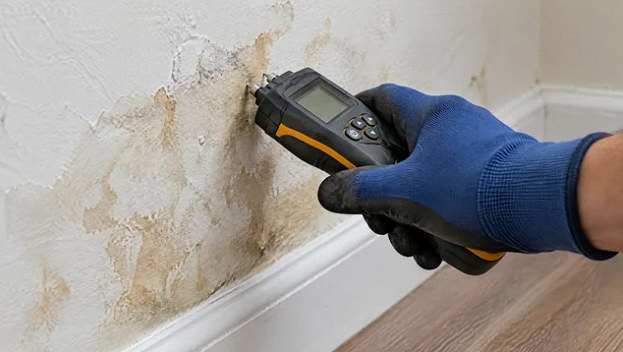
First decisions · 4 min read
Hidden Moisture: What Meters and Thermal Cameras Can Tell You
Learn how to read a moisture report, distinguish instrument scales, and ask useful questions about concealed walls, floors, and ceilings.
Read the guide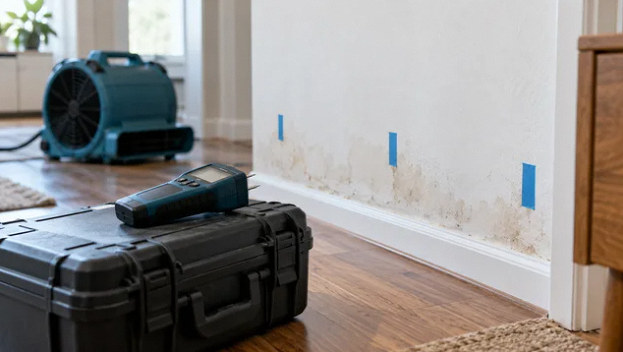
Drying and equipment · 3 min read
Why Water Damage Drying Can Stall
What to review when drying readings stop improving: the source, concealed layers, measurement locations, and equipment operation.
Read the guide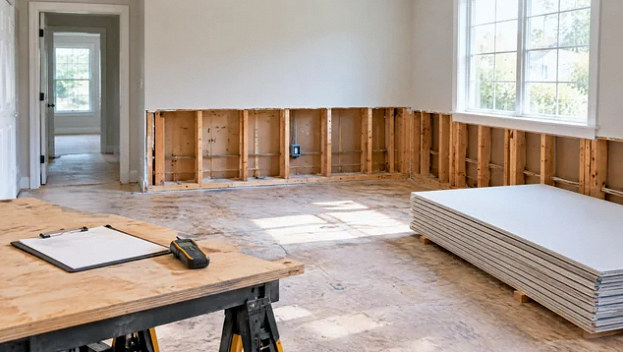
Materials and repairs · 5 min read
Before Rebuilding: How to Review the Drying Handoff
Ask for final material readings, remaining limitations, source-repair records, and a clear handoff before new finishes cover the work.
Read the guide