
EV Charging — Commercial & Fleet
Commercial & Fleet EV Charging — Built for Uptime & Cost-Per-Port
Multi-port Level 2 stations, networked OCPP chargers, dynamic load management, and utility rebate qualification — designed for facility managers and fleet operators who need charging infrastructure that works at scale.
For Facility Managers & Fleet Operators
Scale from 4 ports to 50 without mid-project surprises.
Commercial EV charging is an infrastructure decision, not a hardware purchase. The real questions are: how many ports can your existing service support, what load management strategy keeps you below the utility meter limit, and which rebate programs reduce your per-port cost before you sign a contract.
Our licensed C-10 electricians scope the electrical side completely — load calculation, panel capacity, service upgrade requirement, and ADA stall count — before any contract is signed. The quote covers everything: chargers, conduit, panel work, permit, and inspection. No line-item surprises after the crew arrives.
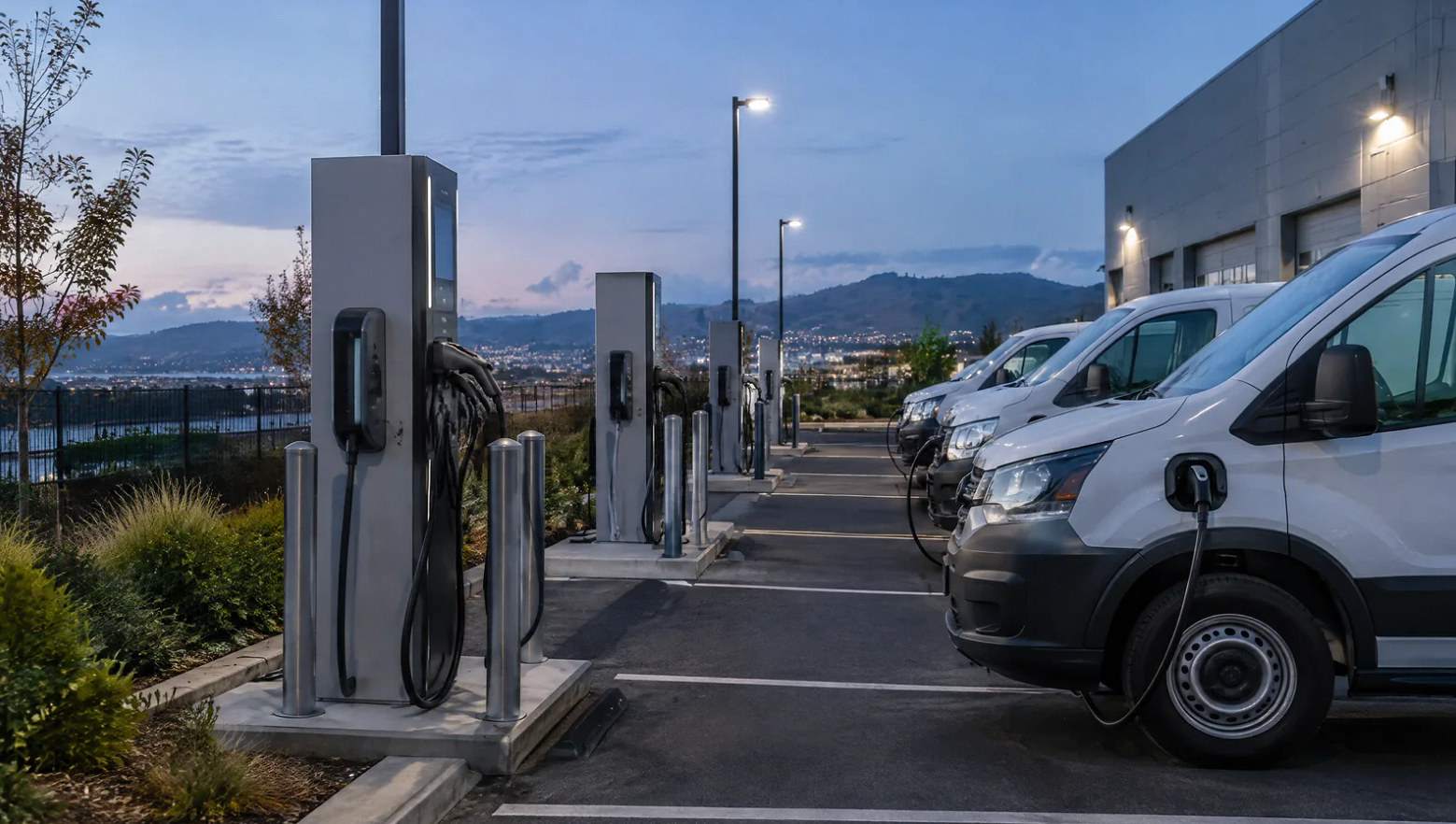
Commercial Level 2 multi-port station — Bay Area facility.
Scope of Work
Six scopes, one C-10 crew, end-to-end.
From charger selection to permit sign-off, the same licensed C-10 electricians handle every piece.
Multi-Port Level 2 Stations
Hardwired commercial-grade Level 2 chargers for parking lots, garages, and fleet yards — 4 to 50+ ports on a single project.
Networked & OCPP Chargers
OCPP-compliant networked chargers with RFID or app-based access control, driver billing, and real-time utilization reporting.
Load Management Systems
Dynamic load balancing keeps charging within your utility meter limit — more ports, no oversized service upgrade.
Service & Transformer Upgrades
When port count exceeds panel headroom, we scope and install the service upgrade or transformer pad as part of the same project.
ADA-Compliant EV Stalls
Accessible stall layout, signage, and equipment placement per California Title 24 requirements — fully permitted and inspected.
Utility Rebate Qualification
We verify current PG&E and Silicon Valley Power commercial EV program eligibility and package the documentation for your application.
Rebates & Incentives
Cut your per-port cost before breaking ground.
PG&E and Silicon Valley Power both run commercial EV charging incentive programs. Eligibility depends on your utility account, project type, and available program funding — which changes throughout the year. We verify current program status against your specific project and prepare the application documentation as part of the scope.
For the federal Section 30C credit, IRS guidance limits eligible property to equipment placed in service by June 30, 2026. Do not include that credit in a new project budget without current tax-advisor confirmation. Utility incentives have separate eligibility and funding rules. Read the IRS eligibility guidance.
See Rebates & IncentivesWhat We Handle
- Utility rebate eligibility verification
- Application documentation & submittal
- PG&E & Silicon Valley Power programs
- Title 24 / CALGreen compliance records
- Permit and inspection documentation
FAQ
Commercial EV charging — straight answers for decision-makers.
Port count depends on the existing building loads, available service and utility capacity, vehicle charging needs and the proposed control system. A service rating alone does not establish how many ports can be added. Begin with a site-specific load and charging-schedule assessment before deciding whether additional capacity or managed charging is needed.
The need is site-specific. Review existing loads, the proposed charging power and schedule, customer equipment and utility capacity together. Managed charging may reduce simultaneous demand, but it must still meet the vehicles’ operating requirements. Confirm the utility and customer work before relying on an installation schedule.
Review accessibility and permitting for the actual site and charging use. California requirements include scope-specific provisions and exceptions; a universal percentage based on total parking is not a reliable rule. Confirm the layout, applicable drawings and required professional approvals with the design team and local enforcing agency before installation.
Ready to Scope Your Project?
On-site assessment — full infrastructure scope before you commit.
We walk the site, run the load calculation, verify rebate eligibility, and deliver a written quote covering every line item — chargers, conduit, panel work, ADA layout, permit, and inspection.
Questions worth a closer look
From a short answer to a practical plan.
Explore the causes, tradeoffs and records behind these common project questions.
Do we need one maximum-power charger for every fleet vehicle?
Not automatically. Compare route energy, return and departure times, vehicle charging limits and available site power. The plan must meet each vehicle’s departure requirement under realistic conditions, including late returns and equipment failures.
Read the full guide: Fleet charging: size the plan around daily energy and departure times ↗What should an HOA decide before installing shared or assigned-space charging?
Define the power source, ownership of wiring and chargers, payment records, maintenance and rules for future users. Compare assigned-space and shared-port operation against parking rights and a site-specific electrical assessment before selecting equipment.
Read the full guide: HOA EV charging: decide who owns the wiring and pays the operating costs ↗What policy decisions should come before workplace charger selection?
Define eligible users, fleet priority, expected charging need, reservations or turnover, payment and support. Then choose equipment whose access controls, power-sharing behavior and reporting can implement that policy.
Read the full guide: Workplace EV charging: design sharing and billing before the first conflict ↗What must happen after commercial chargers are physically installed?
Complete the applicable customer and utility work, required inspections, meter or service activation and equipment commissioning. Track each dependency separately; installed hardware alone does not establish that the site can charge vehicles.
Read the full guide: EV make-ready work: separate installed chargers from utility energization ↗What operating costs should we review before selecting DC fast chargers?
Review the site’s applicable utility tariff and charging profile, network and payment fees, maintenance, warranty limits and outage response. Use realistic utilization scenarios; charger output and equipment price alone do not establish operating cost or profitability.
Read the full guide: DC fast charging operating costs: model the tariff, utilization and support together ↗Frequently asked project questions
Work through the difficult decisions.
Explore the causes, choices and practical next steps behind common project questions.
How should fleet charging bays accommodate different vehicle sizes and inlet locations?
Check each committed vehicle model against the proposed bay, parking orientation, connector, and supported cable reach. Include loading access, pedestrian routes, and alternate-bay compatibility. Test the actual driver task before acceptance; do not rely on unsupported extension cables to correct a poor layout.
Read the full guide: Fleet charging bays: make the cable reach the van without disrupting depot traffic ↗Will fleet load balancing continue if the internet connection fails?
It depends on the exact equipment and configuration. Require written behavior for internet, local-network, and meter-signal failures, including the safe aggregate limit and expected energy delivery. Demonstrate the agreed failure modes during commissioning; OCPP support by itself does not prove offline load balancing.
Read the full guide: Will fleet chargers keep sharing power when the internet fails? ↗Can scheduled fleet charging reduce demand charges?
Scheduling can reduce costs when it avoids expensive energy periods or a billed power peak. On qualifying PG&E BEV accounts, review subscribed capacity and overage exposure rather than assuming a conventional demand charge. Use the actual account tariff and vehicle deadlines; an economic override must never bypass the approved electrical limit.
Read the full guide: Why a small fleet can receive a large charging electricity bill ↗Can we start fleet charging while a larger utility service is pending?
Possibly, if a separately approved initial installation fits the existing supply and operating schedule. Document the initial power cap, supported routes, and contingency charging. Spare conduit or future switchgear does not establish available utility capacity, and expansion must be commissioned after its approvals are complete.
Read the full guide: Vehicles are arriving before the depot power upgrade: what can proceed? ↗How should we prepare for a fleet charger failure?
Create an alert and recovery plan around vehicle energy targets and departures. Identify a compatible spare bay or alternate vehicle, assign someone to respond, and document electrical, network, and vehicle support responsibilities. Test incomplete-session alerts before acceptance; an online charger is not proof that a vehicle is ready.
Read the full guide: A charger is online but the van is empty: design for dispatch failures ↗- Fleet charging bays: make the cable reach the van without disrupting depot traffic
- Will fleet chargers keep sharing power when the internet fails?
- Why a small fleet can receive a large charging electricity bill
- Vehicles are arriving before the depot power upgrade: what can proceed?
- A charger is online but the van is empty: design for dispatch failures
Contact Us
Request A Consultation
Local Services
We're in your city.
Choose your city and tell us what you need. We'll plan the project around your location.
Choose your city to include it with your project details.
Or call us to discuss your project:
(650) 550-0819Request received
Thank you. Your request has been received.
