
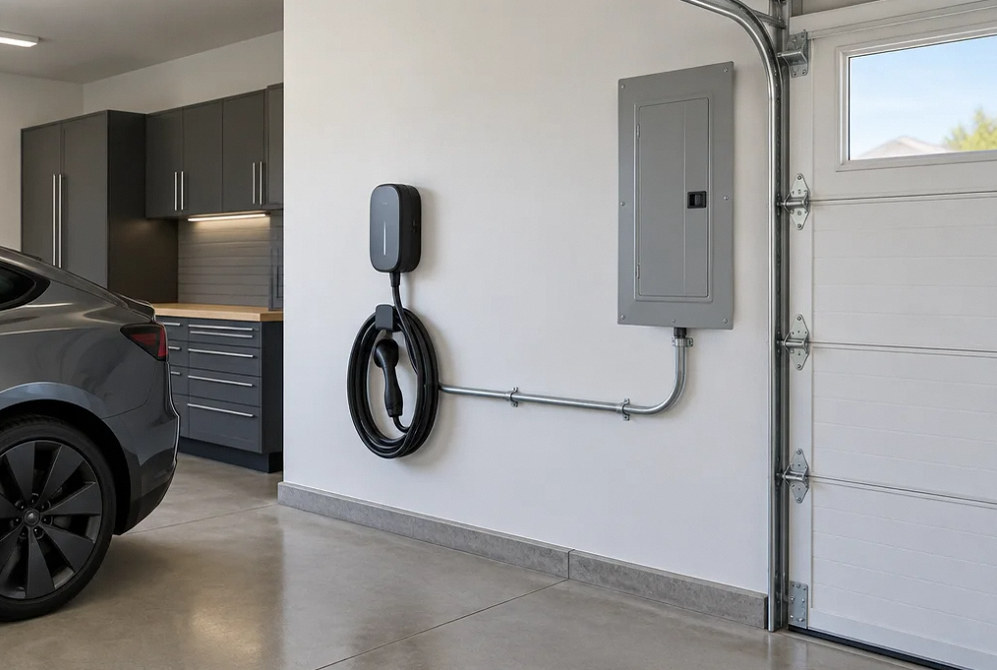
Dedicated 240V Circuits for EV Charging
Dedicated EV Charger Circuit Installation in the Bay Area
Yes, a Level 2 EV charger needs its own 240V circuit: NEC 625.40 allows no other outlets on it. We size the breaker to the charger (40A for a 32A charger, 50A for 40A, 60A for 48A), run the circuit to your parking spot, pull the permit and pass inspection.
What & Why
Choose the charging arrangement before the cable route.
Share the charger model and whether it will be hardwired or connected through a receptacle. The proposed operating current, circuit protection and conductors must be selected together for that equipment and installation. A generic 240V outlet request leaves important choices open.
Daily driving and parking time help establish a useful charging target. The Department of Energy describes home charging around the vehicle, available electrical supply and installation conditions. The largest advertised charger rating is not automatically the right target for the home.
Useful details for the first assessment
Charging equipment
Brand, model and hardwired or plug-in arrangement
Parking position
Where the car parks and where its charge port sits
Daily use
Typical mileage and overnight charging time
Existing equipment
Panel location and any known capacity concerns
Project Scope
A clear scope for this part of the charging project.
Agree on the equipment, electrical work and completion checks before authorizing installation or repair.
Charging configuration
Confirm the charger model and proposed charging setting before defining the circuit.
Supply assessment
Review the panel, available spaces and the demand on the existing supply. Identify any separate upgrade or control requirement.
Route and protection
Plan the conduit or cable route, environmental exposure and physical protection. Describe wall, ceiling or trench access.
Connection details
Define the hardwired connection or compatible receptacle arrangement, with required protection and equipment instructions.
Permit and installation
Identify the applicable permit and inspection scope and install the agreed circuit and connection.
Verification and labeling
Check the installed configuration, charging operation and circuit identification. Record the approved setting and any operating limits.
Project concepts
See the possibilities for your space
Drag the divider to compare before and after, or open a comparison for a closer look.
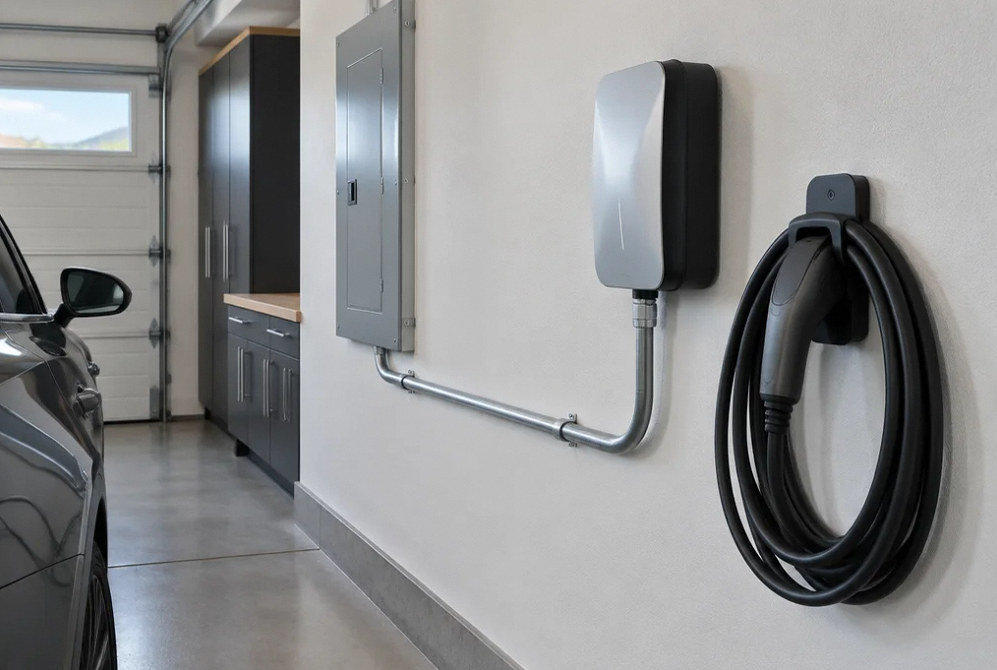
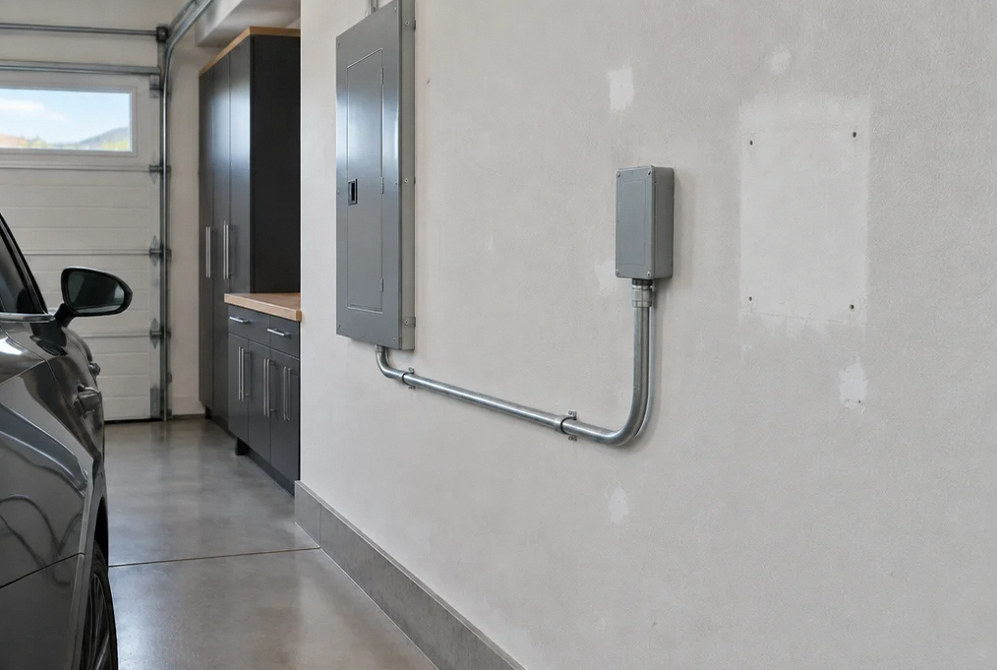
Drag to compare
Before You Choose
The proposal should resolve these choices.
Compare the available choices against the vehicle, property and charging schedule.
| Question | What to establish |
|---|---|
| Hardwired or plug-in | The supported connection type for the chosen equipment and location. |
| Charging setting | The current approved for the complete installation, not simply the charger’s maximum. |
| Route | Visible conduit, concealed work or underground routing with any finish restoration. |
| Charger supply | Whether the charger itself is included or provided by the owner. |
Estimate Planning
What changes the electrical scope and cost?
Ask for the actual configuration, included work and any conditions that still need site confirmation.
- Distance and access between the panel and parking location
- Hardwired or receptacle configuration and protection requirements
- Conduit, cable, trenching and restoration
- Permit, inspection and any separately required panel work
FAQ
Dedicated 240V Circuits for EV Charging: questions before work begins.
Does an EV charger need a dedicated circuit?
Yes. NEC 625.40 requires each outlet for EV charging rated over 16 amps or 120 volts to be supplied by an individual branch circuit with no other outlets. A Level 2 charger gets its own 240-volt circuit and breaker. The one exception is several chargers sharing a circuit under an energy management system.
What size breaker does an EV charger need?
The breaker must be at least 125% of the charger's continuous current under NEC 625.41: a 32-amp charger needs a 40-amp breaker, a 40-amp charger a 50-amp breaker, and a 48-amp charger a 60-amp breaker. The conductors are sized to the breaker and the wiring method.
Do EV chargers need GFCI protection?
Yes for receptacles. NEC 625.54 requires ground-fault protection for personnel on every receptacle installed for EV charging, so a NEMA 14-50 outlet for a car needs a GFCI breaker. Hardwired chargers have this protection built in and are connected without a GFCI breaker.
Should an EV charger be hardwired or plugged into a NEMA 14-50?
Hardwired is the usual choice for 48-amp charging, because a NEMA 14-50 receptacle on a 50-amp circuit limits charging to 40 amps. A plug-in charger is easier to replace or take along when you move, but it needs a GFCI breaker and an industrial-grade receptacle.
Can I use an existing dryer outlet for EV charging?
A 30-amp dryer circuit can supply at most 24 amps of continuous EV charging, and only if nothing else shares it. Check the circuit, the receptacle and the charger's setting before use, and never use an improvised adapter or extension cord.
Do you need a permit for an EV charger circuit in California?
Yes. A new 240-volt EV circuit needs an electrical permit and inspection. Under California's AB 1236 (Government Code 65850.7), cities must offer a streamlined, expedited permit process for residential EV chargers.
Is a spare breaker space proof the circuit can be added?
No. Space and capacity are separate checks: an existing home needs a load calculation under NEC 220.83 or 220.87 to show the panel and service can carry the new continuous load.
Does a dedicated circuit price include the EV charger itself?
Only when the written scope says so. Identify who supplies the charger, its exact model and who is responsible for setup. The circuit and the charging unit should not be confused in a price comparison.
Related EV charging services
Technical references · reviewed October 3, 2026
Your Next Step
Discuss your dedicated 240v circuits for ev charging needs.
Share your charger model, parking location and the electrical question you need to resolve. We can identify the next assessment or installation step.
