
Audio systems · Practical guide
Loud but Unclear: Planning Audio for a Reverberant Room
A practical sequence for separating microphone pickup, speaker coverage, background noise and room reflections before replacing an audio system.
YKCA Journal · 6 min read · Updated October 3, 2026
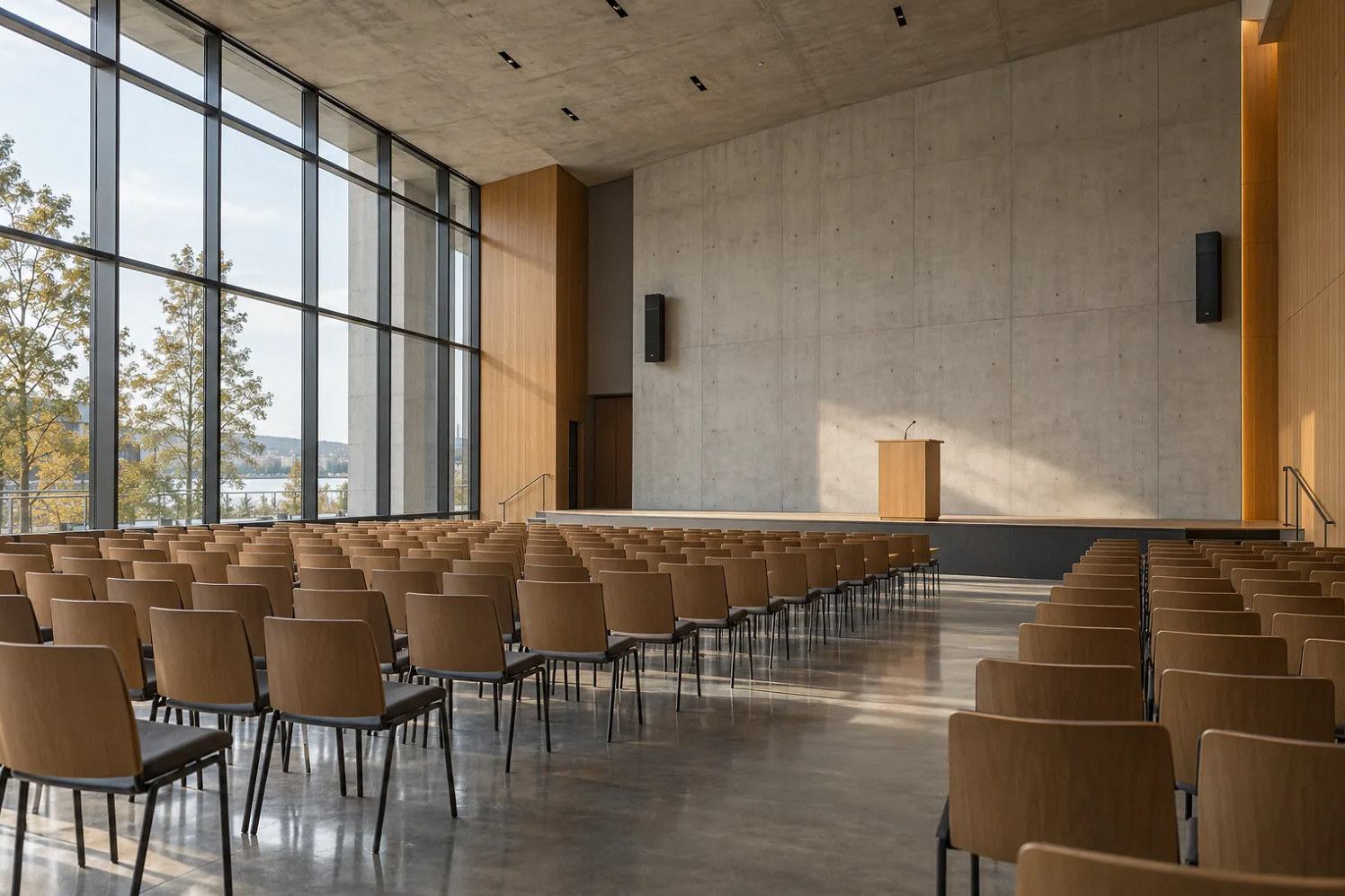
Start here
Evaluate the complete speech path before buying louder speakers.
Identify where the words become unclear
A room can sound impressively loud while making an ordinary sentence difficult to follow. Before specifying replacement speakers, walk the listening area during a controlled spoken presentation. Mark seats where words blur, where sound becomes harsh, and where a listener hears a distinct second arrival. Keep the talker, microphone position and spoken material consistent. Record the room setup, operating ventilation and whether the space is occupied. A pattern matters more than a single complaint: speech that is clear near the loudspeakers and smeared farther away points to the balance between direct and reflected sound, while a whole room that sounds muddy may also involve pickup or noise. Your first deliverable is a map of symptoms on a seating plan, with the loudspeaker positions marked.
Separate pickup from playback
Listen to a direct recording of the microphone before judging the room loudspeakers. If that recording already sounds distant and smeared, the problem begins upstream. Shure explains that a microphone captures both direct speech and reflected speech; placement relative to the talker matters. Its guidance also distinguishes reverberation from background noise. Those principles do not establish a universal mounting distance for every room. Ask the designer to compare realistic talker positions, including a seated panelist who turns toward a neighbor. A very clear demonstration with a technician speaking directly into the microphone may conceal poor results during normal use.
Reference: Shure: Critical Distance and Microphone Placement · Shure: Predicting Speech to Background Noise at the Microphone
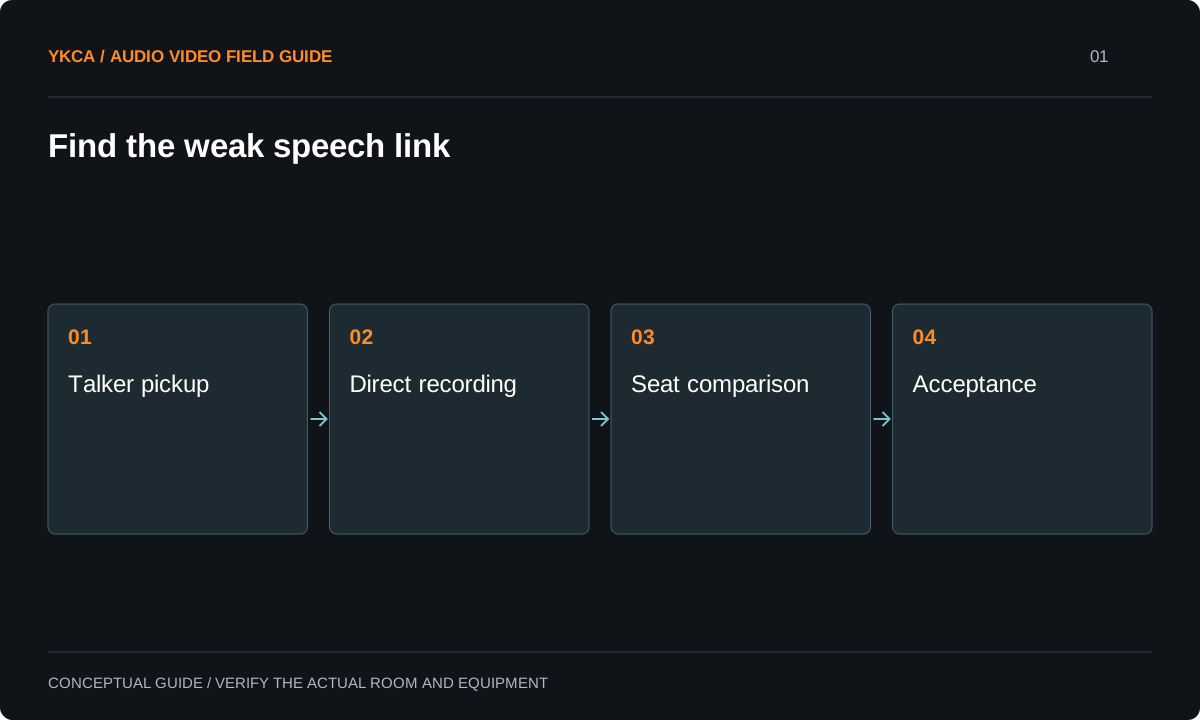
- Talker pickup
- Direct recording
- Seat comparison
- Acceptance
Understand why louder can sound worse
Every loudspeaker sends some sound straight to the listener and the rest toward walls, floor and ceiling, where it returns later as reverberation. Close to the source the direct sound dominates; beyond what acousticians call the critical distance, the reflected sound is stronger than the direct sound. Raising the level raises both together, so a listener past that distance hears a louder blur rather than clearer words. Reverberation time, often written RT60, is the time a sound takes to decay by 60 decibels; a long reverberation time is why a stone, glass or high-ceilinged room can be loud and still hard to understand.
That explains the usual families of remedy. Loudspeakers with controlled or electronically steered vertical coverage, such as column arrays, aim more energy at the seats and less at reflective surfaces. Distributed loudspeakers placed closer to listeners shorten the path to each ear; their timing is coordinated with the main system so overlapping arrivals do not create a second audible event. The final delay and level balance must be checked at the seats where coverage overlaps. Acoustic absorption reduces the reflected energy itself. A coverage change aims to deliver useful sound to occupied seats without unnecessarily exciting walls and ceilings. An acoustic change aims to reduce troublesome reflections. A microphone change aims to improve the signal captured from the person speaking. These are related tasks, but they are not interchangeable purchases. Equalization, which adjusts the balance of frequency bands, can shape tonal response; it should not be presented as a replacement for all room treatment. Request separate explanations for each proposal. If the scope includes new overhead equipment or treatment panels, include appropriate attachment, access and building coordination in the review rather than treating those as decorative details.
Reference: Shure: Critical Distance and Microphone Placement · Shure: Predicting Speech to Background Noise at the Microphone
Compare a meeting-hall scenario
Imagine a multipurpose hall where the first rows understand announcements, the rear rows hear a blur, and a direct microphone recording is acceptable. That pattern suggests evaluating sound distribution and the room before replacing the microphone. A temporary demonstration might compare the existing arrangement with a professionally positioned distributed layout. Use the same spoken material, matched listening levels and the same marked seats; even a small level difference is easily mistaken for improved clarity. If both arrangements remain unclear, bring the acoustic findings into the next design decision. Do not call a louder result a successful result merely because rear seats now hear more energy.
Write acceptance around ordinary use
Choose meaningful tasks: understanding names, following a short instruction and hearing a question from the expected microphone position. Include front, middle, rear and side seats, not only the mixing position. If a quantitative target is appropriate, the speech transmission index (STI) defined in IEC 60268-16 is a widely used measure, commonly taken with the STIPA method on portable meters. The standard defines the measurement and its limitations; it does not set one pass mark for every room. Have the designer specify the method, measurement positions, operating conditions and acceptance value before procurement, and ask whether reverberation time will be measured before and after any acoustic work. Do not invent a passing number after the room is built. Repeat the listening evaluation with ventilation running and the furniture in its normal layout. A subjective walkthrough and a formal measurement answer different questions; the handoff should identify which was performed and retain unresolved limitations openly.
Reference: IEC 60268-16:2020: objective rating of speech intelligibility
Preserve the settings that make it work
The final package should explain microphone technique, permitted speaker adjustments, normal operating levels and which controls staff should leave alone. Save the commissioned processor configuration and label the operating presets by actual room use. A banquet setup, lecture setup and live-music event may have different requirements. Record any approved acoustic work separately so later remodeling does not quietly undo it. Before signing off, have a regular operator start the system and lead the listening check. If satisfactory speech depends on a specialist standing beside the controls throughout the event, the operating scope needs further work or an explicit staffing plan.
Make the comparison auditable with a simple seat worksheet: location, spoken task, normal listening level, observed difficulty and the configuration used. Ask listeners to write what they heard before discussing impressions together. That avoids a persuasive demonstration leader unintentionally influencing every answer. Include a repeat of the original configuration where practical, because small changes in talker technique can otherwise be mistaken for equipment improvement. Keep subjective observations labeled as observations, and attach any professional measurement report separately. When the proposal arrives, connect each recommended item to a documented problem on that worksheet. Equipment that cannot be connected to an agreed need deserves a clearer justification before purchase. Keep this worksheet with the sound system installation proposal so competing designs are judged against the same speech task.
Compare the next steps
A decision table for this problem
| Observed pattern | First comparison | Decision it informs |
|---|---|---|
| Direct recording is also muddy | Normal versus closer pickup | Microphone placement or room pickup |
| Front clear, rear unclear | Listening map at stable level | Coverage and reflections |
| Ventilation masks quiet speech | Same task with normal HVAC | Noise coordination |
| One seat hears a second arrival | Compare adjacent seating areas | Timing and speaker interaction |
| Music pleasant, announcements unclear | Ordinary speech acceptance task | Separate speech commissioning |
Use this in the room
Your working checklist
Common questions
Will more amplifier power solve it?
Only if insufficient output is the actual constraint. When reflections or poor pickup dominate, increasing level may leave the words equally difficult to understand.
Should we test an empty room?
An empty-room check is useful, but document that condition and include representative operating conditions in acceptance. Occupancy and furniture can change the acoustic result.
Can we keep the existing speakers?
Possibly. Their coverage, condition, location and compatibility must be evaluated before reuse is accepted. Keep or replace them based on the required result rather than age alone.
Read the original guidance
Sources and discussion context
Research used primary documents and, where full text was unavailable, indexed excerpts from official sources. A citation does not mean the complete document was accessible. Product behavior depends on the actual model, configuration and documentation. Confirm the requirements for your venue before changing the installation.
- Shure: Critical Distance and Microphone Placement↗
- Shure: Predicting Speech to Background Noise at the Microphone↗
- IEC 60268-16:2020: objective rating of speech intelligibility↗
Reader problems behind this guide
These Reddit discussions helped identify the practical question. They are individual experiences, not technical authority or a measure of how common the problem is. Examples and diagrams illustrate planning decisions; they are not records of completed YKCA projects or installation drawings.
- Advice On Speaker Placement For HIGHLY Reverberant Venue
Announcements became unintelligible farther into a highly reflective venue.
Research access: search excerpt only.
Keep the whole system in view
