
Audio systems · Practical guide
Why Remote Callers Hear Themselves: AEC and Audio Routing
Distinguish acoustic echo, duplicate meeting endpoints and incorrect reference routing before changing conferencing microphones.
YKCA Journal · 6 min read · Updated October 3, 2026
Start here
Test the far-end experience and trace the return path before increasing echo suppression.
Start with who hears the problem
Ask whether the person in the room hears a repeat, the remote participant hears their own voice, or both sides hear distortion. Those reports imply different tests. Record when it begins: at connection, when a second laptop joins, when presentation audio starts, or when someone raises the room volume. Use an authorized test call with a colleague or a controlled test endpoint, not an unsuspecting client meeting. A useful incident description names the active devices and destination. “The sound is bad” leaves the integrator guessing; “the remote person hears a delayed copy after the room speaker is raised” gives a reproducible starting point.
Trace the reference separately from the microphone
Acoustic echo cancellation, or AEC, compares microphone pickup with a reference for the audio played into the room. Q-SYS identifies the far-end signal as the reference. Biamp's Tesira commissioning guidance is more specific: route the signals feeding the room loudspeakers into the AEC reference at the corresponding level, excluding the local microphone when it is reinforced in the room. A microphone must not feed its own reference. The installed processor's documentation determines the exact routing and gain arrangement.
Draw these as separate inputs to the AEC processor. The microphone carries local speech together with sound it hears from the loudspeakers; the reference tells the processor which playback to suppress in the return to remote participants. Include presentation audio when it plays through the room speakers. A system can work for conversation and echo during a video if that additional playback was omitted from the reference. Mark the room-speaker feed, reference feed and remote send for each operating mode before changing processing settings.
Reference: Biamp: Commissioning a Tesira Conference Room · Q-SYS: Acoustic Echo Canceler
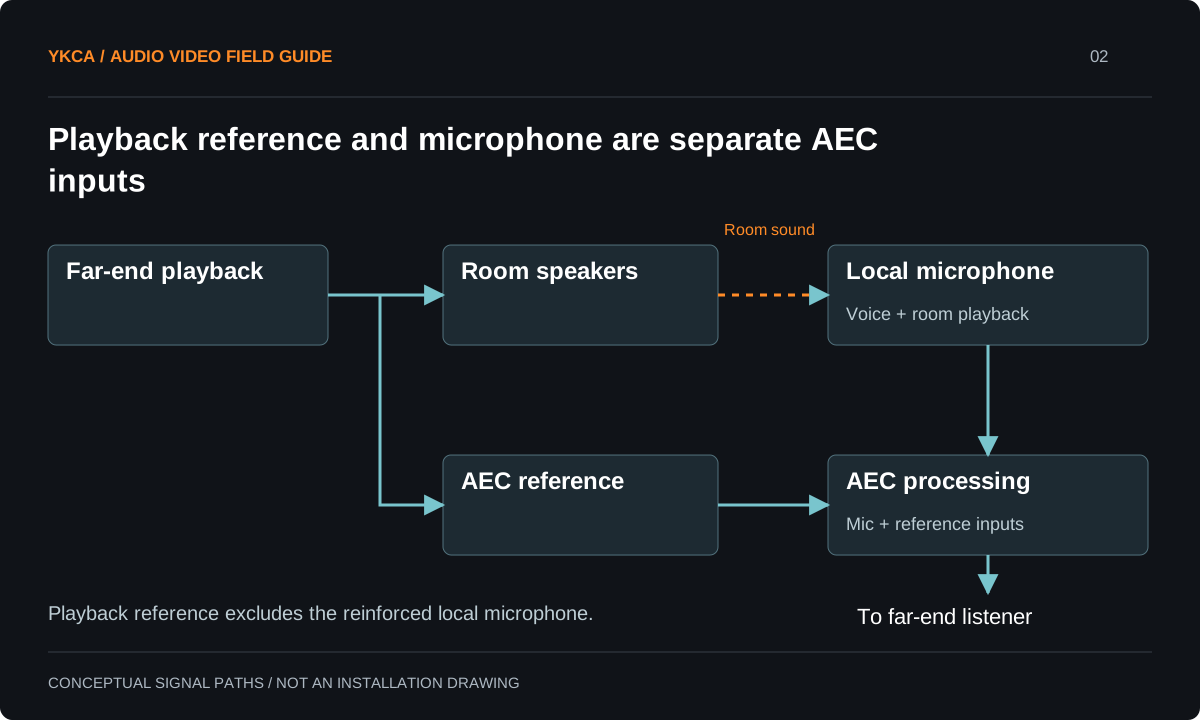
- Far-end playback feeds room speakers and the AEC reference.
- The microphone captures the local talker and sound from the room.
- AEC compares the microphone input with the playback reference.
- Processed microphone audio returns to the far end.
Remove competing paths before adjusting processing
Start with one room endpoint and one remote endpoint. Silence or disconnect the audio participation of additional laptops according to the meeting platform’s supported workflow. Confirm that the room computer uses the intended input and output device. Then reproduce the problem with presentation sound absent and present. These comparisons can identify a duplicate return path that no microphone replacement will address. Processor work belongs with someone who understands the installed design. Arbitrarily increasing suppression, changing gain at several places or enabling overlapping processing can make diagnosis harder and may trade echo for clipped words or unnatural conversation.
Reference: Biamp: Commissioning a Tesira Conference Room · Q-SYS: Acoustic Echo Canceler
Use a two-mode test
Consider a room that works during a basic call but develops echo when a laptop plays a video. In a documented test, the technician checks the video’s intended route to remote participants and its playback through room speakers. The reference design is then reviewed against the manufacturer’s requirements. A separate test checks whether the presenter also joined the call with laptop audio enabled. These are alternative hypotheses, not a diagnosis from symptoms alone. After each isolated change, replay the same short clip and repeat normal conversation. Preserve the starting file so a change that improves the clip but damages discussion can be reversed.
Test conversation, not just silence after a clap
A single sound followed by silence is an incomplete conferencing test. Include a remote person talking while someone in the room responds, a quiet speaker, an ordinary interruption and presentation playback. Listen for missing opening syllables, sudden pumping, residual repeats and unnatural level changes. Repeat at the approved range of room volume settings and expected microphone positions. The acceptance record should identify the calling platform, endpoint selection and supported modes. If the room is divisible or can use several connection types, check each commissioned configuration. One successful laptop call does not certify every path the control panel offers.
Also test double talk: a local person and a remote person speaking at the same time. Both should remain understandable. Aggressive non-linear processing, often abbreviated NLP in processor controls, can suppress unwanted return sound but make interruptions sound clipped or unnatural. Have the commissioning technician evaluate those controls after the reference and gain arrangement are correct; a quieter return during silence alone is not proof of a usable conversation.
Reference: Biamp: Commissioning a Tesira Conference Room · Q-SYS: Acoustic Echo Canceler
Make the recovery path understandable
Give staff a short sequence for identifying duplicate meeting audio and restoring the normal preset. Technical routing, reference selection and gain structure should remain in the commissioning record rather than becoming an operator guessing exercise. Keep a versioned processor file and identify who may change it. When reporting a later problem, staff should be able to capture the room name, meeting mode, approximate time and who heard the echo without recording private meeting content. The system should have a clear support boundary: which issues belong to the room integrator, which to IT and which depend on the conferencing service.
A commercial audio installation should also define the distinction between local reinforcement and the remote send. Local reinforcement means amplifying a person for people in the same room; the remote send is what the meeting application transmits outward. Ask for a test sheet with rows for lectern speech, seated discussion, remote speech and presentation playback, and columns for each destination. Staff need not understand the processor drawing to confirm whether each audience receives the right material. This matrix is especially useful when a room supports a hybrid event and an ordinary meeting with different operating presets. Keep private conversation out of test recordings and preserve only the non-sensitive test material needed to compare the result.
Compare the next steps
A decision table for this problem
| Symptom | Controlled check | Possible next investigation |
|---|---|---|
| Only remote person hears repeat | Single room endpoint | Acoustic return and reference |
| Echo starts with second laptop | Remove duplicate audio participation | Meeting endpoint workflow |
| Problem starts with video playback | Trace presentation audio route | Reference and send routing |
| Speech breaks during interruption | Two people talk naturally | Gain and processing behavior |
| Only one room mode fails | Compare saved routing modes | Configuration-specific commissioning |
Use this in the room
Your working checklist
Common questions
Does AEC remove room reverberation?
Its primary purpose is suppressing the loudspeaker return toward remote participants. Room acoustics still influence microphone pickup and the overall quality of conversation.
Should every device have echo cancellation enabled?
Follow the documented system architecture. Multiple devices processing the same path are not automatically better; the integrator should identify where each function belongs.
Can a good local recording prove the call is good?
No. The call may use different routing or processing. Listen at the actual remote destination as well as checking the local signal.
Read the original guidance
Sources and discussion context
Research used primary documents and, where full text was unavailable, indexed excerpts from official sources. A citation does not mean the complete document was accessible. Product behavior depends on the actual model, configuration and documentation. Confirm the requirements for your venue before changing the installation.
Reader problems behind this guide
These Reddit discussions helped identify the practical question. They are individual experiences, not technical authority or a measure of how common the problem is. Examples and diagrams illustrate planning decisions; they are not records of completed YKCA projects or installation drawings.
- AEC Referencing
Practitioners disagreed about reference placement and its relationship to loudspeaker output.
Research access: search excerpt only.
Keep the whole system in view
