
Audio systems · Practical guide
Too Loud Here, Too Quiet There: Planning Audio Zones
How to define useful zones, evaluate loudspeaker coverage and keep restaurant or venue music manageable for staff.
YKCA Journal · 5 min read · Updated October 3, 2026
Start here
Separate coverage problems from volume-control problems before adding more amplifier power.
Define the complaint by location and activity
If guests near a speaker find the music intrusive while distant tables barely hear it, the first question is coverage. If an entire patio needs a different level from the dining room, the first question may be zoning. Draw the operating areas and mark actual listening positions, not just architectural room names. Include queue locations, staff work areas and doors between spaces. Record whether the request changes between lunch, evening service and private events.
Distinguish speaker coverage from zone control
A zone is an area with an agreed control relationship, such as its own volume or source selection. Several speakers can belong to one zone, and one large room may need several zones. JBL’s distributed-system design tool treats room geometry, speaker choice, spacing, level variation and amplifier requirements as separate variables. Its distributed-speaker guide explains transformer taps used in appropriate systems. A tap is a selected power setting at a compatible speaker, not a substitute for a complete coverage design. Existing speakers and amplifiers need identification before a technician decides whether their configuration supports the proposed operating areas.
Reference: JBL: Distributed System Design · JBL: Distributed Speaker Systems 101
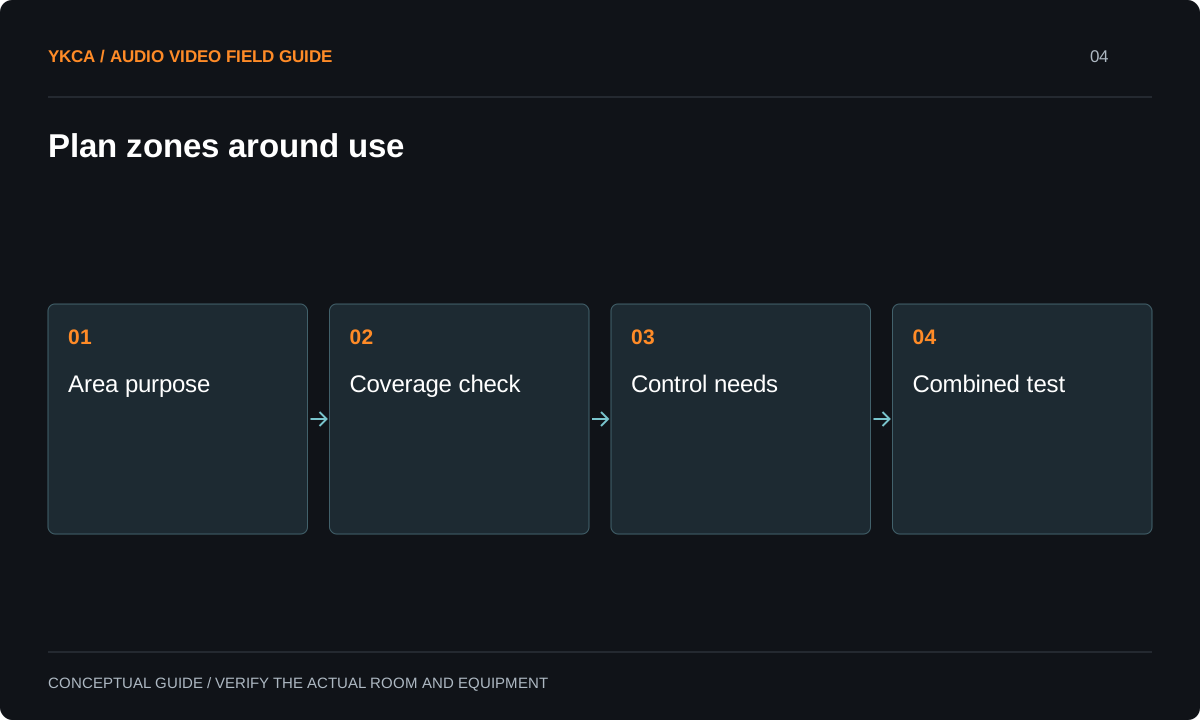
- Area purpose
- Coverage check
- Control needs
- Combined test
Trace the installed speaker circuits
Before creating a new software zone, have the technician trace which loudspeakers are connected to each amplifier output. Several rooms may share one speaker circuit, so changing a processor label cannot make their volume independent. The survey should distinguish a low-impedance system from a distributed system using compatible transformer taps, identify the amplifier and speaker models, and record the present tap settings where applicable. Only qualified personnel should access concealed wiring or change those settings.
Use that record to compare the actual alternatives: retain one circuit and improve its local coverage, separate an area into another amplifier channel, or replace incompatible equipment. For a distributed system, changing one loudspeaker's tap changes its contribution and the total connected load. Ask the designer to check the amplifier loading and every affected listening position, not only the table nearest the loudspeaker. A quieter hot spot can expose a gap elsewhere. Keep emergency or life-safety functions outside ordinary music zoning unless the responsible system designer has explicitly included them.
Reference: JBL: Distributed System Design · JBL: Distributed Speaker Systems 101
Compare coverage changes at fixed listening points
For example, two adjacent dining areas share one music feed, but seats close to the wall speakers are too loud and the middle tables are difficult to hear. Keep the same test track and master setting while the designer records representative near, middle and edge positions. Compare a revised loudspeaker layout or a documented tap adjustment using those same positions. The useful result is a smaller variation between intended listening positions, not just a lower average level.
Now test the second area alone and both areas together. Sound crossing an open doorway may make two individually satisfactory zones intrusive when combined. Have the designer identify whether the remedy belongs in placement, aiming, local level or the control relationship. If the installation cannot provide the desired independence without new cable or amplification, price that physical scope explicitly before asking staff to compensate with a daily workaround.
Verify interaction between neighboring areas
Test one zone at a time, then test the combination staff will actually use. Sound spilling through an open doorway can change the experience even when each zone seems acceptable in isolation. Include normal ventilation and activity where practical. Compare approved presets with ordinary spoken conversation at representative seats, and verify the intended source in every area. Staff should be able to mute one area without unexpectedly silencing another. Record any limits associated with outdoor sound, building use or neighboring occupants through the appropriate project review. Do not invent a universally acceptable volume setting; the final operating limits need site-specific agreement.
Make future changes inexpensive to understand
Deliver a labeled zone map, circuit and amplifier assignments, saved processor settings and a short operator guide. Identify spare capacity as measured or documented capability rather than a vague promise that more speakers can always be added. If new areas are anticipated, have the designer describe the information needed for that expansion, including routes, loads and control requirements. Train a normal staff member to change the private-room mode and restore background music. The handoff is successful when staff can operate the defined areas consistently and a future technician can identify what each cable and control actually serves.
A commercial audio installation proposal should include a plan showing the loudspeakers, amplifier channels, circuit assignments and the listening positions used for acceptance. Mark any areas that still share a physical circuit. Retain the approved tap or level settings as part of the technical record and define who can change them. When furniture, partitions or speaker locations change, recheck the affected listening positions. Daily source selection and opening or closing routines belong in the restaurant operating guide; this engineering record explains what the installed system can independently deliver. That distinction lets a manager request a new workflow without assuming that every requested zone already exists in the wiring.
Compare the next steps
A decision table for this problem
| Area requirement | Control needed | Coverage question |
|---|---|---|
| Shared music, quieter seating | Independent level | Are nearby seats still too loud? |
| Private speech event | Mute or alternate source | Does speech reach intended listeners? |
| Earlier outdoor closing | Independent shutdown | How much sound crosses boundaries? |
| Open lobby and dining doorway | Coordinated presets | Do overlapping speakers conflict? |
| Future room expansion | Documented capacity review | Will existing placement still serve it? |
Use this in the room
Your working checklist
Common questions
Can each speaker become a separate zone?
Only if the wiring, amplification and control design support it. Treat that as a scope review, not a software assumption.
Should all zones use identical speakers?
Not necessarily. Mounting constraints, environment and listening requirements can differ. Consistent operation is more important than forcing one speaker model into every location.
Can we add automatic volume adjustment?
It may be an option in a suitable design, but first establish good coverage and sensible operating limits. Automation should not conceal an unresolved layout problem.
Read the original guidance
Sources and discussion context
Research used primary documents and, where full text was unavailable, indexed excerpts from official sources. A citation does not mean the complete document was accessible. Product behavior depends on the actual model, configuration and documentation. Confirm the requirements for your venue before changing the installation.
Reader problems behind this guide
These Reddit discussions helped identify the practical question. They are individual experiences, not technical authority or a measure of how common the problem is. Examples and diagrams illustrate planning decisions; they are not records of completed YKCA projects or installation drawings.
- Sound System for a Cafe Restaurant & Aperitivo Bar
Four cafe/restaurant areas needed independent levels with one shared music source; lunch and evening service had different listening needs.
Research access: saved full post opened during initial research; direct recheck unavailable.
Keep the whole system in view
