
Theaters & concert halls · Practical guide
Why the Back Rows Sound Dull: Diagnose Theater Coverage Before Buying Bigger Speakers
An owner guide to under-balcony coverage, mix-position bias and acceptance checks across the audience rather than at one convenient seat.
YKCA Journal · 5 min read · Updated October 3, 2026
Start here
Compare the audience areas and the mix position separately, then commission a coverage solution against agreed listening and measurement checks.
Map the complaint to seats and operating conditions
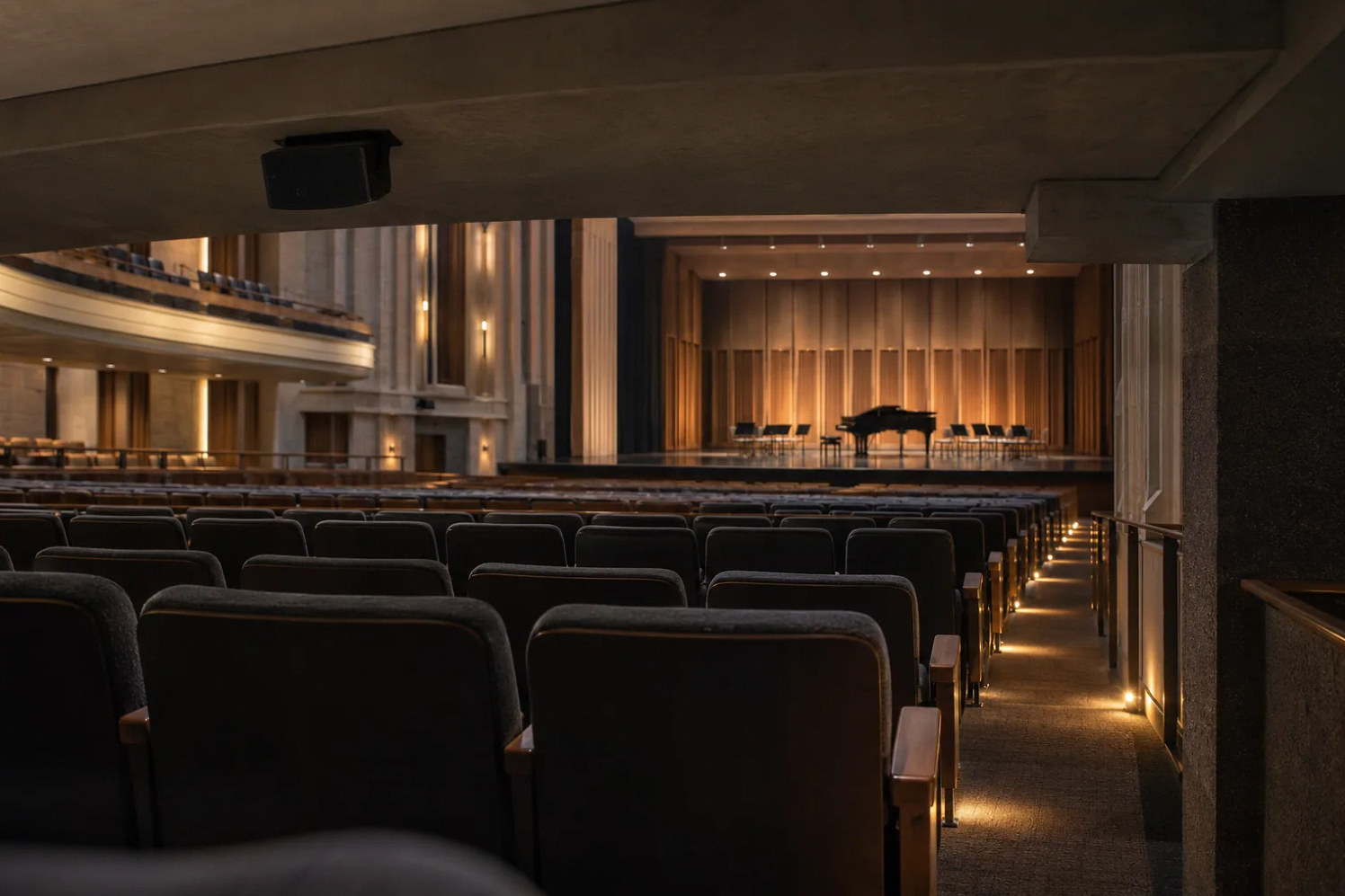
The phrase bad sound in the back can describe several different problems. Patrons may struggle with speech beneath a balcony while the center floor sounds clear. The sound operator may be in another acoustic pocket entirely. Ask staff to identify where the problem is heard, during which programs and whether it changes with occupancy or production setup.
This illustrates why the console position cannot be the only acceptance point. Build a seat map with complaint areas and reference locations. A commercial audio installation should be evaluated against the audience experience the venue needs, not only against equipment specifications.
Separate audience coverage from operator monitoring
The audience system must serve the people in the room. The operator also needs a reliable way to judge the mix, but those are related and distinct requirements. Adding a monitor near the console might help the operator hear particular details; it does not establish that listeners under the balcony receive clear, balanced sound.
Ask the designer to evaluate both questions explicitly. If the console location is constrained by architecture, document the compromise and the proposed operating method. Include the effect of any local monitor on nearby seats. Avoid a design that improves the sound at one desk while masking an unresolved audience problem. The owner should receive a plan showing which areas each proposed change is intended to improve.
A fill loudspeaker placed near the under-balcony audience may arrive at listeners before sound from the main system unless its timing is coordinated. The designer uses delay and level adjustment to make overlapping coverage useful rather than creating a distinct second arrival. Check this at the boundary between main and fill coverage as well as deep under the balcony. There is no single delay value for every theater; geometry and the complete signal path matter.
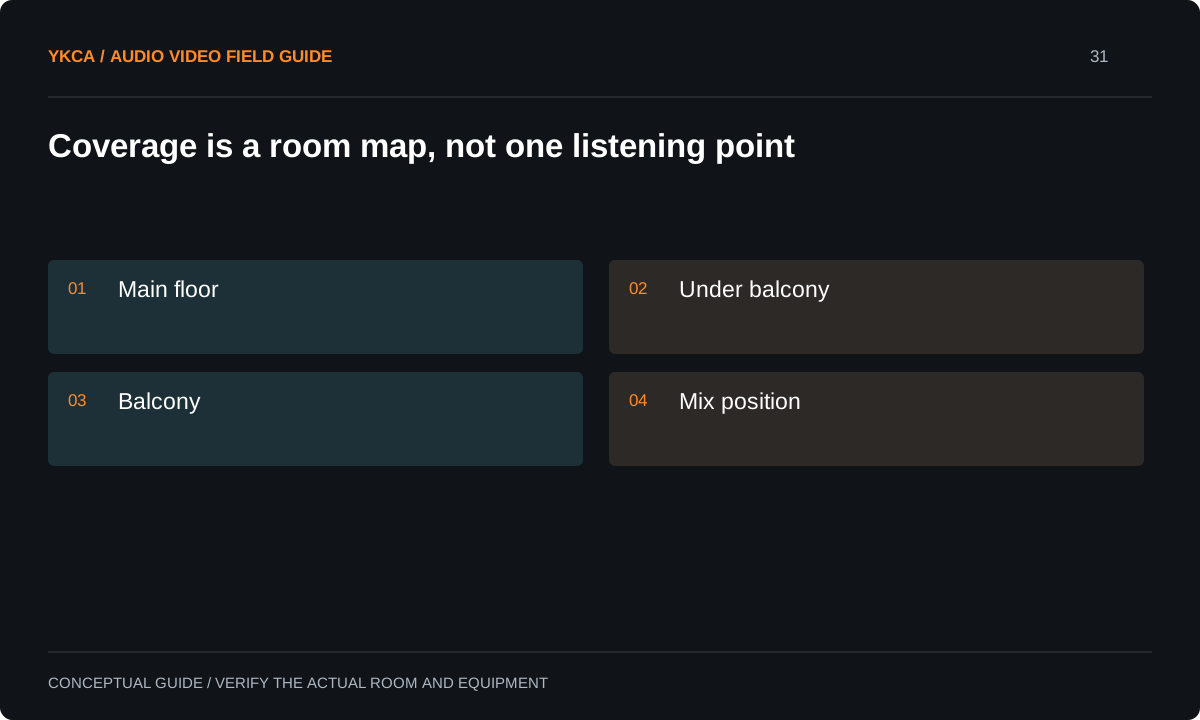
- Main floor
- Under balcony
- Balcony
- Mix position
Understand the role of fill speakers and alignment
A fill speaker serves an area that the main system does not adequately cover. Its placement, orientation and relationship to other speakers matter. Meyer Sound's UPM instructions discuss fill applications and measurement-based decisions about delay and polarity for those products. This supports a commissioning approach; it does not prescribe a universal setting for every theater.
Ask the proposal to identify the intended coverage area and the method for integrating each fill with the main system. Do not approve speakers solely by cabinet size or mounting convenience. Coordinate the acoustic proposal with sightlines, support review and service access. A loudspeaker location is useful only if it can perform its job and be responsibly installed and maintained.
Reference: Meyer Sound UPM-1P and UPM-2P operating instructions
Worked example: clear center seats, weak rear speech
Imagine a theater where a spoken announcement is intelligible in the center but difficult beneath a deep balcony. Turning up the main system may make the center louder without addressing the rear area's coverage. Ask the specialist to compare the existing arrangement with a targeted fill approach and any relevant acoustic limitations.
Use the same spoken passage and program material in each listening position so the comparison is meaningful. Include normal production levels and the venue's likely microphone use. Let measurements inform the evaluation, while retaining actual listening checks. The owner should understand which problem the proposed work addresses and whether another factor, such as room noise or reverberation, remains a separate scope item.
Define acceptance locations before equipment arrives
Choose representative locations with the designer: main-floor center, lateral seats, under-balcony rows, balcony seats and the operator position where applicable. Record the agreed listening goals and any measurement criteria in the scope. Avoid writing a vague requirement for perfect sound everywhere without defining the venue's use or realistic constraints.
For an older or significant interior, coordinate mounting and cable routes with the building team early. NPS guidance emphasizes identifying important interior features before rehabilitation changes. That consideration should shape feasible positions rather than become an afterthought after the acoustic layout is complete. A modest mockup can help owners assess visibility and service access before committing to a permanent location, where the project team considers that appropriate.
Reference: NPS: Identifying primary and secondary interior spaces
Preserve the settings and the listening reference
At handoff, retain the final speaker layout, processing configuration and a record of the locations used for acceptance. Identify who may change system processing and how a supported backup is restored. Separate show mixing controls from installation settings so routine production adjustments do not accidentally alter the commissioned coverage arrangement.
Give staff a repeatable reference check using familiar approved material and the agreed seats. This is a way to notice changes, not a substitute for professional measurement or tuning. If the room layout or suspended scenery changes substantially, ask whether the coverage assumptions remain valid. The installation remains more useful when staff can distinguish a new production issue from a change to the underlying room system.
Compare the next steps
A decision table for this problem
| Decision or observation | What to request | Acceptance evidence |
|---|---|---|
| Rear speech sounds dull | Location-based assessment | Affected and reference seats documented |
| Console sounds different | Mix-position review | Operator and audience needs separated |
| New fill proposed | Coverage and integration plan | Agreed area improved in acceptance |
| Historic mounting location | Interior and support coordination | Location accepted across disciplines |
| Processing changed later | Configuration backup and access policy | Original commissioned state recoverable |
Use this in the room
Your working checklist
Common questions
Will larger main speakers solve the back rows?
Not necessarily. The issue may be geometry, coverage, room behavior or another constraint. Assess the affected seats before selecting hardware.
Can we tune from the sound desk alone?
That risks optimizing for an unrepresentative location. Include agreed audience positions and appropriate measurements.
Should we copy delay settings from another theater?
No. Alignment depends on the actual arrangement and signal paths. Have the system commissioned for this installation.
Read the original guidance
Sources and discussion context
Research used primary documents and, where full text was unavailable, indexed excerpts from official sources. A citation does not mean the complete document was accessible. Product behavior depends on the actual model, configuration and documentation. Confirm the requirements for your venue before changing the installation.
- Meyer Sound UPM-1P and UPM-2P operating instructions↗
- NPS: Identifying primary and secondary interior spaces↗
Reader problems behind this guide
These Reddit discussions helped identify the practical question. They are individual experiences, not technical authority or a measure of how common the problem is. Examples and diagrams illustrate planning decisions; they are not records of completed YKCA projects or installation drawings.
- System engineers…
An operator in a historic theater reported high-frequency loss at an under-balcony mixing position despite audience delay speakers.
Research access: search excerpt only.
Keep the whole system in view
