
Houses of worship · Practical guide
Clear Worship Speech Starts With the Service Run Sheet
Build a speech plan for lectern readers, moving clergy and congregation responses before approving a sanctuary sound upgrade.
YKCA Journal · 6 min read · Updated October 3, 2026
Start here
Test every speaking role from the seats that struggle.
Replace “make it louder” with a speaking map
A speech complaint should start a conversation about which words disappear, where the listener sits and who is speaking. Ask whether the reader is understandable at the lectern but becomes difficult to follow while turning toward the congregation. Note whether the problem starts during music, beneath a balcony or after a different microphone is opened. These observations give a designer a useful problem statement instead of a request for a larger amplifier.
Create one line in the service run sheet for every speaking role. Include location, expected movement, microphone, who activates it and who confirms it is off afterward. A visiting speaker needs the same preparation as a regular officiant. Do not assume that familiarity with public speaking means familiarity with your sanctuary system.
Match the microphone to the person’s movement
A reader who stays at a lectern and a clergy member who walks into the aisle do not present the same pickup problem. A microphone’s position relative to the mouth affects how much direct speech it receives compared with surrounding sound. Shure’s pastor guidance highlights this distinction and warns about simultaneously active worn and lectern microphones. Treat that as a reason to rehearse handoffs, not an instruction to buy a particular model.
Have the actual person read while looking down, looking up and turning as they normally do. Check clothing noise and comfort with worn microphones. Agree on a discreet correction cue before the service. A setup that only works when someone freezes in an unfamiliar posture is unlikely to stay consistent.
Reference: Shure: Choosing a pastor microphone
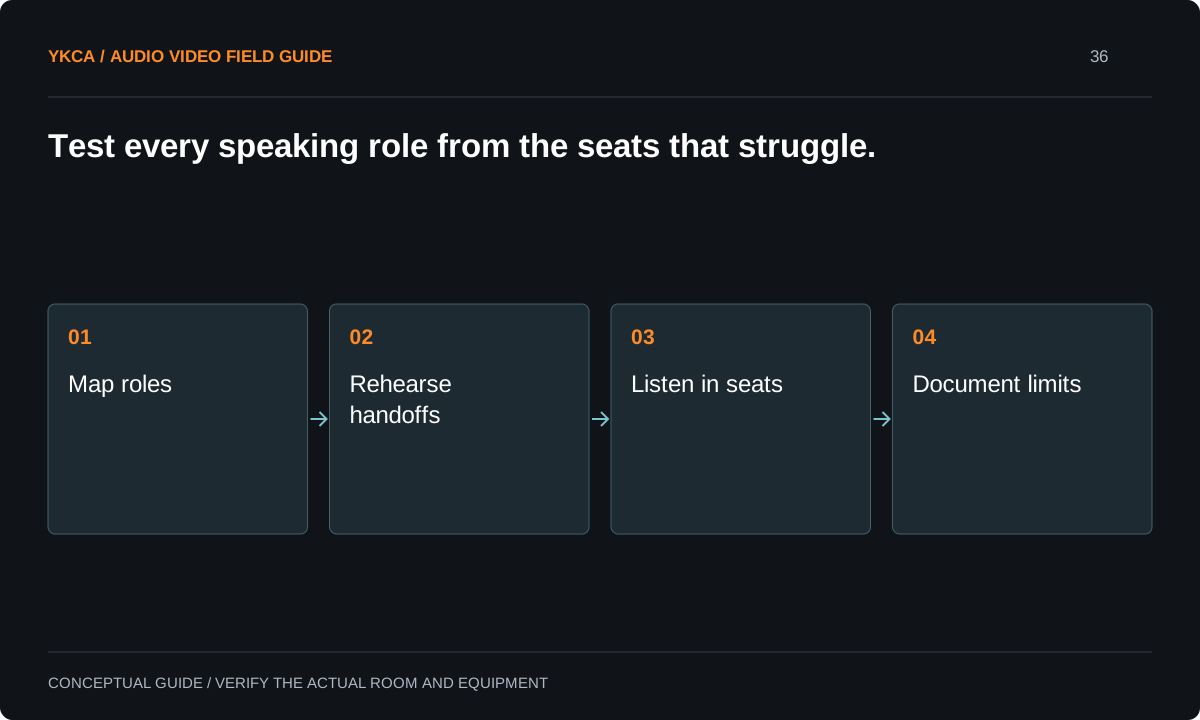
- Map roles
- Rehearse handoffs
- Listen in seats
- Document limits
Separate operator mistakes from room limitations
Ask the technician to establish a repeatable speech test using one known microphone and one designated talker. Keep processing and level unchanged while listeners check several seats. Then repeat with the actual service microphones. If the reference is clear but one role is not, investigate that pickup and transition first. If every source is difficult in the same area, coverage and room behavior deserve closer examination.
This is a screening exercise, not an acoustic certification. Record the seating locations and listening conditions, including occupancy and ventilation. A phone recording can document an incident but should not be treated as a calibrated intelligibility measurement. An experienced designer can decide what measurements are necessary and what improvement is achievable.
Rehearse the quiet transitions
For example, a service begins with a lectern welcome, moves to a headworn sermon microphone, then invites a response from the rear aisle. The run sheet assigns the operator to close the lectern channel after the welcome. An usher brings a handheld microphone to the respondent. The technician listens to the stream as well as the room before accepting that sequence.
The example does not require all three channels to remain open throughout the service. It requires a dependable handoff and a clear fallback. If the handheld is unavailable, the leader can repeat the response into the working microphone. Agree on that fallback in advance so the operator is not forced to improvise while several people speak at once.
Write the handoff as a short cue, not just a list of microphones: the lectern reader finishes, the operator mutes that channel, the next speaker confirms the worn microphone, and the operator verifies speech before the transition proceeds. Rehearse what happens if the next person walks to the lectern while still wearing an active microphone. Two open pickup paths can create a different sound and reduce the usable margin before feedback. Decide which microphone remains primary rather than relying on the operator to improvise every week.
Reference: Shure: Choosing a pastor microphone
Evaluate upgrade proposals against the same service
When comparing proposals, give each designer the same speaking map, seating complaints and architectural constraints. Request an explanation of what will improve each weak listening area and what remains limited. Ask how microphones, speaker coverage, processing, acoustic treatment and assistive listening fit together. A list of speaker models does not demonstrate a usable service workflow.
If a demonstration is offered, use your actual readers and locations. Include listeners who regularly report difficulty, while recognizing that individual hearing needs differ. Compare understandable speech at a comfortable level, not which demonstration sounds more impressive. Proposed overhead work and permanent mounting need their own qualified review and approval.
A church sound system setup should also account for ceremonies outside the ordinary weekly pattern. A wedding may put readers in a side aisle; a memorial may include unfamiliar speakers; a special service may move the lectern. Keep these as named variations rather than silently changing the normal setup. Before accepting an upgrade, choose one realistic variation and ask the team to prepare it using the documented process. Record whether additional microphones, rehearsal or staff are required. This gives the church an honest boundary for future bookings and prevents a successful Sunday test from being treated as proof that every ceremony is covered.
Accept the handoff in the seats
The final check should follow a complete spoken sequence rather than a technician saying “check” from one position. Walk the seating areas during lectern speech, moving speech and an audience response. Confirm that the stream and any overflow feed receive the intended speaker without an unexpected mute or duplicate pickup. Record unresolved locations explicitly.
Keep the marked run sheet beside the operator position and give volunteers a concise version with microphone names matching the console. Store a copy with the current system documentation. When a service format changes, update the map before changing permanent settings. Clear ownership of those revisions prevents a successful demonstration from becoming a one-time event.
Compare the next steps
A decision table for this problem
| Situation | Operating decision | Evidence to check |
|---|---|---|
| Lectern reader turns away | Rehearse normal reading posture | Words remain understandable during head movement |
| Moving officiant | Select and fit a suitable worn microphone | Comfort, clothing noise and level checked |
| Audience response | Provide an identified response microphone | Rear seating and stream hear the same contribution |
| Only one seating area struggles | Request coverage evaluation | Marked seats and repeatable test material |
| Multiple channels remain open | Assign transition mute responsibility | Run sheet matches console labels |
Use this in the room
Your working checklist
Common questions
Should we buy a louder system first?
Not from a volume complaint alone. Establish whether the failure follows a microphone, a person or a seating location. That distinction makes an upgrade proposal much more useful.
Can a scene handle every transition?
A saved scene can help if its scope is documented, but it cannot know when a reader pauses or a guest changes position. Retain a trained operator and rehearse the actual service.
How should we compare two bids?
Give both designers the same speaking roles and acceptance locations. Compare proposed performance, operational limits, documentation and support, rather than speaker count or advertised power.
Read the original guidance
Sources and discussion context
Research used primary documents and, where full text was unavailable, indexed excerpts from official sources. A citation does not mean the complete document was accessible. Product behavior depends on the actual model, configuration and documentation. Confirm the requirements for your venue before changing the installation.
Reader problems behind this guide
These Reddit discussions helped identify the practical question. They are individual experiences, not technical authority or a measure of how common the problem is. Examples and diagrams illustrate planning decisions; they are not records of completed YKCA projects or installation drawings.
- PA Advise for church with MASSIVE reverb
Congregants could not understand the priest; proposed large arrays prompted concern in a stone sanctuary.
Research access: search excerpt with post text; not independently opened.
Keep the whole system in view
