
Houses of worship · Practical guide
Why a Choir That Sounds Good in the Church Can Sound Uneven Online
Plan choir placement, microphone roles and listening checks around the broadcast audience without overcomplicating volunteer operation.
YKCA Journal · 5 min read · Updated October 3, 2026

Start here
Balance the ensemble at the microphones before adding more channels.
Define the ensemble you need to capture
A choir is not a collection of identical sources. Singers differ in strength, height and distance from the microphones, and the room blends those contributions differently from a close recording. Before adjusting electronics, document the planned rows, choir width, accompaniment and soloists. Ask the director whether the singers can keep that arrangement throughout the service.
Your rehearsal should establish whether the imbalance follows the singers, the placement or the broadcast routing.
Choose distinct roles for choir and ambience
A choir microphone should capture the ensemble you intend to present. A congregation microphone adds a sense of participation or room atmosphere. An individual reading from the congregation needs another plan. Combining those purposes into an undefined “room mic” makes it difficult to evaluate what should improve when that channel is raised.
Shure’s worship microphone guidance distinguishes ensemble pickup, broadcast ambience and individual audience speech. Use those distinctions in your input list. Label channels with their purpose and destination. A microphone added for broadcast atmosphere should not automatically enter the sanctuary reinforcement system, where it can change the room’s feedback behavior.
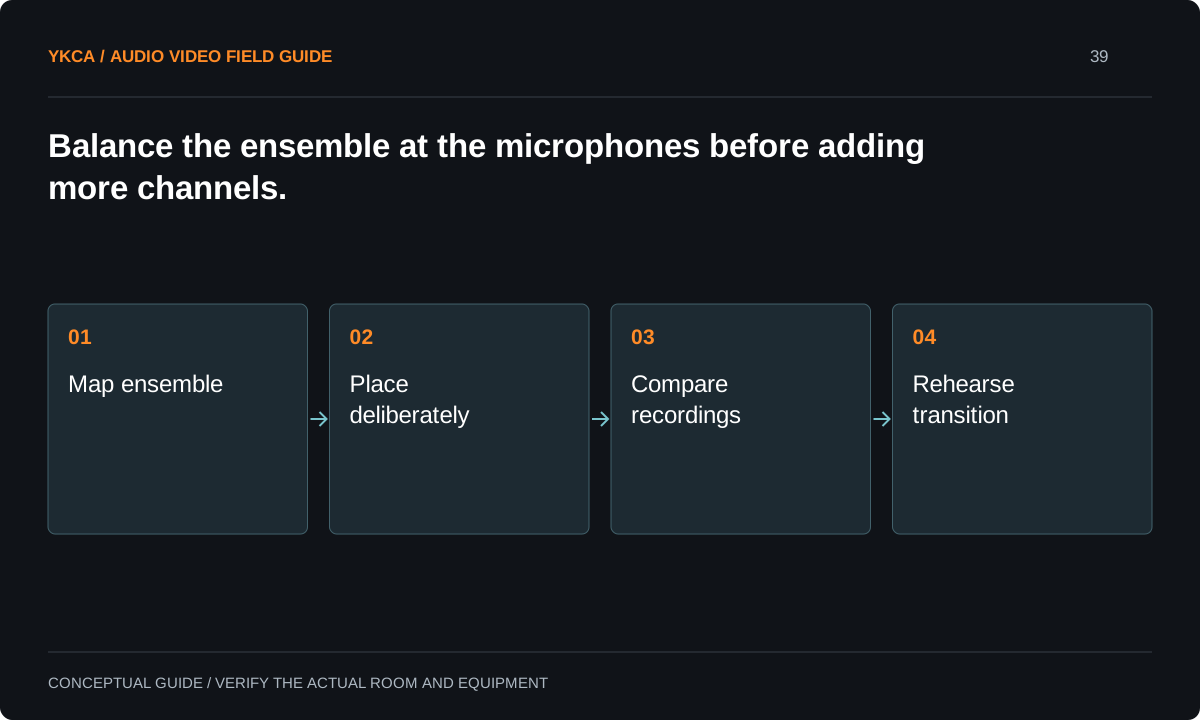
- Map ensemble
- Place deliberately
- Compare recordings
- Rehearse transition
Solve obvious balance problems through placement
Listen to each choir microphone separately, then to the combined feed. Ask whether one nearby singer dominates, whether the rear row disappears, or whether the sound changes unnaturally when channels are combined. Have the technician adjust placement and evaluate the effect with the full choir present. Keep a sketch and an authorized reference recording so the next rehearsal begins from known conditions.
Shure’s choir guidance favors the minimum useful microphone count and careful placement to limit overlapping pickup. That is a starting principle rather than a universal dimensioned design. Choir depth, room geometry, microphone pattern and accompaniment all matter. Permanent suspension or overhead installation belongs in a separately reviewed mounting scope.
Run an outside-the-room listening comparison
For example, the choir sings the same short passage twice, once with the initial placement and once after a deliberate adjustment. A reviewer listens to the authorized recordings in a separate quiet area at a consistent playback level. The director and technician compare ensemble balance and word clarity before deciding which arrangement to retain.
Monitoring next to the choir can be misleading because direct room sound reaches the listener alongside the headphone signal. The separate review reduces that confusion without pretending to be a controlled laboratory test. Include a quiet section and a stronger section. A placement that flatters one solo line may still be poor for the whole ensemble.
Make the service variation explicit
Holiday services often change the choir’s size, staging and accompaniment. Do not assume that a saved channel setting compensates for a different physical arrangement. Add a choir setup note to the run sheet: rows, stand locations, soloist microphone, accompaniment inputs and which microphones close after the music. Keep changes understandable enough for the volunteer who will actually operate the service.
If there is no time for a full rehearsal, reduce the scope of the promise. A simple, predictable capture may be preferable to several newly added microphones whose combined result nobody has heard. Explain that limitation to the director before the audience arrives, and agree on the next rehearsal needed to improve it.
Include accompaniment in the church audio visual installation brief for choir services. An organ, piano, drum kit or amplified instrument can change what the choir microphones capture even when the singers remain in the same positions. Compare a short unaccompanied passage with the full arrangement during rehearsal. Ask whether the director can still hear the intended balance in the broadcast reference, and record any limits that cannot be corrected through the agreed placement. This separates an ensemble-placement problem from accompaniment dominating the pickup. It also helps decide whether the next improvement is a musical arrangement, a revised stage layout or a separately designed input path.
Accept the choir and speech handoff together
The final test should move from choir music into the next spoken part of the service. Confirm that choir and ambience channels close as intended, the speech microphone is present in the stream and the room level remains comfortable. Listen through the real encoder or a representative authorized recording path, not only a console solo button.
At handoff, retain the placement sketch, channel list, broadcast assignments and rehearsal observations. Note any singer positions that could not be covered consistently and the reason. That record gives the next operator a practical starting point. It also helps the church decide whether future spending should address placement, monitoring, staffing or additional equipment.
Compare the next steps
A decision table for this problem
| Situation | Operating decision | Evidence to check |
|---|---|---|
| Front-row singer dominates | Review placement and ensemble arrangement | Separate-channel and combined listening |
| Choir sounds hollow when mixed | Have technician evaluate overlapping pickup | Same passage before and after adjustment |
| Stream feels detached | Evaluate a dedicated ambience role | Choir clarity remains intact |
| Holiday choir is larger | Rehearse the new physical setup | Placement sketch reflects actual rows |
| Music ends and speech begins | Close choir channels as planned | Spoken feed stays clear and present |
Use this in the room
Your working checklist
Common questions
Will one more microphone always improve the choir?
No. It may cover a genuine gap or introduce more overlapping pickup. Add it for a named purpose and evaluate the combined result with the ensemble present.
Can we use the congregation microphone for a reader?
Distant atmosphere pickup and understandable individual speech are different tasks. Provide a suitable speaking microphone or have the leader repeat the contribution into a working microphone.
Should the stream use the same choir level as the room?
Not automatically. The room already contains direct acoustic sound. Judge the stream through its own listening path and document how its choir contribution is controlled.
Read the original guidance
Sources and discussion context
Research used primary documents and, where full text was unavailable, indexed excerpts from official sources. A citation does not mean the complete document was accessible. Product behavior depends on the actual model, configuration and documentation. Confirm the requirements for your venue before changing the installation.
Reader problems behind this guide
These Reddit discussions helped identify the practical question. They are individual experiences, not technical authority or a measure of how common the problem is. Examples and diagrams illustrate planning decisions; they are not records of completed YKCA projects or installation drawings.
- Church Live Sound w/Choir and Video Streaming
A small team found the room choir balance acceptable but the stream favored nearby singers; an added ambient microphone did not solve it.
Research access: search excerpt with post text; not independently opened.
Keep the whole system in view
