
Bars, restaurants & clubs · Practical guide
Restaurant Music Presets: Staff Handoffs and Patio Closing
Build clear lunch, evening and closing routines for restaurant music, with defined staff permissions, approved sources and a practical patio handoff.
YKCA Journal · 6 min read · Updated October 3, 2026
Start here
Define what each zone should do during each service period.
Start with the service schedule
A restaurant floor plan shows walls and seats; it does not show how the business changes from lunch to a crowded evening bar. Build the audio brief around service periods. For each period, describe which areas are open, what source they use, who adjusts level and whether the patio operates. Include private events, sports and any live entertainment separately.
Restaurant sound system installation becomes easier to specify when those operating decisions are explicit. The objective is not to assign a separate control to every architectural space. It is to give staff the right independent actions where guest use, sound source or schedule differs. Ask managers and floor staff to review the same service map.
Define a preset as an operating state
Treat a preset as a named service state, such as Lunch, Evening or Closing. Record the expected source, permitted staff level adjustment and active guest areas for that state. Staff should be able to recognize the result without understanding amplifier channels. If the system cannot independently control an area, record that limitation and refer the physical change to the zone-design review rather than promising that a new button will solve it.
Decide what happens to a temporary adjustment when the next preset is selected. Should an evening shift inherit a lunch-time reduction, or restore the approved baseline? Test that behavior before writing the operating sheet. A schedule also needs a manual override for a late closing or private function, a named person allowed to use it, and a clear route back to the ordinary schedule. The processor's advertised automation features do not establish how this particular restaurant has been configured.
Assign someone to approve the music service and maintain its business account before staff connect a personal phone. Spotify's consumer agreement, for example, permits personal, non-commercial use; an ordinary subscription should not be assumed to authorize restaurant playback. Confirm that the chosen business service and the venue's public-performance permissions cover the actual use. Keep account ownership and renewal responsibility with the business, and give staff an approved fallback when that source is unavailable.
Reference: AtlasIED: Atmosphere AZM4 · Spotify US end-user agreement: permitted use
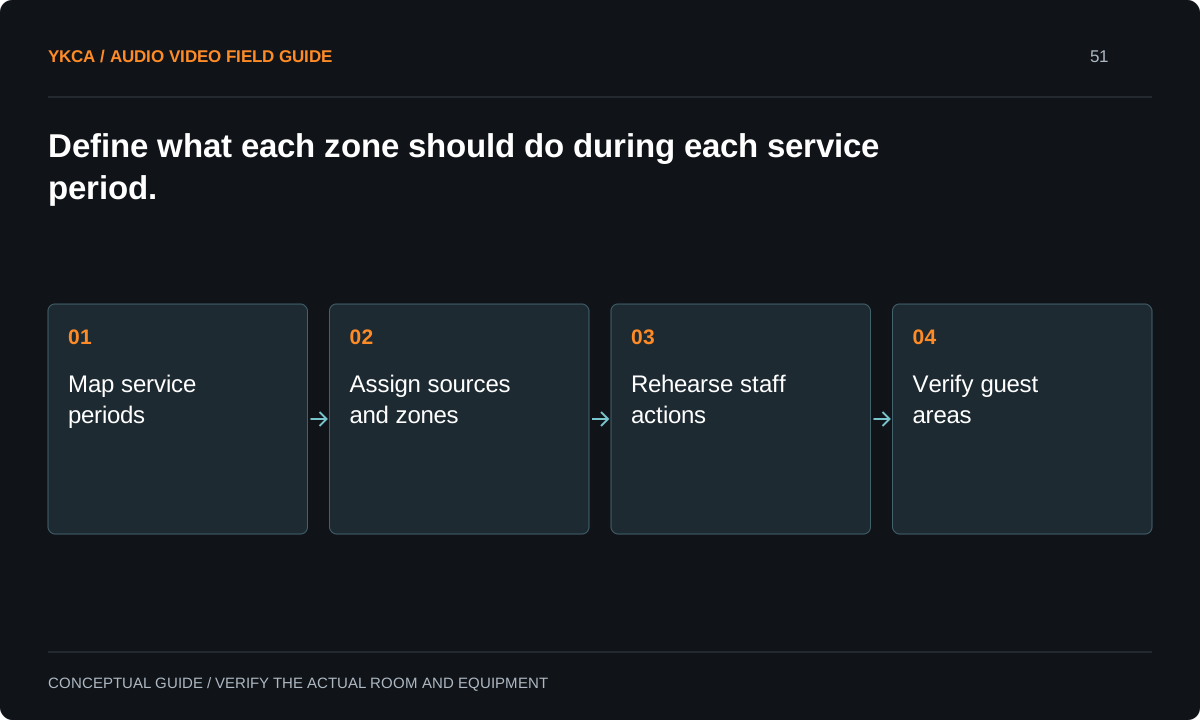
- Map service periods
- Assign sources and zones
- Rehearse staff actions
- Verify guest areas
Give the patio its own operating decision
Outdoor seating can differ from the dining room in opening hours, weather exposure and its relationship to neighboring properties. Assign responsibility for the patio’s permitted operating schedule and any applicable site restrictions. This article does not establish a legal sound limit; the owner should provide the relevant approved conditions for the design and operating plan.
Check what happens when staff close the patio while indoor service continues. The action should be obvious and should not unexpectedly change the dining room. If the venue hosts a DJ or private function, specify whether that source reaches the patio at all. A separate outdoor zone is useful only when its controls and routine reflect those decisions.
Rehearse lunch, evening and closing
For example, lunch uses the same music in the dining room and bar at independently chosen levels, while the courtyard is closed. Evening service opens the courtyard and changes the bar’s level within the approved operating range. Closing turns off guest areas in sequence while staff retain only the functions they need for cleanup.
Have the shift manager perform that sequence using ordinary staff access. Walk the guest areas to verify the result rather than trusting control labels alone. Record any unexpected source changes or zones left active. The rehearsal should include a manager changeover so the procedure does not depend on the person who helped commission the system.
Separate staff adjustments from configuration
Give ordinary staff only the actions needed for service: selecting approved presets and sources, adjusting an authorized area within its limits, and restoring the baseline. Reserve routing, limiter and schedule configuration for designated maintainers. AtlasIED's AZM4 illustrates a zone-processor approach; evaluate the proposed wall control or staff interface with the exact hardware and configuration. A manager should be able to demonstrate recovery from an incorrect selection without entering an engineering screen.
Decide who can change the underlying presets and how those revisions are recorded. An evening manager may need to adjust a zone within an approved range without permanently redefining the opening state. Keep the procedure short and explain what to do when the desired change falls outside the available controls.
Include the staff handoff when a private event ends before ordinary service closes. The event host may leave a different source selected or a zone muted, so the closing manager needs a visible way to restore the approved service state. Rehearse that return using staff permissions and confirm both source and level in each affected area. Keep any temporary guest connections under an assigned employee's supervision. If the event requires settings outside the ordinary staff controls, specify the technician's restoration responsibility in advance. This avoids asking the next shift to infer which changes were intentional and which were forgotten after the guests left.
Accept the system during representative conditions
Listen from dining tables, the bar, circulation areas and the patio under representative conditions. Occupancy changes the listening experience, so note whether checks were performed in an empty room or during an authorized operating review. Do not claim a measured outcome from a quiet pre-opening demonstration alone.
Handoff should include the service map, source names, zone controls, opening and closing procedure, and the owner of future changes. Record the accepted behavior of each preset and any unresolved area. The system is operationally ready when ordinary staff can move between the restaurant’s intended service periods and leave each zone in the correct state.
Compare the next steps
A decision table for this problem
| Situation | Operating decision | Evidence to check |
|---|---|---|
| Lunch dining | Independent level with agreed music source | Conversation and program checked at guest tables |
| Evening bar | Use approved evening operating state | Dining settings remain as intended |
| Patio opens | Activate only its agreed source and level | Owner-approved schedule and conditions followed |
| Private event or DJ | Use separately reviewed event routing | Unintended guest areas do not receive the source |
| Closing shift | Follow zone shutdown sequence | No forgotten outdoor or guest-area playback |
Use this in the room
Your working checklist
Common questions
Do all zones need different music?
No. Independent level can be valuable even when areas share a source. Specify different sources only where the service requires them.
Can automatic level adjustment replace staff judgment?
Treat it as a specific feature to evaluate, not a substitute for an operating plan. Test its behavior under representative conditions and retain a clear staff override where appropriate.
Should a DJ feed automatically reach the whole venue?
Only if that is the approved event plan. Define the intended areas, operating controls and transition back to ordinary service before connecting guest equipment.
Read the original guidance
Sources and discussion context
Research used primary documents and, where full text was unavailable, indexed excerpts from official sources. A citation does not mean the complete document was accessible. Product behavior depends on the actual model, configuration and documentation. Confirm the requirements for your venue before changing the installation.
Reader problems behind this guide
These Reddit discussions helped identify the practical question. They are individual experiences, not technical authority or a measure of how common the problem is. Examples and diagrams illustrate planning decisions; they are not records of completed YKCA projects or installation drawings.
- Sound System for a Cafe Restaurant & Aperitivo Bar
Four cafe/restaurant areas needed independent levels with one shared music source; lunch and evening service had different listening needs.
Research access: saved full post opened during initial research; direct recheck unavailable.
Keep the whole system in view
