
Theaters & concert halls · Practical guide
Fit a Theater AV Upgrade Between Productions Without Sacrificing Commissioning
Plan discovery, preparation, cutover, integrated testing and staff rehearsal around a real production calendar with a defined fallback decision.
YKCA Journal · 5 min read · Updated October 3, 2026
Start here
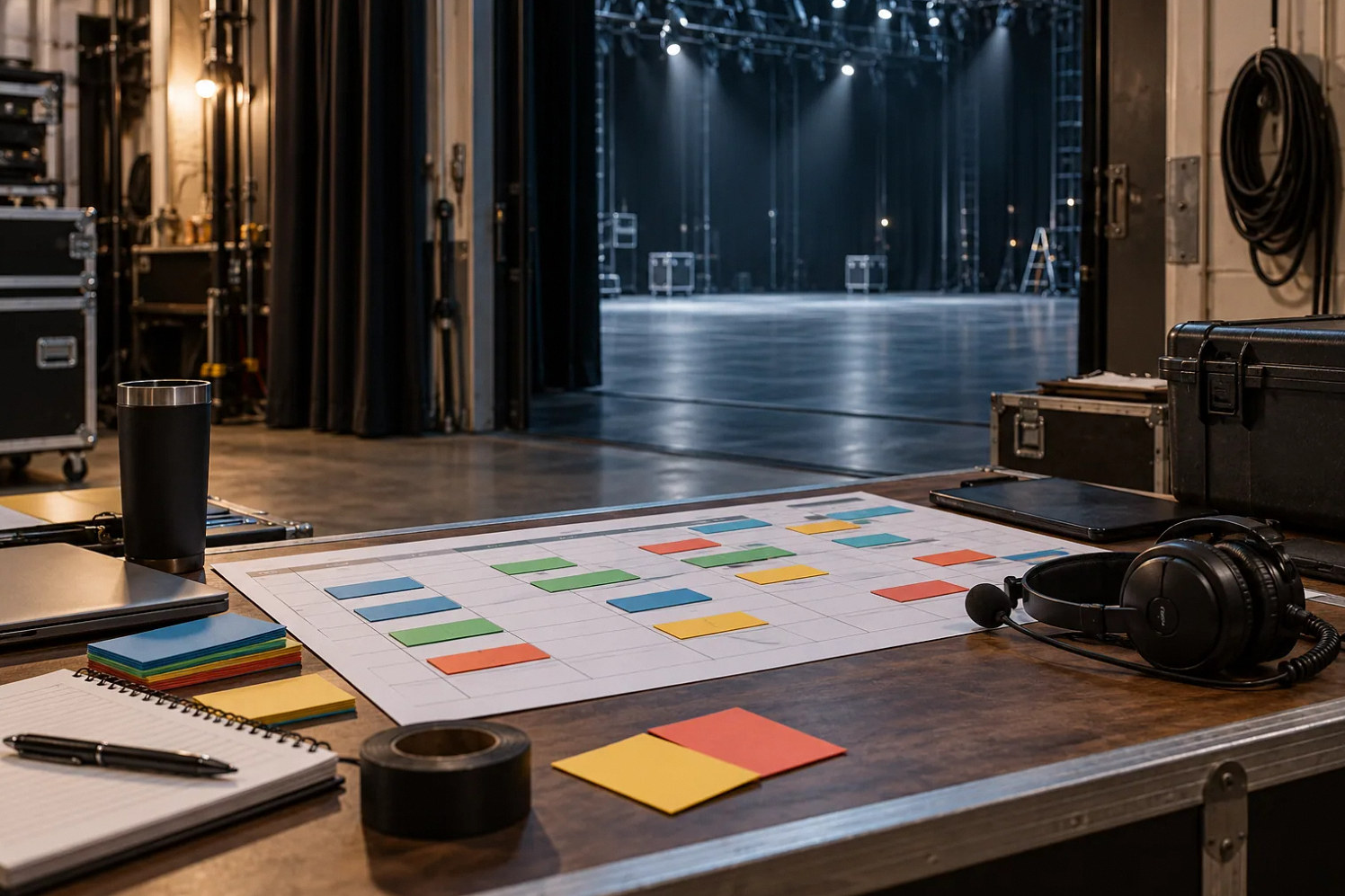
Protect commissioning and operator rehearsal as named schedule activities; installation completion alone does not establish show readiness.
Work backward from the first real rehearsal
The critical date is often the first rehearsal that depends on the new system, not the public opening. Staff need time to learn the controls, adapt show files and discover integration problems while there is still room to respond. Put that rehearsal on the schedule before deciding how much time installation can occupy.
The practical response is to separate milestones. For a commercial audio visual installation, delivery, physical installation, device setup, integrated commissioning and operational acceptance are different states. A calendar that names only installation and opening night leaves the most important transition largely invisible.
Move uncertainty out of the shutdown window
Perform the authorized survey and design coordination before the room goes dark. Identify retained equipment, undocumented connections, access limitations and work that depends on another trade. Confirm which items can be configured or checked before arriving on site and which require the actual room. Document unresolved conditions rather than assuming the crew can absorb them during cutover.
Ask suppliers to identify firmware, interface and configuration dependencies for retained equipment. A system can be physically connectable without supporting the intended behavior. Product-specific documents should guide those decisions. For example, ETC's guidance on dimmers and LED loads demonstrates why a retained power system needs an explicit compatibility check rather than a generic statement that the existing outlets will be reused.
Reference: ETC: LED fixtures and moving lights powered by dimmers
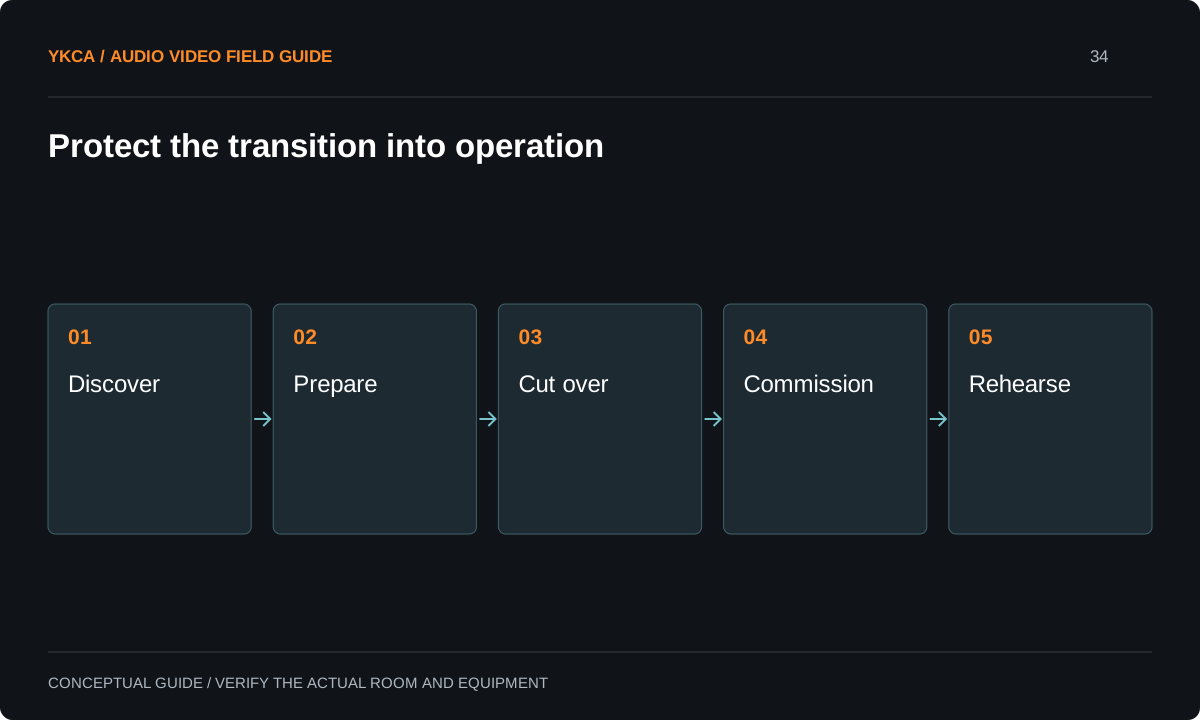
- Discover
- Prepare
- Cut over
- Commission
- Rehearse
Define the cutover boundary and fallback decision
Cutover is the point at which operation transfers from the existing arrangement to the new one. Identify exactly what changes at that point and what must remain available for the next scheduled activity. Preserve authorized backups and the information needed to restore a usable arrangement where restoration is feasible and part of the plan.
Set a decision deadline before the first dependent rehearsal. Name the person who decides whether to continue, use an agreed alternative or reschedule affected activities. Do not promise instant rollback if the work removes infrastructure or changes building systems. The fallback must be a concrete, reviewed option with time and resources assigned. An optimistic sentence in the schedule is not an operating alternative.
Worked example: a console replacement that touches three systems
Imagine replacing an audio console between two productions. The main speakers work after the swap, but the assistive-listening feed, backstage program audio and recording output each depend on settings from the previous console. Testing only the main output would leave three ordinary venue functions unproven.
List those interfaces before cutover and create a verification step for each. Clear-Com's theater and installation documentation illustrates that intercom and program paths can be distinct parts of a venue system. The exact retained equipment determines the required setup. Assign someone to verify each destination with its actual user, so success is established at the receiver or listening position rather than assumed from a meter at the console.
Run acceptance as a representative show workflow
Test startup, source selection, ordinary cues, program feeds, intercom, shutdown and the agreed response to common faults. Use the installed endpoints and representative production material. Include the staff who will operate the venue and record which steps they can complete independently. Keep the test within authorized safe conditions; commissioning does not require sending real messages or creating hazardous failures.
Record issues with an owner, priority and disposition. Separate a cosmetic improvement from a missing essential function. An issue can remain on a punch list only if the responsible parties agree that the intended operation is acceptable with that limitation. Do not call a system ready merely because the unresolved problem affects a less visible audience or staff group.
Close with usable files, training and follow-up support
The handoff should include current diagrams, supported configuration backups, operating instructions and contact responsibilities. Verify that the venue can retrieve these records without depending on a departed installer or personal account. Coordinate account ownership and access through approved mechanisms without placing secrets in general documentation.
Schedule a defined support window around the first production and clarify what is included. After that production, collect staff observations and distinguish training needs from defects or requested changes. Update the accepted configuration if changes are made. This makes the narrow installation window manageable without pretending that every operational detail can be perfected before users have worked through their first real program with the new system.
Compare the next steps
A decision table for this problem
| Decision or observation | What to request | Acceptance evidence |
|---|---|---|
| First dependent rehearsal | Backward schedule | Training and commissioning time reserved |
| Unknown retained connection | Pre-cutover survey | Dependency resolved or allowance explicit |
| Go/no-go deadline | Named decision and fallback plan | Feasible alternative with resources |
| Main output works | Endpoint-by-endpoint checks | All required venue functions verified |
| First production support | Defined availability and scope | Issues captured and assigned |
Use this in the room
Your working checklist
Common questions
Can training happen during opening-night soundcheck?
That leaves little room for mistakes or missing functions. Reserve a separate operator rehearsal and use opening-day preparation for the production itself.
Does a passed device test mean the system is ready?
No. Integrated routes, controls and user workflows may still fail. Verify the complete functions required by the venue.
Should every upgrade be phased?
Only when each phase can leave a coherent, usable arrangement. Splitting tightly dependent work may increase disruption instead of reducing it.
Read the original guidance
Sources and discussion context
Research used primary documents and, where full text was unavailable, indexed excerpts from official sources. A citation does not mean the complete document was accessible. Product behavior depends on the actual model, configuration and documentation. Confirm the requirements for your venue before changing the installation.
- ETC: LED fixtures and moving lights powered by dimmers↗
- Clear-Com Encore Partyline Installation Manual↗
Reader problems behind this guide
These Reddit discussions helped identify the practical question. They are individual experiences, not technical authority or a measure of how common the problem is. Examples and diagrams illustrate planning decisions; they are not records of completed YKCA projects or installation drawings.
- Theatre Renovation
Theater staff describe renovation plans, missing operator input and the risk of scheduling performances too close to construction completion.
Research access: search excerpt only.
Keep the whole system in view
