
Stage power · Practical guide
When One Fault Silences the Whole Stage: Scope the Investigation Before Resetting Again
What owners should document after a stage-power interruption and how to separate immediate response, fault investigation and future resilience.
YKCA Journal · 5 min read · Updated October 3, 2026
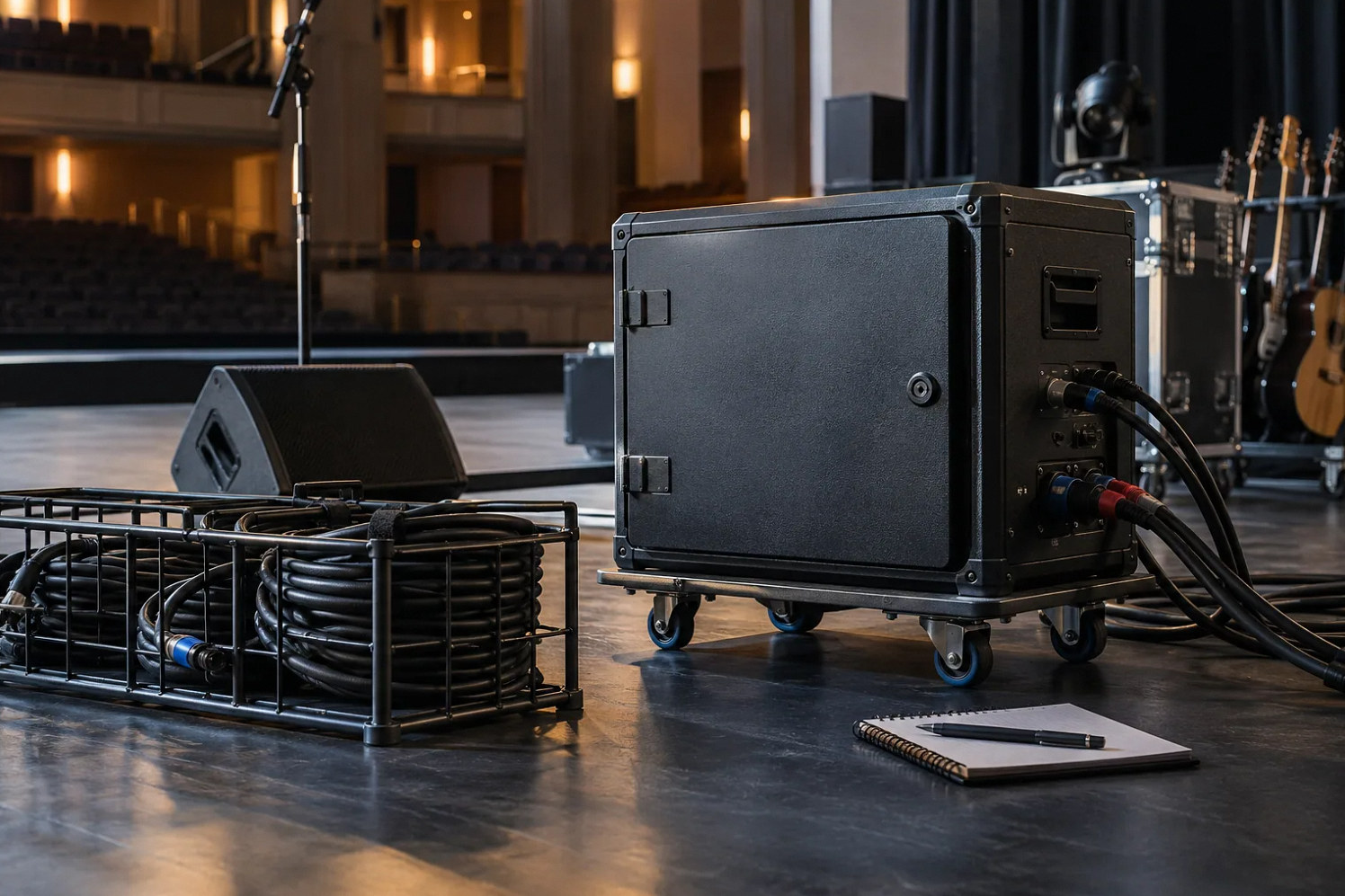
Start here
A reset is not a diagnosis. Preserve event details and have qualified personnel establish safe restoration and the actual failure path.
Separate safe restoration from solving the root cause
A stage can return to life after a reset without anyone knowing why it stopped. The immediate decision is whether restoration is safe; the longer task is identifying what happened and preventing recurrence. Assign those decisions to the responsible qualified personnel rather than allowing show pressure to turn repeated resets into the operating plan.
OSHA's equipment-use rule addresses safe reenergization after protective-device operation and prohibits repetitive manual reclosing. Project applicability should be confirmed, but the practical boundary is clear: a protection device is not an inconvenience to defeat. Do not substitute a larger breaker, bypass protection or keep trying until the show runs. Preserve the event information and obtain the appropriate evaluation.
A theater electrical contractor can help define the building-side investigation, while the event supplier remains responsible for information about its temporary equipment.
Identify which device operated: an overcurrent breaker, a GFCI device, or protection inside a distribution unit or appliance. Those observations direct different investigations. A staff report should name the visible device and affected equipment without interpreting every interruption as overload. A GFCI trip must not be addressed by defeating its protective function or moving loads to an unreviewed circuit.
Reference: OSHA 1910.334: Use of equipment
Trace the actual interruption boundary
The author suspected a connected fan, but the thread does not establish the actual cause. The useful planning lesson is that the nearest visible distribution box may not be the device that interrupted power.
Ask the investigator to document the complete supply path and identify which protection operated. Provide the event distribution drawing if one exists. If it does not, mark that as part of the investigation. Keep power interruption, equipment shutdown and signal loss distinct in the event log; all can silence the stage, but they do not necessarily have the same cause.
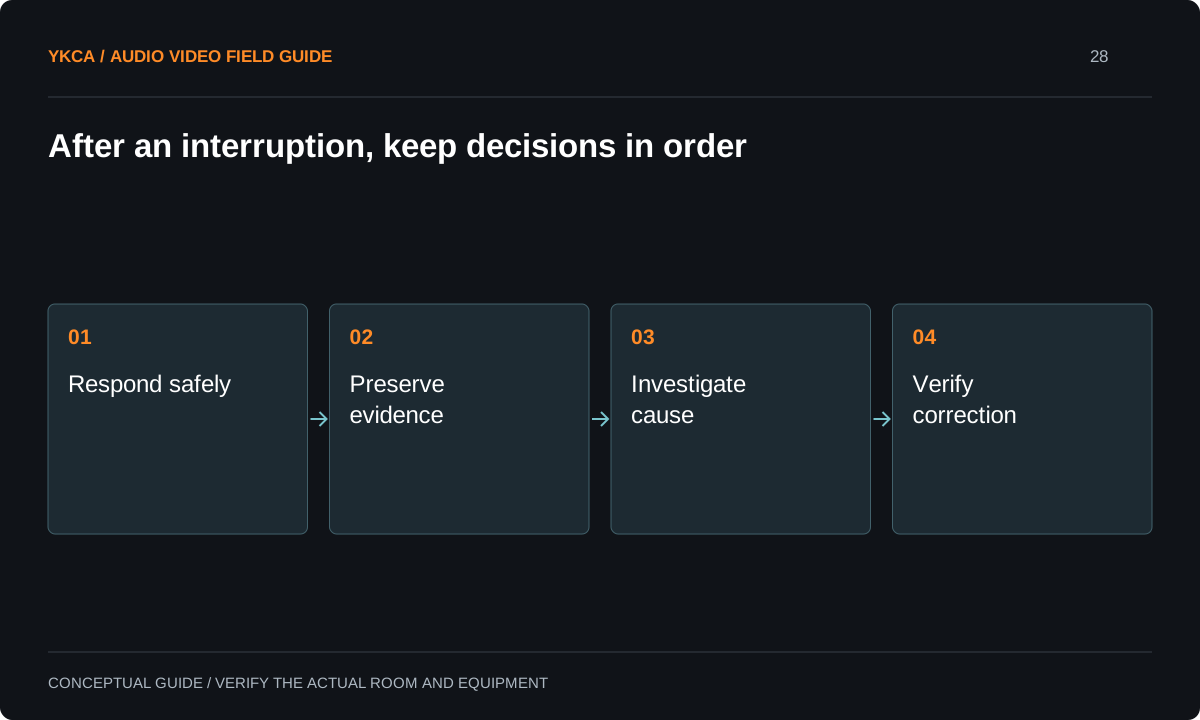
- Respond safely
- Preserve evidence
- Investigate cause
- Verify correction
Capture an event timeline without conducting unsafe tests
Record the time, equipment operating, recent additions, weather or environmental changes and what staff observed. Save available equipment logs through their normal user interfaces if authorized. Note whether lights, consoles, video devices and amplifiers stopped together or in sequence. Different timestamps can help the professional correlate symptoms without relying entirely on recollection after load-out.
Do not ask staff to reproduce a suspected fault or handle damaged equipment. Isolate access through the venue's established response process and let qualified personnel determine the examination. Distinguish observations from hypotheses in writing. A report that says a fan caused the trip can bias the investigation; a report that describes what happened before the interruption preserves useful evidence without pretending the cause is known.
Worked example: added equipment outside the advance list
Imagine a production with a reviewed power schedule that receives extra stage fans during setup. After an interruption, it would be premature to blame those fans merely because they were new. Their presence is an important change to document, alongside their connection locations and the actual operating conditions.
The electrical professional can evaluate whether the event involved an overload, equipment fault, supply problem or another cause. The production manager can separately address why added equipment bypassed the review process. These are different corrective actions. Repairing one defective device does not fix weak change control, while improving the equipment list does not prove the electrical system is ready to return to service.
Reference: OSHA 1910.304: Wiring design and protection
Evaluate resilience after establishing the cause
Once the failure path is understood, ask which systems should remain available during a localized problem and what design measures can reasonably support that goal. This may involve distribution architecture, protection review or carefully scoped backup for particular control functions. It does not mean that a consumer battery unit can operate the entire stage.
Define the desired outcome precisely: retaining a control computer long enough to save work is different from maintaining amplified sound throughout an outage. Have the designers identify dependencies and limitations. A proposed improvement should explain which interruption it addresses and which it does not. Avoid accepting the phrase dedicated power as a complete explanation of failure isolation or continued operation.
Close the incident with evidence and a revised plan
The final record should include the diagnosis or remaining uncertainty, corrective work, any operating restrictions and the verification performed. A successful short soundcheck is not automatically representative of the conditions that preceded the interruption. Agree on a suitable verification plan with the responsible professional and production team, without deliberately recreating unsafe conditions.
Update the stage technical information and staff response procedure where the investigation identifies gaps. Assign responsibility for rented equipment records and late additions. Review the incident before the next similar booking. The useful result is a clearer, tested operating plan and a traceable disposition of the fault, not a promise that the venue will never experience another interruption.
Compare the next steps
A decision table for this problem
| Decision or observation | What to request | Acceptance evidence |
|---|---|---|
| Whole stage stops | Timeline and affected-system list | Power versus signal failure distinguished |
| Downstream main unchanged | Complete supply-path review | Actual operated device identified |
| New equipment added | Model and connection record | Change evaluated without assumed blame |
| Proposed backup power | Specific continuity objective | Dependencies and runtime basis documented |
| Return to normal operation | Corrective and verification record | Restrictions formally resolved |
Use this in the room
Your working checklist
Common questions
Is one successful reset proof the circuit is safe?
No. Follow the applicable procedure and qualified determination for restoration. A successful restart does not identify the original cause.
Can we prevent every upstream trip?
Do not assume that. Ask the design team to evaluate the actual protection and distribution arrangement, then document the limits of any proposed improvement.
Should we install a battery backup immediately?
First define which equipment must continue and for what purpose. Backup equipment has its own load, compatibility and maintenance requirements and does not repair a fault.
Read the original guidance
Sources and discussion context
Research used primary documents and, where full text was unavailable, indexed excerpts from official sources. A citation does not mean the complete document was accessible. Product behavior depends on the actual model, configuration and documentation. Confirm the requirements for your venue before changing the installation.
Reader problems behind this guide
These Reddit discussions helped identify the practical question. They are individual experiences, not technical authority or a measure of how common the problem is. Examples and diagrams illustrate planning decisions; they are not records of completed YKCA projects or installation drawings.
- Entire audio system tripped, still not sure how
An upstream lighting-distribution breaker removed the audio supply while the audio distribution main appeared untripped.
Research access: search excerpt only.
Keep the whole system in view
