
Stage power · Practical guide
Audio Hum on Stage: What to Investigate Before Requesting New Electrical Circuits
Distinguish an audio signal-path problem from an electrical installation issue while preserving protective grounding and a useful investigation scope.
YKCA Journal · 5 min read · Updated October 3, 2026
Start here
Coordinate audio and electrical diagnosis. New circuits may be appropriate, but removing a safety ground is never an audio remedy.
Describe the symptom before naming the cause
Hum is a symptom, not a complete diagnosis. Record when it appears, what source is active and whether it changes with ordinary user controls. A system that becomes noisy when a guest laptop is connected presents a different investigation from one that is noisy with every input muted. Those observations help define the work without requiring staff to open equipment or alter electrical connections.
Requiring all audio equipment to share one circuit can jump too quickly from an audible problem to a wiring solution. Start with the signal and power arrangement together, and ask the relevant specialists to establish which part of the system needs correction.
Include these investigation responsibilities when requesting stage power installation so a noise complaint is not automatically converted into unnecessary construction.
Keep protective grounding outside the audio workaround
A ground loop is an unintended current path involving interconnected equipment that can introduce noise into an audio system. The technical paper hosted by Shure explains signal-path isolation as a possible approach while explicitly warning against defeating protective grounding. The appropriate remedy depends on the actual interfaces and equipment; it is not a blanket instruction to add an isolator everywhere.
Make the boundary clear to staff and visiting operators: the electrical safety ground is not an optional audio feature. OSHA's equipment-use provisions also address continuity of equipment grounding. A quiet system with a defeated protective connection is not an acceptable acceptance result. Stop using improvised adapters that compromise the protective arrangement and have the condition evaluated appropriately.
Reference: Shure: noise identification and ground-loop resources · OSHA 1910.334: Use of equipment
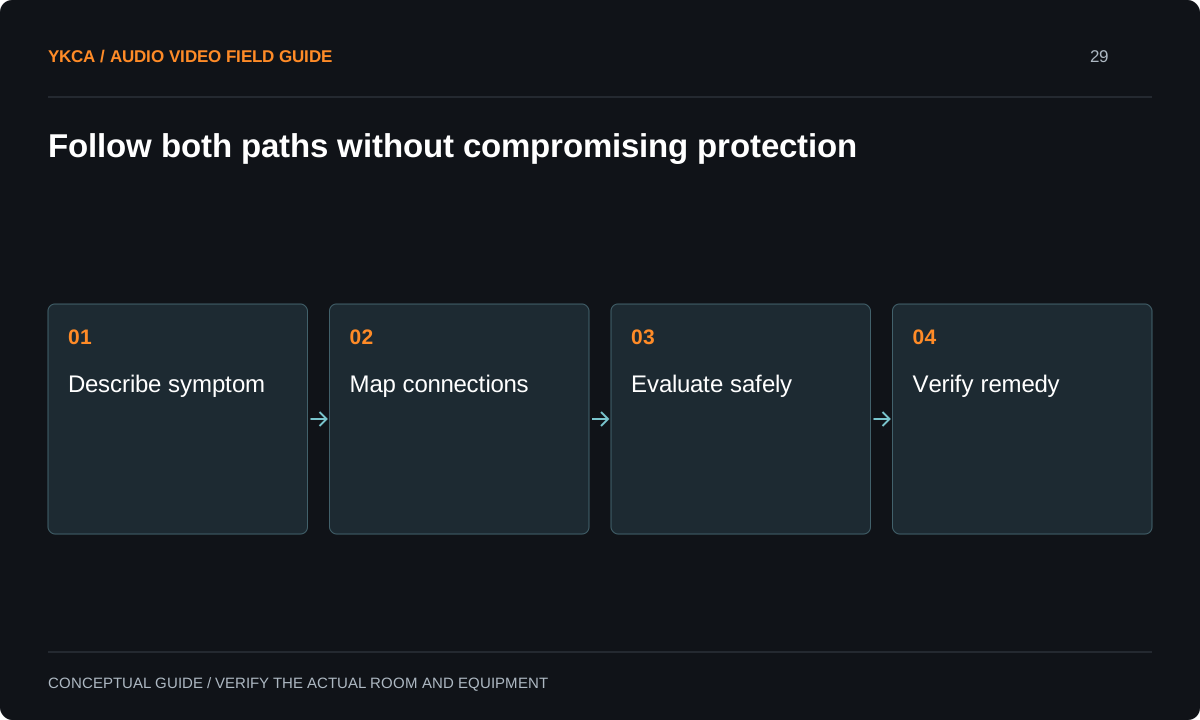
- Describe symptom
- Map connections
- Evaluate safely
- Verify remedy
Write a joint investigation scope
Ask the audio specialist to document sources, interconnections and where the noise enters the signal chain. Ask the electrical professional to evaluate relevant supply and grounding questions within their scope. Neither discipline should be expected to certify the other's work from a casual site conversation. Name the person who will combine the findings and recommend the next step.
Provide a list of connected equipment, including video displays, computers and other systems linked to the audio path. A noise problem may change when one of those systems is introduced. Include the ordinary event setup rather than only the simplified configuration used during an installer demonstration. The investigation should reflect what the venue actually expects staff and renters to connect.
Worked example: the presentation laptop that adds noise
Consider a room that sounds clean with its installed playback device but develops hum during guest presentations. Staff may request a new electrical circuit because the symptom appears when the laptop charger is used. That observation is useful, but it does not by itself identify a building defect or prove that another circuit will solve it.
Have the specialist evaluate the complete presentation path using approved equipment and procedures. Compare a documented interface change with any electrical correction supported by the findings. Include guest usability in the decision: a technically successful remedy is incomplete if presenters must find a hidden switch and reconstruct the connections before every meeting. Make the accepted setup repeatable.
Reference: Shure: noise identification and ground-loop resources
Distinguish the proposed remedy from a product promise
A quotation for a power conditioner, isolated interface or new circuit should state which finding it addresses and how success will be checked. Avoid choosing by a product category alone. An accessory may solve a defined interface problem while leaving an unrelated wiring issue untouched. Conversely, necessary electrical repairs may be justified even if the audio noise has another source.
Ask what will remain in the system and what changes for the operator. If a temporary diagnostic arrangement was used, do not assume it is suitable as the permanent installation. Request the final configuration, supported connections and any maintenance or replacement requirements. The owner should understand the intended remedy without needing to become an expert in every noise mechanism.
Accept the system across realistic operating states
Agree on a verification sequence covering the sources and operating states that produced the complaint. Include installed playback, guest presentations and relevant lighting or video conditions. Document the test conditions and remaining limitations rather than claiming the system is silent under every conceivable circumstance. Use the normal controls and approved connection points that staff will use after handoff.
Save the connection diagram and a short symptom-report template. If hum returns after equipment changes, the next technician can compare the new arrangement with the accepted one. This also helps staff recognize when they need support instead of buying another accessory. A useful handoff preserves both the safety boundary and the evidence behind the chosen audio solution.
Compare the next steps
A decision table for this problem
| Decision or observation | What to request | Acceptance evidence |
|---|---|---|
| Noise only with guest source | Source and interface investigation | Repeatable approved guest connection |
| Noise across all sources | Broader audio and supply review | Cause or remaining uncertainty documented |
| Ground-defeating adapter found | Qualified corrective response | Protective arrangement preserved |
| New circuit proposed | Finding-linked electrical scope | Reason for change and verification stated |
| Noise returns after changes | Current-versus-accepted diagram | Changed dependency identified |
Use this in the room
Your working checklist
Common questions
Must all audio equipment share one circuit?
There is no universal answer that replaces proper electrical design and signal-interface evaluation. Capacity, protection and the actual interconnections all matter.
Is a signal ground-lift switch the same as removing a safety ground?
No. A manufacturer-provided signal function has a defined use. Never interpret it as permission to remove protective grounding from electrical equipment.
Can we buy an isolator before the visit?
Identify the connection and requirements first. The wrong interface may not address the cause and can create new level, quality or compatibility problems.
Read the original guidance
Sources and discussion context
Research used primary documents and, where full text was unavailable, indexed excerpts from official sources. A citation does not mean the complete document was accessible. Product behavior depends on the actual model, configuration and documentation. Confirm the requirements for your venue before changing the installation.
Reader problems behind this guide
These Reddit discussions helped identify the practical question. They are individual experiences, not technical authority or a measure of how common the problem is. Examples and diagrams illustrate planning decisions; they are not records of completed YKCA projects or installation drawings.
- Helping to set up a art center stage, question about ground loops and power distro
An art-center stage planner asked whether all audio must share one circuit to avoid ground loops.
Research access: search excerpt only.
Keep the whole system in view
