
Stage power · Practical guide
Outdoor Stage Power: A Permanent Feed Does Not Finish the Event Plan
Clarify the boundary between a building electrical supply and temporary event distribution, weather decisions and equipment acceptance.
YKCA Journal · 6 min read · Updated October 3, 2026
Start here
Document who accepts the permanent supply, who designs the event distribution and who controls operational decisions for the actual setup.
Define the handoff between building and event systems
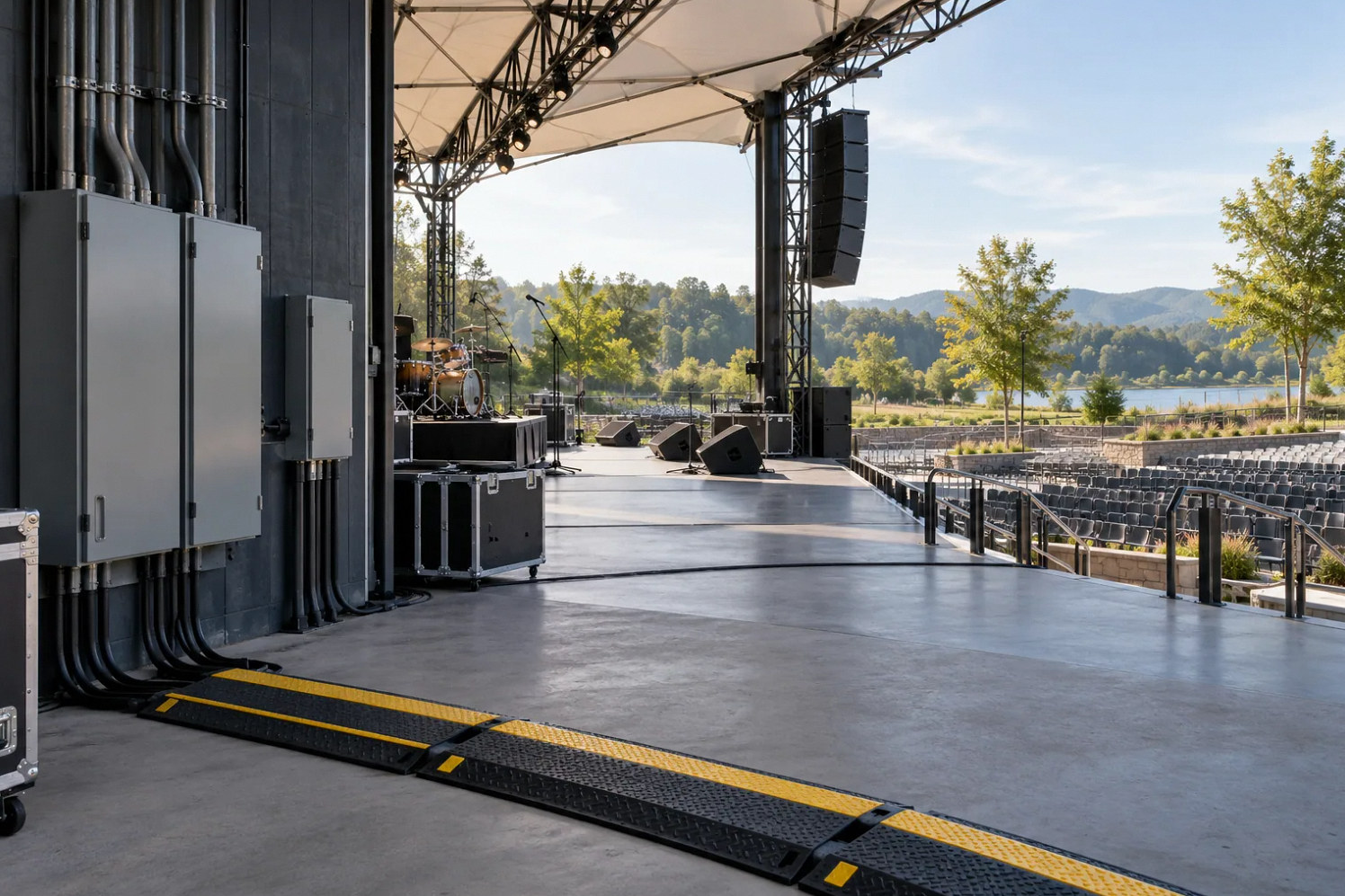
An outdoor stage may have a newly installed building supply and still rely on a temporary distribution package for each event. The permanent work and the event setup need a clear handoff: what connection is provided, what has been verified, and who is responsible for the equipment and cabling beyond that point.
Equipment can still reset after a venue changes power sources; that observation alone does not identify the failure. Ask for documented verification of the actual supply and event arrangement rather than accepting the phrase shore power as evidence that every downstream dependency has been resolved.
A stage power installation scope should identify this interface clearly enough that both the building and event teams can explain their responsibilities.
Specify the permanent-work deliverables
The building contractor's scope should identify the designed supply, connection location, labeling, required approvals and verification records. Include the condition and capacity questions the design must resolve. The venue should receive a usable record of the accepted installation and any restrictions relevant to event use.
Ask which loads and future scenarios informed the design. A connection intended for a modest recurring program should not be advertised as suitable for any touring package. If expansion is expected, define the scenario with the designer. Coordinate physical access and site restoration so the event crew can use the connection as intended. Do not leave that practical access question until the first production arrives with equipment and a deadline.
Reference: OSHA 1910.304: Wiring design and protection
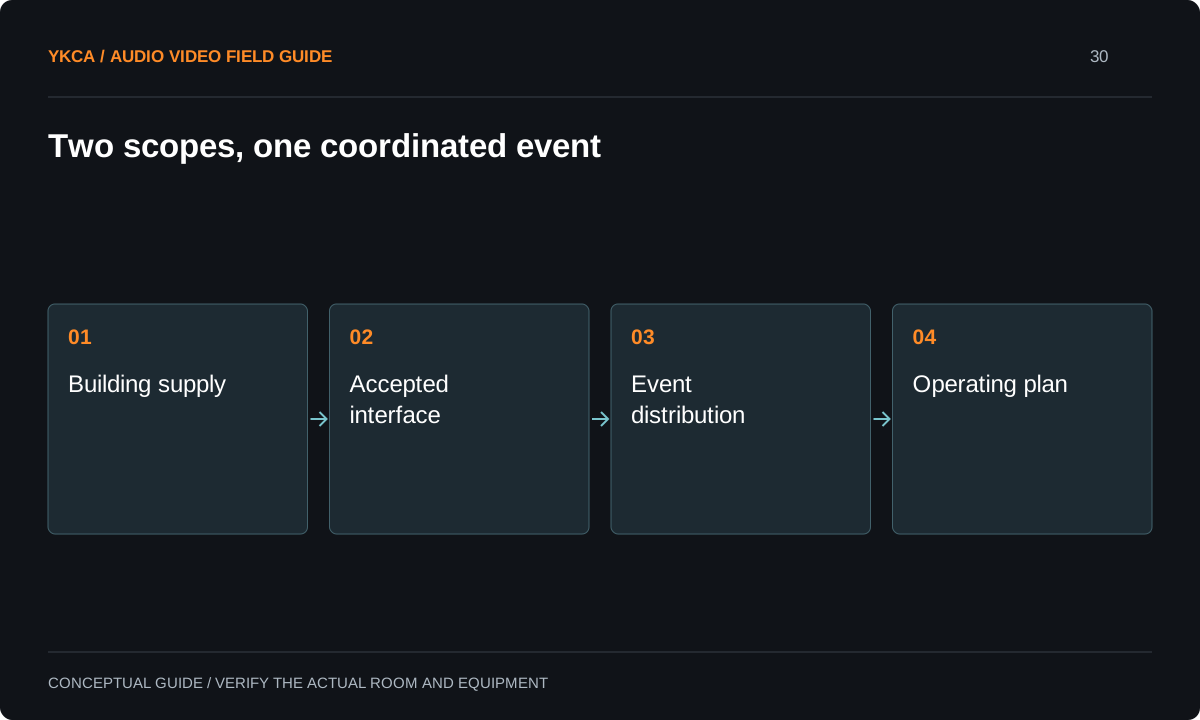
- Building supply
- Accepted interface
- Event distribution
- Operating plan
Specify the temporary-event deliverables separately
The event provider should submit the equipment schedule, distribution arrangement, connection requirements and responsibility for setup and verification. Include all departments and late additions. Identify equipment intended for the actual environmental conditions and how its documentation will be available to the responsible personnel. Permanent building power does not transform indoor-only equipment into outdoor equipment.
OSHA's equipment-use provisions address damaged portable equipment and suitability where water or conductive liquids may be encountered. Apply the relevant requirements through qualified review rather than improvising weather protection. The plan also needs cable routes and coordination with audience and vehicle movement. Those site decisions belong in the advance package, alongside electrical information, so the proposed setup can be assessed as a whole.
Make ground-fault circuit-interrupter protection, usually called GFCI protection, an explicit design and handoff item. A GFCI addresses leakage that can create shock risk; it does not serve the same purpose as an ordinary overcurrent breaker. The electrical designer must identify the adopted code provisions for the permanent outdoor receptacles and for the particular temporary distribution or event use. OSHA also has specific GFCI provisions for temporary wiring during construction-like work, but that scope should not be presented as a blanket rule for every concert. Record which protective devices serve the event connection, who verifies them, and who may respond to a trip. Never bypass required protection to keep a show running.
Reference: OSHA 1910.334: Use of equipment · OSHA 1910.304: wiring design and protection · NFPA 70: National Electrical Code
Worked example: the stage moves across the lawn
Imagine an event that uses the same building supply but moves the stage for a larger audience. The relocation changes cable routes, equipment positions and potentially exposure conditions. The previous event's accepted arrangement should not be carried over merely because the source connection is unchanged.
Have the provider submit the revised layout and the qualified parties evaluate the changed setup. The venue can compare the new location with an alternative that preserves better access and fewer routing conflicts. Record who accepts the final arrangement and what information the operating crew receives. A simple site change is easier to manage before rental equipment is loaded than after the public areas are already being built.
Assign weather and interruption decisions before opening
The event plan should name who monitors conditions, who can pause operation and who authorizes any restart after a problem. Use the requirements of the actual equipment and approved event plan; do not borrow a generic weather threshold from another production. Coordinate electrical, production and venue responsibilities so a decision does not depend on finding an off-site supplier during a developing incident.
Include the response to power loss and abnormal equipment behavior. Staff need a reporting route and a safe process for clearing affected areas. They should not be expected to investigate electrical faults in wet or crowded conditions. An operating plan is useful only when the people present understand it and have the authority to carry out their assigned roles.
Distinguish a protective-device trip from a loss of supply or an equipment restart. Staff can report the device label, affected areas, weather and sequence without opening equipment. The responsible qualified person should assess moisture, connected equipment and the complete distribution before re-energization. Include access to the protective devices and the agreed shutdown contact in the event handoff, so a touring crew does not improvise a reset or move to an unreviewed receptacle.
Reference: OSHA 1910.304: wiring design and protection
Accept the actual event configuration and preserve the record
Require the responsible personnel to verify the event setup against its submitted arrangement before use. Record deviations, unresolved items and the accepted operating boundaries. A representative equipment run can support commissioning, but document what it covers and what it does not. Do not represent a short rehearsal as proof of performance under every environmental or loading condition.
After the event, record equipment problems and changes worth reviewing before the next booking. Keep the permanent installation record separate from individual event configurations, with clear references between them. That makes repeat events easier to advance while preserving the need to review meaningful changes. The result is a defined interface and accountable operation, rather than two contractors each assuming the other owns the whole system.
Compare the next steps
A decision table for this problem
| Decision or observation | What to request | Acceptance evidence |
|---|---|---|
| New building supply | Permanent design and verification record | Accepted connection and restrictions |
| Rental distribution | Event-specific equipment and layout | Responsible provider and setup record |
| Stage relocated | Revised routes and site plan | Changed conditions reviewed |
| Weather exposure | Equipment suitability and operating plan | Named decision authority |
| Recurring equipment resets | Qualified investigation scope | Cause or unresolved limitation recorded |
Use this in the room
Your working checklist
Common questions
Is building power always better than a generator?
Neither label establishes suitability. Evaluate the designed source, distribution, equipment and operating conditions for the actual event.
Can the rental company rely on our permit?
Clarify what the building approval covers and what the event provider must separately assess or obtain. One approval does not automatically cover all temporary arrangements.
Does one good event approve the next setup?
Only the documented arrangement and conditions were evaluated. Changes in equipment, layout, exposure or use may require a new review.
Read the original guidance
Sources and discussion context
Research used primary documents and, where full text was unavailable, indexed excerpts from official sources. A citation does not mean the complete document was accessible. Product behavior depends on the actual model, configuration and documentation. Confirm the requirements for your venue before changing the installation.
- OSHA 1910.304: Wiring design and protection↗
- OSHA 1910.334: Use of equipment↗
- OSHA 1910.304: wiring design and protection↗
- NFPA 70: National Electrical Code↗
Reader problems behind this guide
These Reddit discussions helped identify the practical question. They are individual experiences, not technical authority or a measure of how common the problem is. Examples and diagrams illustrate planning decisions; they are not records of completed YKCA projects or installation drawings.
- How to deal with bad electricity
Recurring outdoor equipment resets continued after a venue changed from generator supply to building power.
Research access: search excerpt only.
Keep the whole system in view
