
Stage power · Practical guide
Ten Stage Outlets May Still Be One Circuit: Verify the Map Before an Upgrade
How to commission an outlet and circuit survey that supports stage planning, rental advances and targeted power improvements.
YKCA Journal · 5 min read · Updated October 3, 2026
Start here
Count verified circuits and documented shared loads, not visible receptacles, when planning stage distribution.
Do not use outlet count as a capacity claim
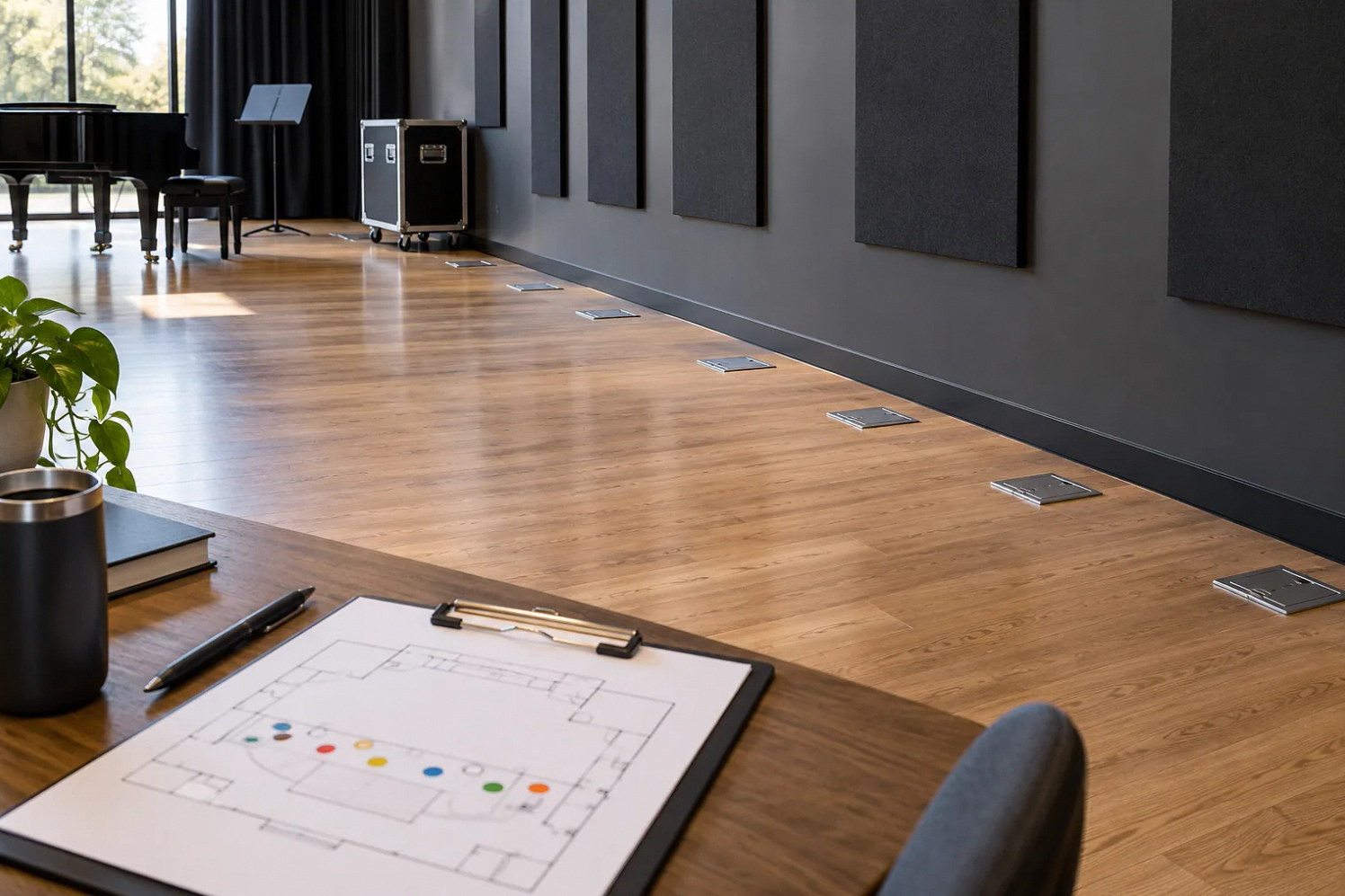
A row of receptacles makes a stage look well supplied. It does not reveal whether they share a circuit with one another or with equipment elsewhere in the building. When a renter asks how many circuits are available, counting faceplates can produce an answer that sounds precise but is unsupported.
The venue's response should be a verified map, not a guess based on physical spacing. Ask a qualified electrical professional to establish circuit relationships, evaluate condition and identify the boundaries relevant to the planned use. Staff should not open panels or probe live equipment to fill the gap.
Before approving a stage power installation, use the verified map to explain exactly which operational limitations the proposed work will address.
Reference: OSHA 1910.334: Use of equipment
Specify a survey that ends in usable information
A useful survey deliverable links each stage receptacle identifier to its documented supply and notes relevant shared loads. Include locations outside the immediate stage that production routinely uses, such as control positions, backstage equipment and nearby event areas. Define the survey boundary before the visit so a convenient outlet in the lobby is not assumed to be part of the stage system.
Ask the professional to distinguish verified information from labels that were merely transcribed. Include unresolved access limitations and any recommended corrections. The resulting plan should be readable by production staff without exposing internal electrical work. A simple room drawing with consistent identifiers is often more useful during load-in than a folder of unrelated panel photographs.
Reference: OSHA 1910.304: Wiring design and protection
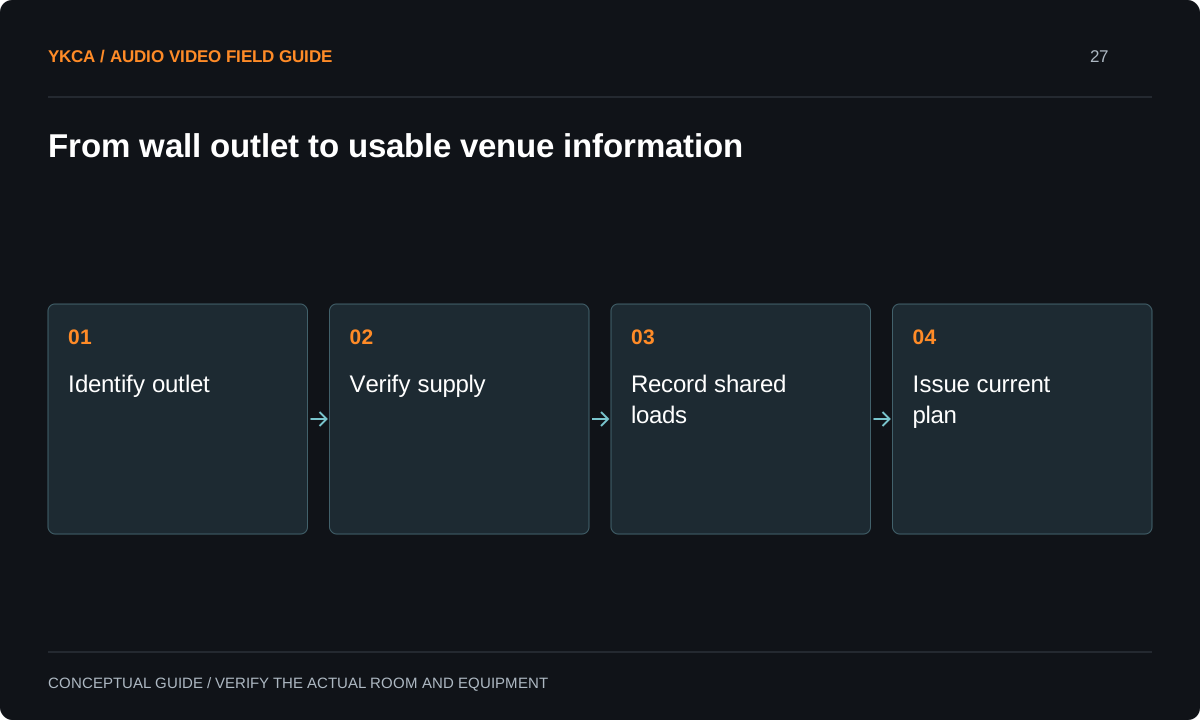
- Identify outlet
- Verify supply
- Record shared loads
- Issue current plan
Identify what kind of power each connection provides
Theater outlets may be part of dimming, switched-power or constant-power systems. Similar connectors do not guarantee equivalent behavior. An outlet that changes with a lighting control state can be unsuitable for equipment expecting continuous unregulated power. Have the survey identify the actual source and operating behavior rather than labeling everything stage power.
ETC's guidance for LED fixtures and moving lights explains why a dimmer's non-dim setting is not automatically equivalent to a relay or constant-power module. This is product-specific guidance, not a universal rule for every rack. For retained theater power equipment, require compatibility to be checked against its exact model and the connected load before authorizing reuse.
Reference: ETC: LED fixtures and moving lights powered by dimmers
Worked example: the outlet beside the sound console
Consider a sound console that works during rehearsal but loses power when a staff member shuts down an adjacent area. The outlet's location near the console led everyone to assume it was dedicated to audio, while its control relationship was never documented.
The survey should establish the actual arrangement and the qualified reviewer should propose the appropriate correction or operating restriction. Update both the outlet map and the shutdown procedure. Merely placing a new audio label on the faceplate would preserve the same dependency. Test the agreed operating sequence after corrective work, including ordinary room closing tasks, so the new documentation reflects how staff actually use the building.
Use the map to target the improvement
Once circuit relationships and equipment needs are documented, the design team can compare reuse, redistribution and new work. Keep these alternatives separate in the proposal. Reuse may be appropriate for some connections while another location needs modification. Do not assume that an additional receptacle adds electrical capacity; ask what supply change, if any, the proposed work actually provides.
Include access, finish repair, labeling, testing and permit responsibilities in the scope. Those items affect whether the delivered upgrade is usable. If records reveal shared loads outside the project area, agree how they will be handled before committing to a design. A stage project can otherwise improve the visible outlets while preserving the dependency that caused the original problem.
Keep the verified map available at booking and load-in
Store a current, legible stage-power plan with the venue's technical information. Give production staff the approved version and a contact for unresolved questions. The plan should help them advance equipment needs before arrival, while making clear that visiting equipment still needs to fit the reviewed use.
Update the map after electrical changes and periodically compare it with the installed labels through the appropriate professional process. Record the revision date and owner. During acceptance, ask venue staff to locate representative outlets using the drawing and explain the relevant restrictions. If the paperwork cannot be used during a normal load-in, improve its presentation before treating the survey as operationally complete.
Compare the next steps
A decision table for this problem
| Decision or observation | What to request | Acceptance evidence |
|---|---|---|
| Many outlets on one wall | Verified supply relationships | Map identifies shared circuits |
| Old handwritten label | Field verification record | Verified status and revision date |
| Lighting-controlled connection | Exact source and power mode | Compatible intended load identified |
| Outlet near another department | Shared-load investigation | Dependency shown on stage plan |
| Proposed new receptacle | Description of supply work | Capacity claim matches actual scope |
Use this in the room
Your working checklist
Common questions
Can a plug-in tester create the full map?
It does not replace a qualified assessment of circuit relationships, capacity, condition and protection. Have the professional choose appropriate methods.
Will adding outlets stop trips?
Only if the underlying cause and electrical design are addressed. More receptacles on the same supply do not inherently add usable capacity.
Can a renter rely on last year’s technical sheet?
Provide a current revision and review equipment changes. A previous technical sheet may predate wiring modifications or new shared loads.
Read the original guidance
Sources and discussion context
Research used primary documents and, where full text was unavailable, indexed excerpts from official sources. A citation does not mean the complete document was accessible. Product behavior depends on the actual model, configuration and documentation. Confirm the requirements for your venue before changing the installation.
- OSHA 1910.334: Use of equipment↗
- OSHA 1910.304: Wiring design and protection↗
- ETC: LED fixtures and moving lights powered by dimmers↗
Reader problems behind this guide
These Reddit discussions helped identify the practical question. They are individual experiences, not technical authority or a measure of how common the problem is. Examples and diagrams illustrate planning decisions; they are not records of completed YKCA projects or installation drawings.
- Tripped a breaker??
Discussion notes that multiple stage outlets may all share one breaker.
Research access: search excerpt only.
Keep the whole system in view
