
Stage & architectural lighting · Practical guide
Bright Stage, Dark Faces: Fix the Lighting Position Problem First
Plan usable front-light coverage for speakers and performers before adding effects fixtures or more overhead brightness.
YKCA Journal · 5 min read · Updated October 3, 2026
Start here
Judge faces from the audience and camera positions, not the brightness of the stage floor.
Look at people rather than the empty stage
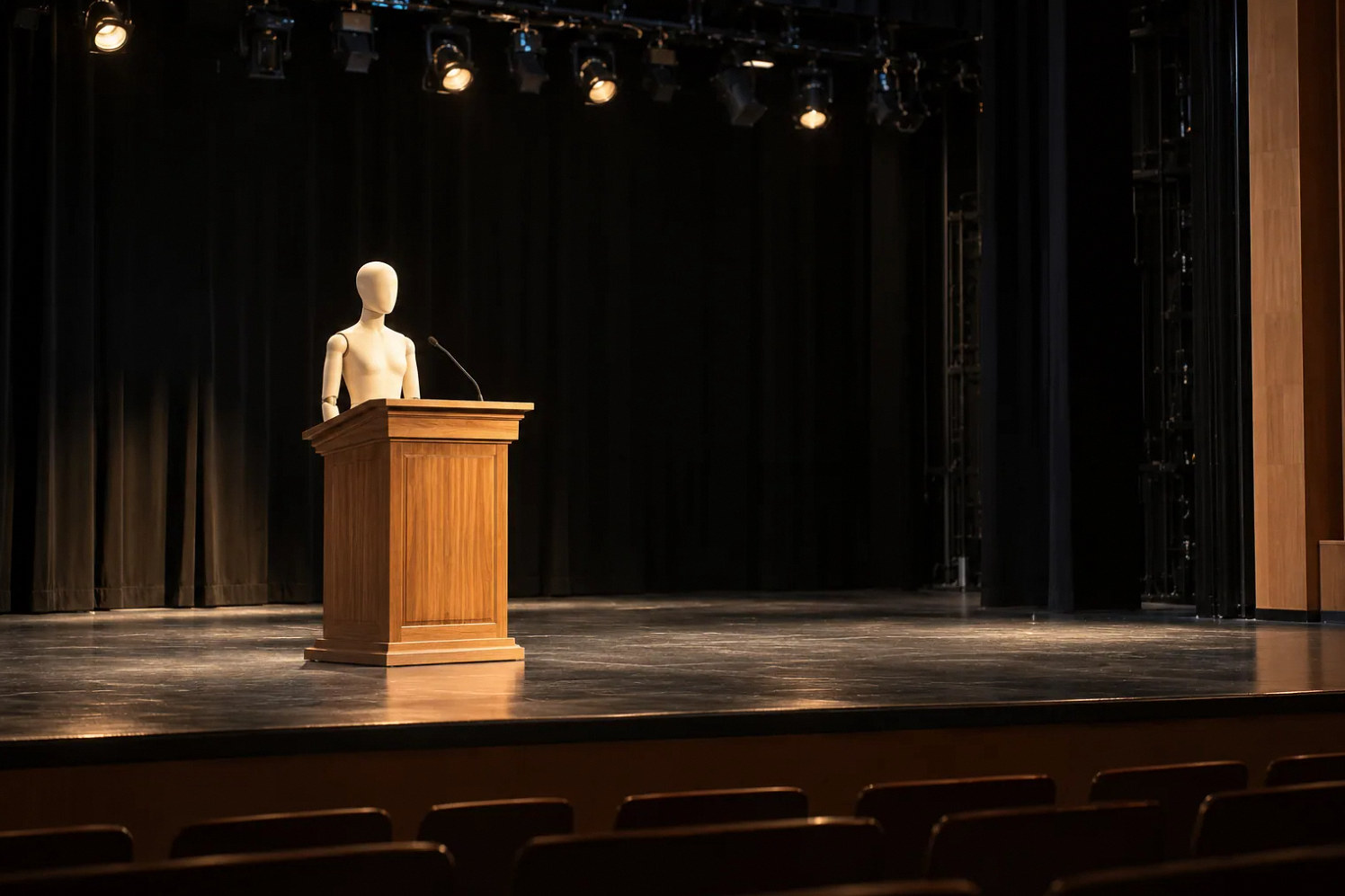
An empty stage can appear bright even when the audience cannot see a speaker’s eyes or expression. Place a person at the lectern, presentation mark and other commonly used locations. Observe from central and side seats and from the planned camera positions. Include realistic clothing, glasses or hats when those are part of the event. It identifies a position problem worth investigating; it does not authorize improvised supports or establish that a particular fixture count will fit another room.
Understand what direction changes
ETC's stage-lighting guidance describes front light around 45 degrees above the performer's eye line as a useful starting point for balancing visibility and shadows. Two front-light directions can reduce the deep shadow created by a single side. By comparison, steep top light tends to leave dark eye sockets and a shadow beneath the nose: increasing that same overhead light may brighten the floor without revealing the face. These are starting relationships for a lighting mockup, not a required mounting angle for every room.
Show the designer where people actually stand and face, then compare those positions from the audience and the camera. A low front position may create glare; a steep position may recreate the original facial shadows. The useful compromise depends on feasible support locations, sightlines, beam control and the event's intended appearance. ETC's planning guidance describes dividing a stage into acting areas so the designer can check overlap as people move rather than judging only one person standing still at center stage.
Reference: ETC: Stage Lighting Design, Lighting Angles · ETC: Stage Lighting Design, Planning Your Design
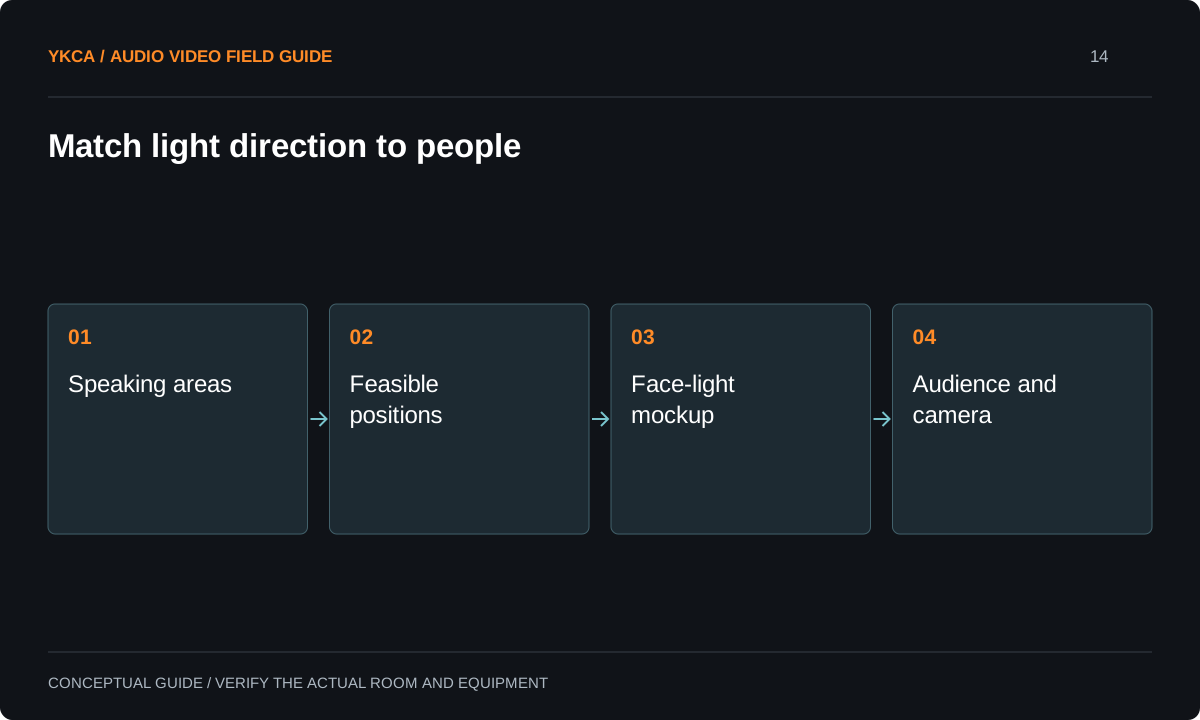
- Speaking areas
- Feasible positions
- Face-light mockup
- Audience and camera
Inventory feasible positions before selecting fixtures
Document existing approved mounting locations, sightlines, access and the areas that must remain clear. A desirable lighting angle on paper may be unavailable because of architecture, audience glare, maintenance access or structural limits. Have qualified professionals evaluate any new overhead or freestanding support and its electrical needs. Do not treat a pipe-and-base suggestion from a forum as a complete support design. Once feasible positions are established, compare suitable optics, control and output for the required coverage. Buying fixtures first can leave the project with equipment that is bright enough but cannot be placed where it needs to be.
Reference: ETC: Stage Lighting Design, Lighting Angles · ETC: Stage Lighting Design, Planning Your Design
Use an apron-lighting mockup
Imagine a multipurpose room where presenters stand in front of the existing stage wash. A designer marks the approved speaking area and uses a safely prepared demonstration from a feasible front position. The owner compares facial visibility at the center and edges, then checks the view from the streaming camera. The same test includes a person turning naturally while speaking. If one fixed area looks good but a roaming presenter leaves the light, either the coverage or the operating expectation must change before the design is finalized.
Balance visibility with the rest of the room
Useful face light should be coordinated with projected content, audience comfort and the visual style of the event. Check whether spill washes a screen, reaches the audience or lights scenery that should remain dark. Beam control and careful focusing can matter as much as adding output. Include the camera operator when recording is required, because exposure and background balance affect the final image. The owner should see the complete scene rather than approving isolated fixtures one by one. A room used for several activities may need a small set of clearly named scenes instead of a single compromise setting that disappoints every activity.
Accept the coverage with ordinary operators
Walk the approved performance area while staff recall each normal scene. Check transitions between areas and verify that the lectern or furniture can be placed as intended. Record focus positions, fixture modes and scene levels sufficiently for maintenance without exposing unnecessary programming controls to every user. Identify which changes require a refocus or design review, such as moving the lectern, adding a screen or changing camera positions. Provide an access and maintenance plan for installed equipment. Completion means the people in the defined areas are visible for the agreed uses, with the remaining movement limits stated clearly.
Before approving a stage lighting installation, put the expected movement on the floor plan. A speaker who remains at a lectern, a panel seated across the stage and a presenter walking onto the apron create different coverage requirements. Ask the designer to show which zones each scene supports and where additional focus or equipment would be needed. That drawing also helps event staff place furniture correctly without calling the lighting operator for every setup. If the room must remain flexible, identify the intended changeover work and who performs it. Flexibility is useful only when the owner understands whether a new arrangement can be recalled with a button or requires qualified access, refocusing and another visual check.
Compare the next steps
A decision table for this problem
| Observation | Design question | Useful test |
|---|---|---|
| Bright floor, shadowed eyes | Is the direction suitable for faces? | Person at normal speaking mark |
| Center good, apron dark | Does coverage match actual use? | Walk the full approved area |
| Face clear, screen washed out | Is spill controlled? | Full presentation scene |
| Audience sees glare | Is the position and beam appropriate? | Check occupied viewing angles |
| Camera image differs from room view | Are exposure and background coordinated? | Record the final camera view |
Use this in the room
Your working checklist
Common questions
Should all shadows be removed?
Not necessarily. The desired modeling depends on the event. The practical issue is whether faces remain usefully visible for the agreed presentation or performance.
Are moving fixtures required for a lectern?
Often the requirement can be evaluated with a fixed lighting position. Movement capability should follow the operating need rather than serve as a substitute for good placement.
Can staff move the lectern later?
Only within the accepted coverage without further checking. Record the approved area and arrange a lighting review if the presentation location changes materially.
Read the original guidance
Sources and discussion context
Research used primary documents and, where full text was unavailable, indexed excerpts from official sources. A citation does not mean the complete document was accessible. Product behavior depends on the actual model, configuration and documentation. Confirm the requirements for your venue before changing the installation.
Reader problems behind this guide
These Reddit discussions helped identify the practical question. They are individual experiences, not technical authority or a measure of how common the problem is. Examples and diagrams illustrate planning decisions; they are not records of completed YKCA projects or installation drawings.
- Recommendations
Overhead track lights left faces in shadow on a cafetorium apron with limited mounting options.
Research access: search excerpt only.
Keep the whole system in view
