
Stage & architectural lighting · Practical guide
One Interface for House and Stage Lights: Define Priorities First
Plan architectural and theatrical lighting control without losing everyday operation or creating conflicting commands.
YKCA Journal · 5 min read · Updated October 3, 2026
Start here
Shared buttons need a documented control hierarchy and a clear failure behavior.
List the people who use the lights
A stage operator, receptionist, custodian and weekend volunteer may need different lighting actions in the same room. Write those actions before choosing a control bridge. Include opening the room, ordinary daytime use, presentation, performance, cleaning and closing. Identify whether each action should work when the show console is off. A consumer smart-switch feature list does not establish compatibility with the installed stage and house-lighting controls. The owner needs dependable operation across all intended activities.
Distinguish shared interface from shared responsibility
A single panel can present commands for several systems without making their underlying functions identical. ETC’s Echo scene-controller documentation describes one product family that recalls DMX snapshots from architectural stations. Its troubleshooting guidance also illustrates how another active controller can affect the resulting scene under a particular configuration. Those examples show why supported integration and priority rules matter. They do not mean that every DMX device automatically cooperates with every wall station. Confirm compatible interfaces, supported modes and the exact behavior when two users act at once. Keep required building and emergency-lighting functions within the appropriate professional design review.
Reference: ETC: Echo DMX Scene Controller · ETC: Echo DMX Scene Controller Presets Always White
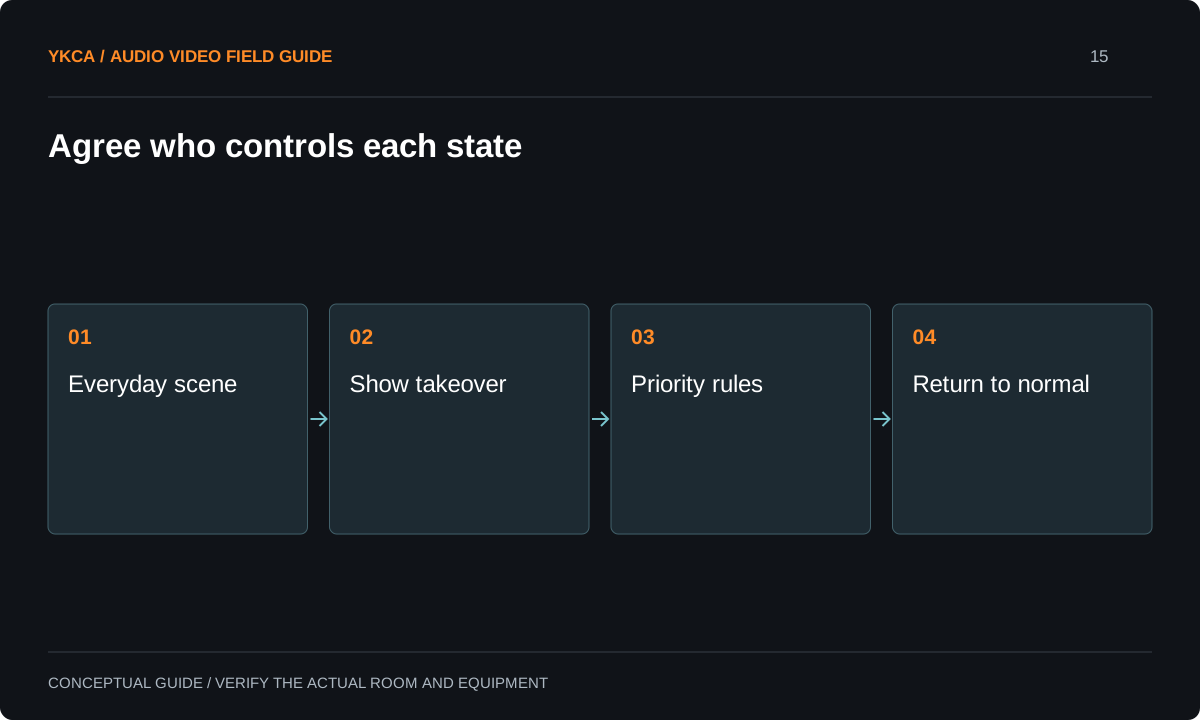
- Everyday scene
- Show takeover
- Priority rules
- Return to normal
Write the priority and recovery rules
Decide what happens if a wall station requests a cleaning scene during a show, if the console starts transmitting after an architectural scene is active, and if a control connection disappears. The correct answer depends on the venue’s operating requirements and applicable design constraints. Do not let it emerge accidentally from default settings. Identify which actions staff may perform and which require a technical role. A simple state table is often clearer than a feature list. For each operating state, name the active controller, available local controls, expected light scene and approved method of returning to everyday operation.
Reference: ETC: Echo DMX Scene Controller · ETC: Echo DMX Scene Controller Presets Always White
Test a multipurpose-room day
Imagine the room begins with a custodian selecting a cleaning scene at a wall station. Later, staff select a presentation scene, and an event operator takes control for a performance. After the performance, ordinary room controls must resume predictably. Demonstrate that whole sequence with the selected hardware and configuration, including a controlled loss of the show-control connection where authorized. If returning to normal requires a specialist to reboot several devices in an undocumented order, the integration is not yet ready for ordinary staff use.
Evaluate maintenance and network dependence
Document which functions operate locally and which depend on a network, server, account or subscription. A convenient mobile interface may be useful, but determine whether essential everyday operation also requires it. Review update ownership and how compatibility will be maintained when one component changes. Avoid an unsupported chain of software bridges unless its maintenance burden is explicitly accepted and scoped. The appropriate design may be simple or sophisticated; the test is whether its dependencies are understood. Include qualified evaluation of existing circuits and fixtures when converting house lighting, because adding a control interface does not establish electrical or dimming compatibility.
Deliver scenes that staff can verify
Name scenes by activities and show their expected result in the operating guide. Have representative users perform the opening, event transition and closing tasks without coaching. Retain the technical state table, wiring and network documentation, configuration files and approved failure behavior with the project records. Clearly identify any functions excluded from the integration and any requirements awaiting separate review. Future upgrades should preserve the agreed priority rules or deliberately revise them. A successful combined interface makes everyday lighting predictable while allowing the event team to use the capabilities that were actually designed, tested and handed over.
Retain an interface schedule listing each command, its destination and the confirmation available to the user. “Presentation” might request a house-light scene and a stage-light scene, but a shared label does not prove that both requests completed. Identify what staff see if one subsystem is unavailable and how ordinary operation is restored. Discuss the behavior after scheduled updates or replacement controllers before those changes become urgent. If the project depends on an external service, state which functions remain available during a service interruption. This schedule gives the owner a concrete way to review integration scope and helps future technicians preserve the approved relationship between everyday room lighting and event control. Keep this schedule with the lighting control system documentation and update it whenever a new control station or operating mode is added.
Compare the next steps
A decision table for this problem
| Operating state | Question to settle | Acceptance action |
|---|---|---|
| Everyday room use | Must wall stations work without console? | Recall normal scenes with console off |
| Show mode | Who has authority over shared channels? | Test approved control takeover |
| Competing requests | Which command wins and why? | Use the documented priority scenario |
| Control-link interruption | What state and local control remain? | Perform an authorized failure test |
| End of event | How does ordinary operation resume? | Have staff restore the room |
Use this in the room
Your working checklist
Common questions
Can a software bridge be part of the design?
It can be evaluated, but its support, update and failure responsibilities must be explicit. A proof of concept is not automatically a dependable operating system.
Should the console control every light?
Only where that fits the agreed design and applicable requirements. Define which lights participate in event scenes and how ordinary room operation remains available.
Does LED conversion remove the electrical review?
No. Existing fixtures, circuits, control methods and intended replacement equipment still require appropriate compatibility and installation review.
Read the original guidance
Sources and discussion context
Research used primary documents and, where full text was unavailable, indexed excerpts from official sources. A citation does not mean the complete document was accessible. Product behavior depends on the actual model, configuration and documentation. Confirm the requirements for your venue before changing the installation.
Reader problems behind this guide
These Reddit discussions helped identify the practical question. They are individual experiences, not technical authority or a measure of how common the problem is. Examples and diagrams illustrate planning decisions; they are not records of completed YKCA projects or installation drawings.
- Need guidance for church building house lights
A multipurpose space sought reliable integration between existing stage scenes and separately switched house lighting.
Research access: search excerpt only.
Keep the whole system in view
