
Rigging & trusses · Practical guide
Inherited a Theater Rig Without Drawings? Rebuild the Record Before Adding Loads
A practical owner checklist for an existing rigging system with missing labels, manuals, drawings or inspection history.
YKCA Journal · 5 min read · Updated October 3, 2026
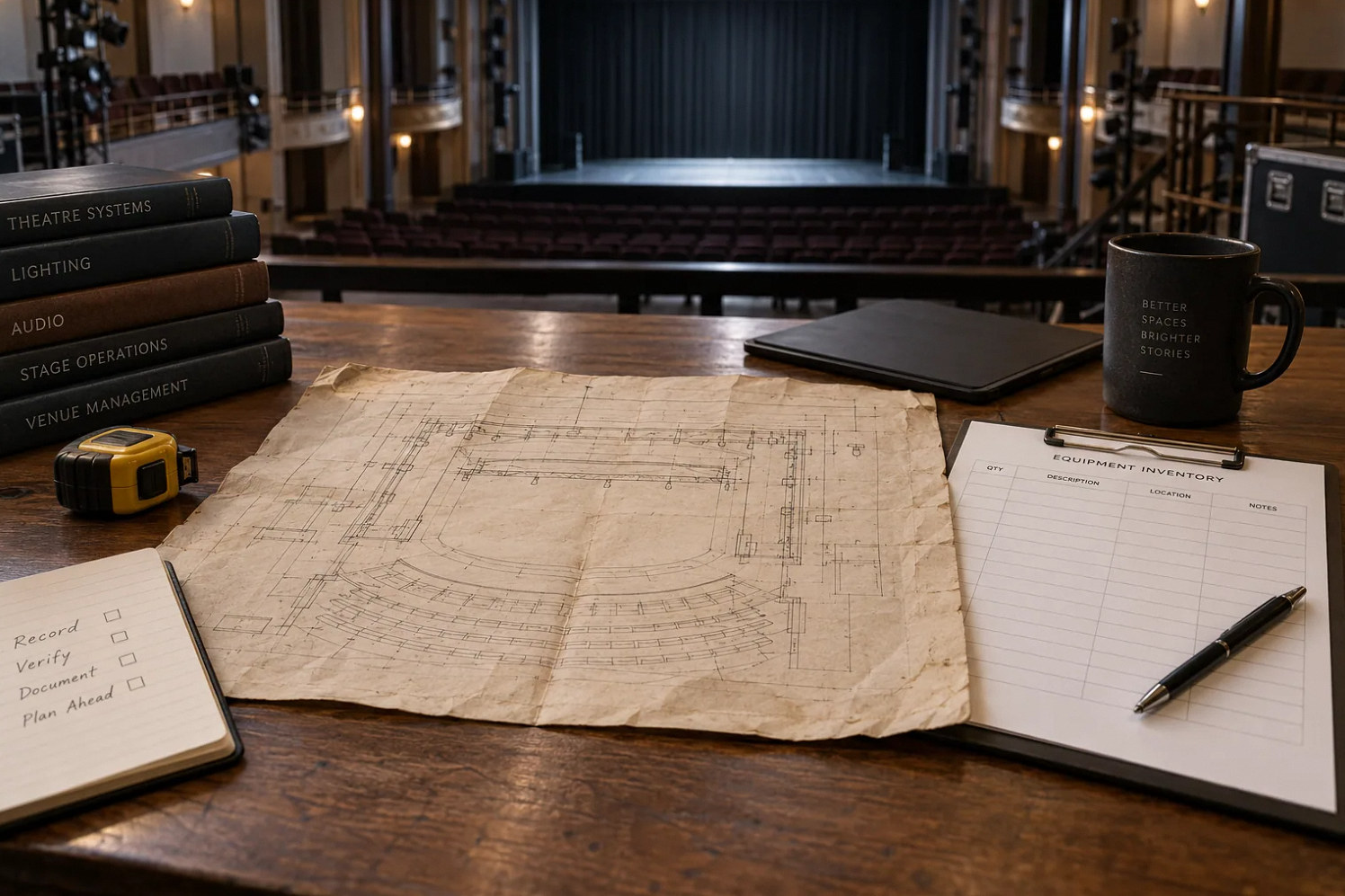
Start here
Missing records are a scope item. Identify the equipment, establish its review status and preserve unresolved restrictions before approving changes.
Treat the missing file as a project problem
An inherited rig can come with years of confident verbal explanations and almost no usable documentation. Staff may know which line moves a curtain while nobody can identify the supports above the ceiling. Familiarity helps explain operation; it does not establish capacity or resolve an unknown modification. Begin by commissioning a documented existing-condition review before approving new equipment or expanded use.
The nearest technical person can become the default decision maker without having the information or authority required. Give the investigation a named owner, a defined professional scope and a place to record questions that remain open.
When engaging a theater rigging contractor, include this investigation and documentation task explicitly rather than assuming it is included in routine maintenance.
Collect evidence without creating a false as-built
Gather purchase records, service invoices, old drawings, inspection reports and manufacturer manuals. Mark every document with its date and apparent relationship to the present installation. An as-built drawing is intended to describe what was installed; a proposal or old design drawing may show something different. Do not silently rename the latter to make the folder appear complete.
Create an inventory using identifiers visible from safe accessible locations. Ask qualified personnel to document inaccessible equipment as part of their survey. Record missing labels instead of guessing models from photographs. The J.R. Clancy manual library is useful once the system is identified; a similar-looking manual cannot supply the missing identity of a component or establish its condition.
Reference: J.R. Clancy operations manuals
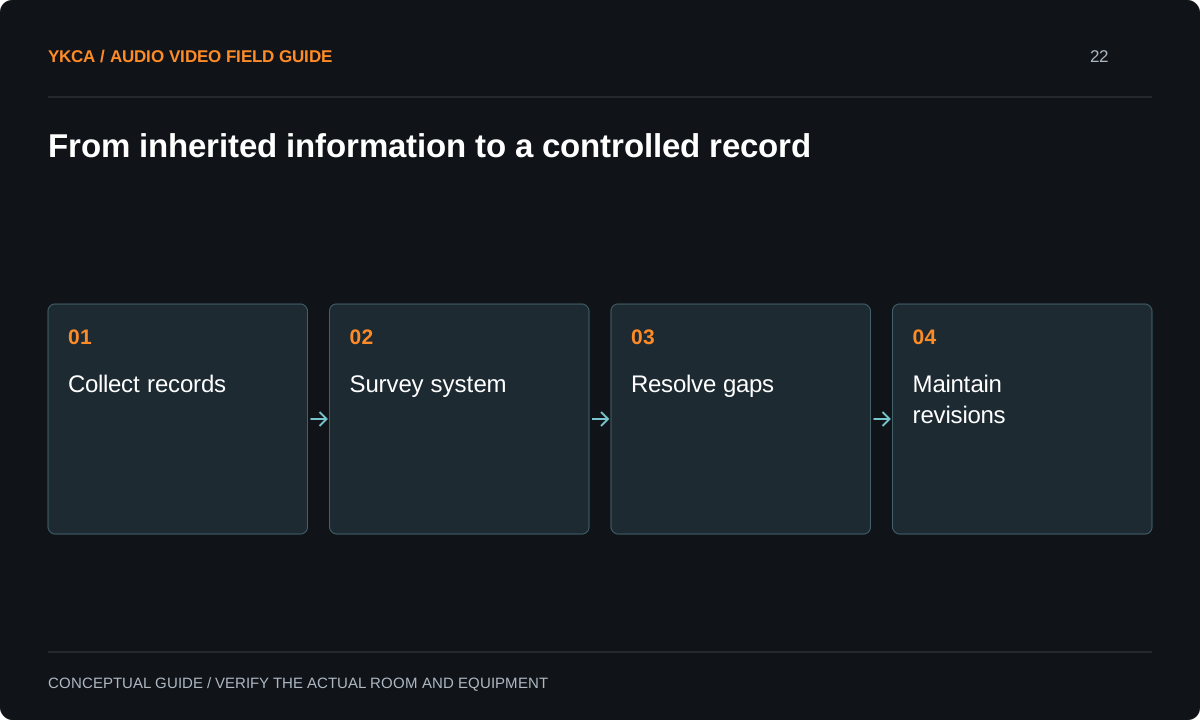
- Collect records
- Survey system
- Resolve gaps
- Maintain revisions
Split the investigation into equipment and structure
The investigation should distinguish rigging machinery, control equipment, suspension hardware and the supporting building. An equipment specialist may recognize a hoist but still need structural information about its attachment. Conversely, a structural drawing may identify a beam without describing later rigging modifications. Ask each reviewer to state which part of the system the proposed service covers.
Use a gap register with three fields: the question, the person responsible for resolving it, and the evidence needed. For example, identifying a motor controller may require a manufacturer response, while confirming an obscured building connection may require an authorized access investigation. The owner can manage these decisions without directing exploratory work or attempting calculations.
Worked example: an undocumented donated projector
Imagine a venue whose old lighting plan predates a donated projector. The projector appears in current photographs but not in the latest drawing, and the bracket has no accompanying record. The first useful output is a clear mismatch entry: additional suspended equipment exists; the reviewed configuration is unknown.
Ask the assigned professionals what operating restrictions and investigation are appropriate. Do not assume that removing the projector personally is safer than leaving it for a planned professional intervention. Compare resolving the existing arrangement with a properly designed alternative location. Include restoration of any disturbed finishes and access equipment in the scope, so a modest equipment change does not produce an incomplete building repair.
Make the report usable for decisions
Request findings tied to unique equipment identifiers and locations. A report saying that several items need attention is difficult to turn into work orders. Each finding should describe its significance, recommended disposition, responsibility and any restriction pending resolution. Ask the inspector to separate items actually examined from areas that were inaccessible or outside scope.
ESTA's public description of rigging-inspection guidance identifies qualifications, responsibilities, inspection scope and report content as separate subjects. Use that distinction when buying the service. An inspection can improve the record without proving everything about an undocumented structure. Require the report to say what additional review is needed rather than expecting the word inspected to mean universally approved.
Preserve the rebuilt record through staff turnover
At handoff, organize information by system identifier rather than by the name of the employee who collected it. Keep the current drawing, manuals, findings and closure records together. Store historical versions in a clearly marked archive. Supply a short index that tells a new manager where to find restrictions and who to contact for a proposed change.
Make document updates part of equipment changes and service visits. The technician closing a repair should reference the original finding and describe the resulting condition. A new piece of paperwork should not erase the old uncertainty unless it actually resolves it. That discipline makes the next inspection more efficient and reduces dependence on one person's memory of earlier productions.
Compare the next steps
A decision table for this problem
| Decision or observation | What to request | Acceptance evidence |
|---|---|---|
| Old proposal drawing | Date and field comparison | Marked verified or historical |
| Missing equipment label | Qualified identification plan | Identity or unresolved status recorded |
| Unknown building connection | Separate structural-review scope | Supporting evidence and limitations |
| Inaccessible equipment | Access and follow-up allowance | Unexamined areas explicitly listed |
| Closed repair | Finding identifier and completion record | Traceable disposition in master file |
Use this in the room
Your working checklist
Common questions
Does an old inspection report approve new equipment?
No. Its date, scope, findings and reviewed configuration matter. A later change needs its own evaluation and documentation.
Should staff make missing labels themselves?
Staff can maintain administrative identifiers, but capacity labels and operating restrictions should come from the responsible professional or manufacturer, not from a guessed specification.
Can we wait until the next renovation?
Ask a qualified reviewer to assess current use and restrictions now. Missing evidence may affect today’s operation, not only a future capital project.
Read the original guidance
Sources and discussion context
Research used primary documents and, where full text was unavailable, indexed excerpts from official sources. A citation does not mean the complete document was accessible. Product behavior depends on the actual model, configuration and documentation. Confirm the requirements for your venue before changing the installation.
Reader problems behind this guide
These Reddit discussions helped identify the practical question. They are individual experiences, not technical authority or a measure of how common the problem is. Examples and diagrams illustrate planning decisions; they are not records of completed YKCA projects or installation drawings.
- Advise on getting asked to do things well outside your role, with significant liability?
A theater-related worker was asked to address safety-critical structural or rigging work outside their expertise.
Research access: search excerpt only.
Keep the whole system in view
