
Rigging & trusses · Practical guide
A Rigging Inspection Is Only Useful If the Findings Get Closed
How venue managers can define rigging inspection scope, distinguish routine observations from professional inspection and track corrective work.
YKCA Journal · 6 min read · Updated October 3, 2026
Start here
Buy a defined inspection, reserve access and repair time, and track every finding through documented disposition.
Begin with the question the inspection must answer
Budget for professional inspection before treating an overhead system as an ordinary maintenance item. J.R. Clancy's published guidance recommends annual inspection of manually operated and motorized rigging, and inspection immediately after installation, alteration or repair. Everyday staff observations do not replace that examination. An unusual event, damage or change in behavior can require action before the next scheduled visit; do not wait for the annual date when a concern is reported.
Use the current standard and the actual equipment to set the inspection scope. ESTA's catalogue lists ANSI E1.47-2020, Recommended Guidelines for Entertainment Rigging System Inspections, as the revision of the older 2017 edition quoted in Clancy's web summary. Ask the qualified inspector to identify the applicable inspection level, frequency and manufacturer instructions, including any shorter interval required by use or condition. The recommended practice is not, by itself, a claim about the law in every jurisdiction. Record the basis, last inspection date and next due date together.
Reference: J.R. Clancy rigging inspection service · ESTA: published technical standards · J.R. Clancy: rigging inspection recommendations
Give routine observations a limited, useful role
Operators are well placed to notice changes: an unfamiliar sound, a control behaving differently or something visibly out of place. Provide a reporting route that captures the equipment identifier, the observation and the time. Staff should know who decides whether use can continue and how an affected system is kept from being used pending review.
Routine observation is not permission to climb into inaccessible areas, adjust machinery or test safety devices without the required training. The operating instructions should establish what staff may inspect and how. Keep this everyday process distinct from the outside professional's examination. Both can contribute to the same record while serving different purposes and requiring different competencies.
Reference: J.R. Clancy operations manuals
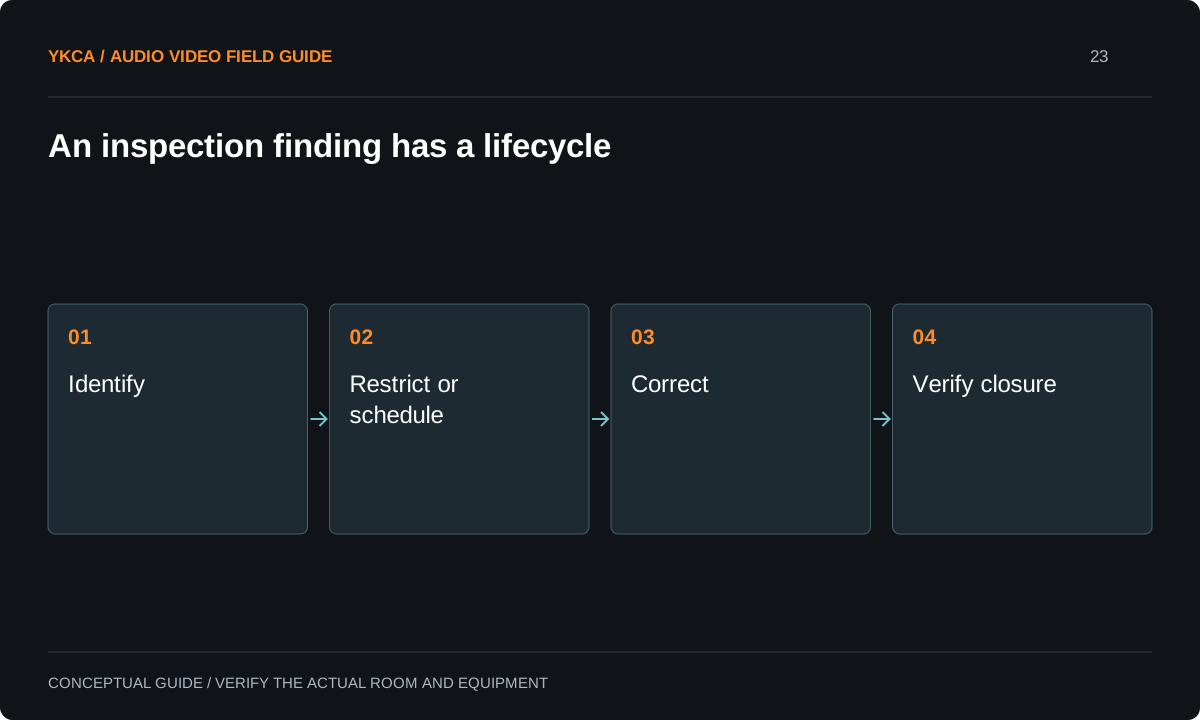
- Identify
- Restrict or schedule
- Correct
- Verify closure
Resolve access and exclusions before the visit
An inspection quote should identify access assumptions, required shutdowns and whether scenery or equipment must be moved. If a visiting production occupies the stage, overhead access may be limited. Reserve a suitable window rather than treating the inspector's arrival as proof that all equipment can be examined.
Ask what the report will say about inaccessible parts. A clear exclusion lets the owner plan follow-up; an unspoken exclusion leaves a misleading impression of completeness. Coordinate building access, responsible staff and any needed specialist participation before the visit. Also ask whether a proposed repair requires a separate visit or another trade. Those answers shape the budget and schedule more usefully than the lowest inspection-only price.
Worked example: turn one report into a controlled worklist
Consider an inspection that identifies one restricted item, several maintenance recommendations and a connection that could not be examined. Create separate records for all three categories. The restricted item needs an operational response and a responsible decision maker. Maintenance recommendations need assigned work and completion evidence. The inaccessible connection needs a defined investigation, not a checkmark under repairs.
Hold a short review with operations and facilities personnel. Confirm which systems are available for the next production and which remain limited. If different contractors address the findings, appoint one person to collect the final records. Otherwise each contractor can finish their task while the venue still lacks a coherent statement of system status.
Specify closure evidence before authorizing repairs
For each repair, request the finding identifier, agreed scope and required verification. The completion record should show what was done, by whom and whether any restriction changed. Photographs may support the record, but they do not establish that a hidden connection or machinery function has been appropriately verified.
J.R. Clancy offers professional inspection services; ESTA's inspection guidance covers report content and responsibilities. Neither makes an unpaid recommendation disappear automatically. Ask the provider how follow-up is documented and what requires reinspection. A purchase order can be administratively closed while a safety-related finding remains unresolved. Keep those two statuses separate in the owner's record and in the information provided to production staff.
Reference: J.R. Clancy rigging inspection service · ESTA explains entertainment rigging inspections
Budget the recurring program, not just the inspection fee
Plan for inspection access, maintenance time, corrective work and record updates. A venue that spends the entire maintenance allowance on the initial visit may have no practical way to act on its findings. Keep repair allowances separate from the inspector's fee and avoid promising the next show unrestricted access before the findings are known.
At the season review, compare open findings with upcoming production demands. Ask whether use, equipment or environmental conditions have changed enough to revisit the program. Schedule the next inspection and identify the person responsible for arranging it. The goal is not to accumulate certificates; it is to keep current, usable evidence of the system's condition and operating boundaries. Before appointing a theater rigging contractor, confirm who will inspect, who can perform corrective work, and who will document the disposition of each operating restriction.
Compare the next steps
A decision table for this problem
| Decision or observation | What to request | Acceptance evidence |
|---|---|---|
| Routine observation | Operator reporting procedure | Observation reaches responsible reviewer |
| Professional inspection | Defined equipment and access scope | Report lists inspected and excluded areas |
| Restricted equipment | Operational disposition | Use status communicated to staff |
| Recommended repair | Finding-linked work order | Verification and closure recorded |
| Inaccessible connection | Follow-up investigation | Unknown remains visible until resolved |
Use this in the room
Your working checklist
Common questions
What inspection schedule should we budget for?
For manually operated and motorized rigging, J.R. Clancy recommends annual inspection and inspection immediately after installation, alteration or repair. Ask a qualified inspector to establish the required scope using current ANSI E1.47 guidance, equipment instructions and applicable requirements. Damage, unusual behavior or demanding service can require earlier review. An annual appointment is not permission to keep using a system with a reported concern.
Can a staff checklist replace an outside inspection?
Not when the specified program calls for professional examination. Staff observations have a different scope and should feed the same reporting process.
What if the contractor says a repair is finished?
Collect the agreed verification and disposition linked to the finding. Completion of labor alone does not explain whether an operating restriction has been removed.
Read the original guidance
Sources and discussion context
Research used primary documents and, where full text was unavailable, indexed excerpts from official sources. A citation does not mean the complete document was accessible. Product behavior depends on the actual model, configuration and documentation. Confirm the requirements for your venue before changing the installation.
- J.R. Clancy rigging inspection service↗
- J.R. Clancy operations manuals↗
- ESTA explains entertainment rigging inspections↗
- ESTA: published technical standards↗
- J.R. Clancy: rigging inspection recommendations↗
Reader problems behind this guide
These Reddit discussions helped identify the practical question. They are individual experiences, not technical authority or a measure of how common the problem is. Examples and diagrams illustrate planning decisions; they are not records of completed YKCA projects or installation drawings.
- Rigging inspections
Venue staff distinguish informal observations from professional inspection of permanent rigging.
Research access: search excerpt only.
Keep the whole system in view
