
Rigging & trusses · Practical guide
Freestanding Truss Towers: Why a Baseplate Is Not a Stability Plan
What venue owners should request before allowing temporary lighting towers, including configuration drawings, stability review and change control.
YKCA Journal · 5 min read · Updated October 3, 2026
Start here
Approve a complete tower arrangement for its actual use, including side-mounted equipment, environment and audience access.
Distinguish carrying weight from resisting overturning
A tower can have components capable of carrying equipment weight and still present an unresolved stability problem. The location of that equipment, the tower geometry and external forces affect the complete arrangement. A neat baseplate does not answer whether the proposed tower is suitable for its location and use.
A generic ballast formula cannot establish the stability of an unspecified tower configuration. Owners should avoid instructing staff to improvise weights or test a tower by pushing it. Get a qualified evaluation of the planned setup and clear installation requirements.
For lighting truss installation, ask who takes responsibility for reviewing the complete arrangement rather than just supplying individual parts.
Reference: Prolyte BlackBook 2024
Ask for the exact proposed arrangement
The submission should identify manufacturer and model, height, base arrangement, mounted equipment and cable routing. Show fixture positions and anything mounted off the centerline. Include banners, screens or decorative elements that might be added after the lighting supplier's first drawing. Document whether the setup is indoors, exposed to weather or adjacent to doors and public circulation.
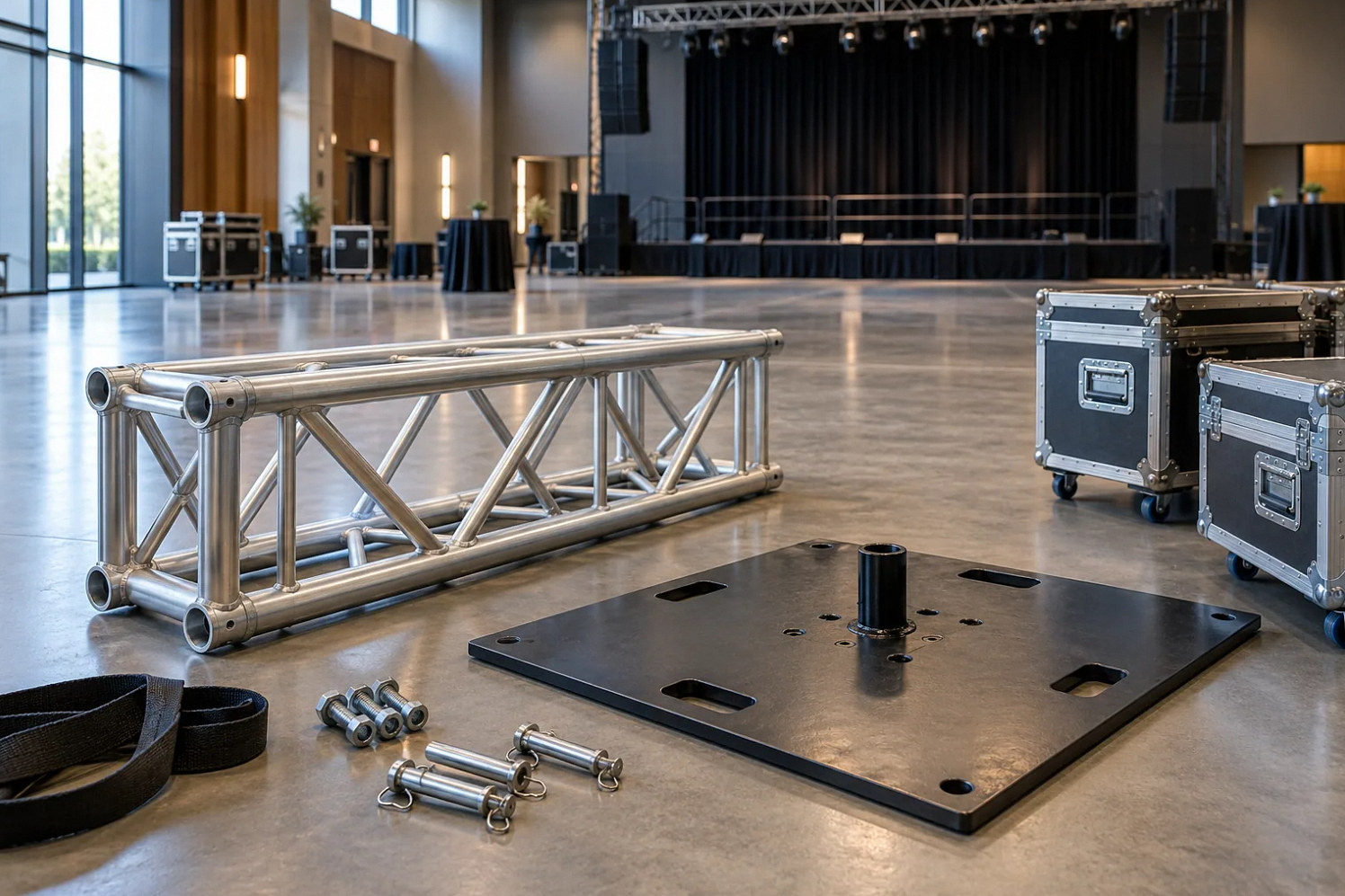
A stock photograph is not a configuration drawing. Ask for a plan view showing where each tower will stand and how its footprint relates to audience movement. The review should also cover setup and removal logistics. An arrangement that fits during installation may be incompatible with the final seating or access layout once the event team finishes dressing the room.
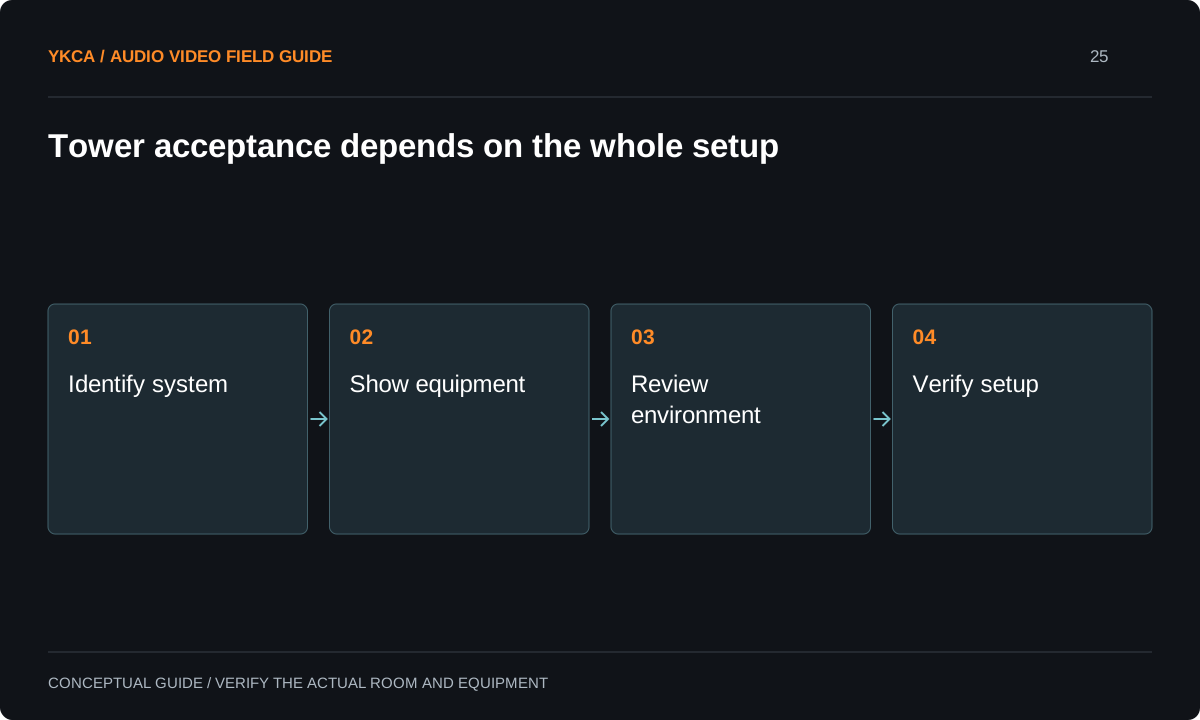
- Identify system
- Show equipment
- Review environment
- Verify setup
Keep manufacturer assumptions attached to the decision
Manufacturer documentation is specific to equipment and configurations. Prolyte's BlackBook discusses truss behavior and the assumptions behind its load information; it does not provide a universal approval for every freestanding tower. Ask the responsible reviewer to identify which product information applies and what additional evaluation is needed for the actual arrangement.
The venue's job is to demand a clear basis and preserve its limitations. If the supplier changes the truss type or adds a side arm, send the change back through the review process. Do not treat a similar-looking replacement as equivalent. Record approved equipment identifiers so the installation crew and venue representative can compare the delivered system with the accepted submission.
Reference: Prolyte BlackBook 2024
Worked example: the sponsor banner added at load-in
Imagine an event with approved indoor lighting towers. At load-in, a sponsor requests a large fabric banner between them. The original submission did not include that element. The correct administrative response is to identify the change and obtain the required review, rather than assume fabric is too light to matter.
Ask the event team for an alternative banner location that does not change the tower configuration. Maintaining a prepared alternative helps the production continue without forcing an unreviewed addition. Include this rule in the advance information sent to renters: equipment and decoration changes require acceptance before installation. Clear expectations are easier to enforce than a last-minute argument after doors are scheduled to open.
Plan public separation and environmental decisions
Review the tower footprint alongside seating, doors, work routes and audience access with the appropriate venue professionals. Staff need to know which areas must remain clear and who may move equipment. Hiding a base under decorative fabric can make its boundaries harder to see; any scenic treatment should be coordinated with the accepted arrangement.
For exposed installations, require an event-specific environmental and operational plan from the responsible parties. Do not transfer an indoor configuration outdoors or invent a generic wind threshold. The plan should assign monitoring and decision authority and explain what happens when conditions exceed the system's permitted use. Venue staff should receive that information before the event, not search for it during deteriorating conditions.
Make acceptance and removal part of the same plan
Before opening the space, have the assigned competent personnel verify the installed configuration against the accepted documents. Record substitutions, placement changes and unresolved issues. Keep the approved drawing available to event and venue staff so subsequent decoration or cable changes can be recognized as changes, rather than absorbed into the setup unnoticed.
Include removal timing, access and responsibilities in the event plan. A system remains a managed operation during dismantling, not merely during the performance. Archive the actual event configuration and any issues for the next booking. Reusing a supplier should make document collection easier, but it should not turn last month's accepted arrangement into automatic approval for a different height, location or equipment package.
Reference: J.R. Clancy rigging inspection service
Compare the next steps
A decision table for this problem
| Decision or observation | What to request | Acceptance evidence |
|---|---|---|
| Side-mounted fixture | Exact position and accessory schedule | Reviewed complete configuration |
| Banner added | Revised proposal before hanging | Change accepted or alternative selected |
| Public circulation nearby | Footprint and access plan | Placement matches venue requirements |
| Outdoor exposure | Environmental operating plan | Named monitoring and decision roles |
| Substituted truss | Model-specific reevaluation | Delivered equipment matches accepted record |
Use this in the room
Your working checklist
Common questions
Can staff calculate ballast from an online formula?
That is not a suitable approval process. The complete equipment, geometry, environment and intended use must be evaluated by the appropriate qualified professional.
Does the same tower work indoors and outdoors?
Do not assume so. Environmental conditions and the operational plan can change the evaluation substantially.
Is a brief temporary event exempt from review?
Short duration does not establish suitability. The venue still needs a defined, accepted setup and responsible installation and operating personnel.
Read the original guidance
Sources and discussion context
Research used primary documents and, where full text was unavailable, indexed excerpts from official sources. A citation does not mean the complete document was accessible. Product behavior depends on the actual model, configuration and documentation. Confirm the requirements for your venue before changing the installation.
Reader problems behind this guide
These Reddit discussions helped identify the practical question. They are individual experiences, not technical authority or a measure of how common the problem is. Examples and diagrams illustrate planning decisions; they are not records of completed YKCA projects or installation drawings.
- Vertical Trussing weight
User asked for a ballast formula for tall towers with side-mounted fixtures and small bases.
Research access: search excerpt only.
Keep the whole system in view
