
Rigging & trusses · Practical guide
Can an Existing Lighting Truss Carry New Speakers or an LED Wall?
How to prepare a useful rigging review when a new speaker or video wall changes the loads on an existing lighting truss.
YKCA Journal · 5 min read · Updated October 3, 2026
Start here
A truss rating alone cannot approve a new hang. Submit the complete proposed configuration and require a documented review of the load path.
Start with the configuration, not the headline rating
A display purchase can look straightforward until its weight reaches the lighting truss. The useful question is whether the existing arrangement can support the proposed equipment in its actual positions. That includes the structure above, the suspension equipment, the truss and the connections below. A change at one point can require review elsewhere along this load path, meaning the chain of components transferring weight to the building or ground.
Adding equipment changes the loads and their locations. Treat the new hang as a configuration change requiring qualified evaluation.
A stage rigging installation proposal should therefore identify the complete reviewed arrangement, not only the equipment being sold.
Reference: Prolyte BlackBook 2024
Build a complete proposed-load schedule
Ask the AV supplier for an itemized equipment list with model numbers, documented weights, mounting accessories and proposed locations. Include brackets, flying frames, cable bundles and equipment added for service access. For an LED wall, identify the complete hanging arrangement, not merely the weight of one panel multiplied by the panel count. A drawing should show the whole assembly and its relationship to the audience and stage.
Keep existing and proposed items in separate columns. Note anything that will be removed and anything that may move between shows. The designer can then evaluate a defined change. An email saying that the new speakers are lighter than the old ones leaves attachment geometry and concentrated loading unanswered.
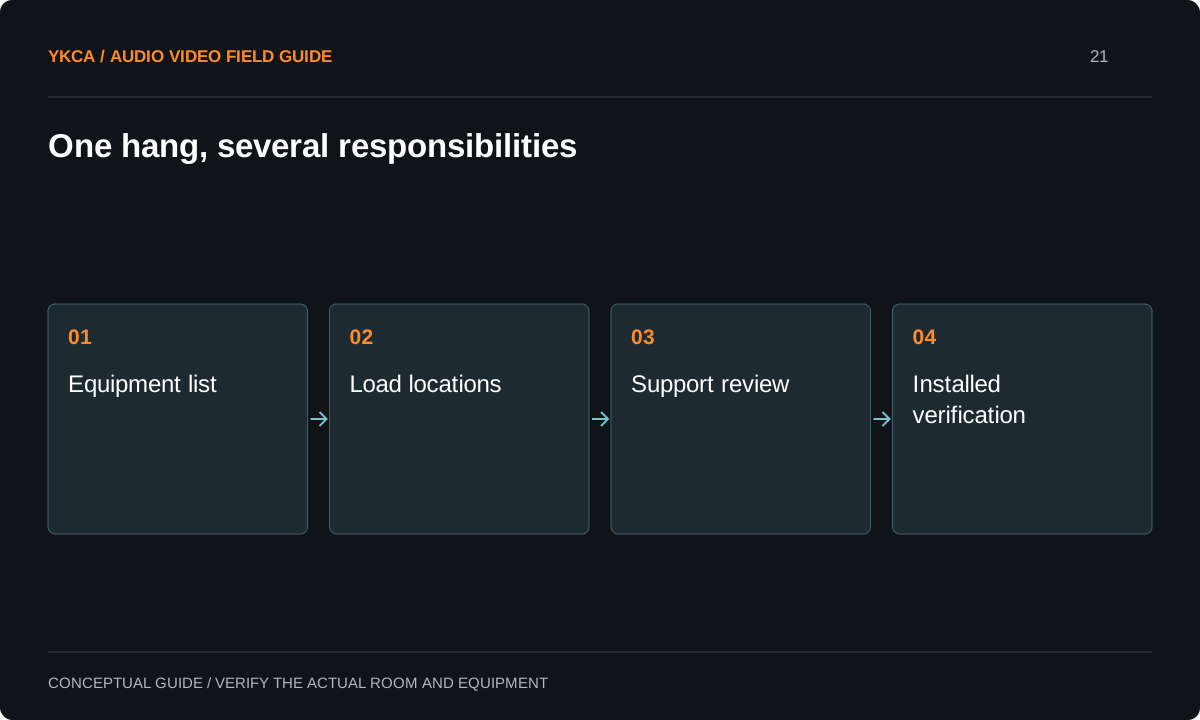
- Equipment list
- Load locations
- Support review
- Installed verification
Separate distributed loading from concentrated loading
A uniformly distributed load spreads along a span; a concentrated load acts at a particular location. Manufacturer tables can distinguish these cases and assume a specific span, orientation and support arrangement. Prolyte's BlackBook explains these assumptions for its trusses. Its tables cannot be transferred to unidentified equipment or used as blanket approval for a different installation.
The owner does not need to calculate these forces. Ask the reviewer to identify the applicable load case and explain what changes would invalidate the conclusion. Useful restrictions might concern approved hanging positions or equipment arrangements. A statement that a truss is strong enough, without identifying which arrangement was reviewed, is difficult for the next production to use responsibly.
Reference: Prolyte BlackBook 2024
Worked example: the lighter replacement that still changes the review
Consider a venue replacing several evenly spaced fixtures with a single center-hung loudspeaker assembly. Even if the total new equipment weight is lower, the distribution has changed. The review also needs the attachment arrangement, any off-center positioning and the relationship between the new load and existing supports.
Give the designer two alternatives: the desired center location and a layout using other acoustically acceptable positions. Coordinate those alternatives with the audio designer before committing to hardware. The cheapest mounting arrangement is not useful if it places the speaker where it cannot cover the audience. A coordinated decision prevents purchasing one system while hoping another discipline can make it fit.
Require a reviewable approval package
Define who is evaluating the rigging components and who is evaluating the building connection. These may be different parties. Ask for the reviewed drawing revision, the equipment schedule, the limitations and the installation inspection or verification scope. If the existing support cannot be identified, keep that uncertainty visible instead of marking the whole project approved.
Match the handoff to the venue's operating model. A fixed installation needs clear restrictions against casual additions. A venue that rearranges equipment needs a process for submitting changes. Manufacturer manuals belong in the package, but a folder of manuals is not the same as a venue-specific configuration record. The J.R. Clancy manual library demonstrates why matching documentation to the actual system matters.
Reference: J.R. Clancy operations manuals
Accept the installed arrangement and control later changes
Before operational handoff, have the responsible professional compare the installed arrangement with the reviewed design. Record deviations, their disposition and any unresolved restrictions. Photograph labels and approved equipment positions from safe accessible locations; photographs help staff identify the system but do not substitute for inspection of concealed or elevated parts.
Store a readable drawing where the venue manager and visiting production team can retrieve it. Give one named person responsibility for revision control. When a renter proposes another banner, projector or speaker, that person should route the change for evaluation. The value of the first review is preserved only if later shows know which configuration it actually covered and where their proposal differs.
Compare the next steps
A decision table for this problem
| Decision or observation | What to request | Acceptance evidence |
|---|---|---|
| Unidentified truss | Manufacturer and model evidence | Equipment identification resolved |
| New center-hung assembly | Location and full accessory weight | Reviewed concentrated-load arrangement |
| Existing roof connection | Structural records and connection scope | Responsible reviewer identified |
| Equipment moves between shows | Permitted locations and change process | Staff can retrieve restrictions |
| Substitution during installation | Revised equipment schedule | Written disposition before use |
Use this in the room
Your working checklist
Common questions
Does lower total weight guarantee approval?
No. Position, connections, support geometry and the equipment configuration can change even when total weight falls. Have the actual proposed arrangement reviewed.
Can the AV equipment supplier approve the roof?
Only if the assigned scope and qualifications include that structural evaluation. Name the responsible party explicitly rather than assuming a product quote covers the building.
What if the old truss has no readable label?
Pause the proposed addition and ask the reviewer what identification or investigation is needed. A visual resemblance to a catalog product is not adequate evidence.
Read the original guidance
Sources and discussion context
Research used primary documents and, where full text was unavailable, indexed excerpts from official sources. A citation does not mean the complete document was accessible. Product behavior depends on the actual model, configuration and documentation. Confirm the requirements for your venue before changing the installation.
Reader problems behind this guide
These Reddit discussions helped identify the practical question. They are individual experiences, not technical authority or a measure of how common the problem is. Examples and diagrams illustrate planning decisions; they are not records of completed YKCA projects or installation drawings.
- Truss stand vertical load limits
Owner asked whether two stand ratings could simply be combined to support an LED wall.
Research access: search excerpt only.
Keep the whole system in view
