
Water damage restoration · 6 min read
Kitchen Water Damage: Must the Cabinets and Countertop Come Out?
Compare targeted access, cabinet removal and reconstruction after a kitchen leak using the affected layers, material condition and repair constraints.
YKCA · References checked 2026-10-03
Start with the essentials
Three decisions inside one kitchen estimate
At a glance
Three things to keep in view.
Identify affected parts
Cabinet box, base, wall and subfloor are separate items.
Define access
Explain what must open to inspect, clean or dry concealed layers.
Price the repair chain
Include disconnections, countertop risk and finish restoration.
The key point
Decide drying access and final cabinet replacement separately. The need to reach a wet cavity does not, by itself, establish that every cabinet and finish must be replaced.
A kitchen water damage repair estimate can expand quickly because cabinets, countertops, plumbing and flooring are connected. Removing one item may require temporarily disturbing another. That practical dependency can be real, but it should be explained rather than hidden inside a single demolition total.
Start by separating three questions: what is wet or damaged, what must be opened to reach it, and what can be repaired or reinstalled afterward. The answers may overlap, but they are not identical. Keeping them separate helps you understand why a proposal includes removal and where the final replacement boundary comes from.
Related service: Water damage restoration questions and planning
Inventory the assembly before choosing a removal boundary
Ask the assessor to identify the affected cabinet components: the bottom panel, sides, back, toe-kick area and any adjacent finish. Include the wall and floor beneath or behind the cabinets. A sink-base floor can look dry while a concealed layer remains affected, and a swollen panel can remain damaged even after its moisture has fallen. Record both condition and location.
Photographs should show the overall kitchen and closer views of the findings. Ask what was measured and what could not be reached. Avoid a conclusion such as all cabinets are damaged when the documented observation is limited to one base panel. Equally, do not assume intact doors prove that the cabinet box and enclosed space behind them are unaffected.
Ask what limited access would answer
A removable panel or other targeted opening may allow inspection, air movement or access to a concealed space. Whether it is appropriate depends on the cabinet construction and the damage. Ask the contractor to explain what limited access would reveal, which surfaces it would still leave inaccessible and how the team would verify the result. The purpose should be specific.
Limited access is not automatically the cheaper successful option. If it cannot support effective cleaning or drying, repeated attempts may extend disruption without resolving the affected assembly. Ask for the point at which the team would reassess and propose removal. A documented conditional plan is more useful than either an unconditional promise to save everything or an immediate assumption that nothing can remain.
Sources for this section
Separate contamination, moisture and physical damage
These three issues can lead to different decisions. A cabinet can be wet but physically intact; a panel can be dry but permanently swollen; a concealed surface can require cleaning that cannot be performed in place. Ask which issue justifies removal of each component. If contaminated water or mold is involved, the plan needs to account for safe access and appropriate handling.
Do not treat spraying a product into a closed cabinet base as evidence that every surface has been addressed. Ask what was exposed, what was removed and what can be inspected afterward. The same discipline applies to a recommendation for replacement: request the observed condition rather than a broad claim that cabinets are never salvageable after any leak.
Sources for this section
Understand the countertop and plumbing dependencies
Before cabinet removal, identify what supports the countertop and what has to be disconnected. Ask who will handle the sink, disposal, dishwasher connections and any other affected services. Discuss whether a countertop can reasonably be detached and reset, what risks the contractor identifies and how damage during that process is handled under the agreement. Those questions affect the real project cost.
Clarify responsibility for temporary protection, appliance storage and restoring use of the kitchen. A mitigation estimate may stop after demolition, leaving you to arrange plumbing and finishes separately. If the contractor says another trade must attend first, request the sequence and the reason. That avoids an exposed room sitting idle because a necessary disconnection or support arrangement was omitted.
Compare restoration scope with finish-matching requests
Damaged material, access-related work and a request for matching finishes should appear as distinguishable parts of the estimate. Ask for the dimensions, quantities and explanation behind each. A larger continuous flooring area or cabinet run may present real repair constraints, but the contractor should identify them. A preference for a completely new kitchen is a different decision from restoring damage.
If insurance is involved, submit the evidence and ask for the insurer's written position on disputed items. Do not assume either the contractor's full proposal or the initial claim allowance is the final technical answer. Where they differ, focus the discussion on the specific material and repair method. Keep optional upgrades priced separately so they do not obscure the covered-damage discussion.
Sources for this section
California Department of Insurance: Residential Property Claims Guide
Set a hold point before reconstruction
Once access or removal is complete, ask for a review of what was actually found. The opening may confirm the original estimate or reveal a different boundary. Save photographs before concealed areas are closed, along with the drying record and any additional findings. Do not let new cabinets conceal a question that the mitigation team has not resolved.
The reconstruction agreement should name the retained items, replacements, finish allowances and outstanding decisions. Confirm who approves substitutions and how changes are recorded. A careful handoff will not make every original cabinet salvageable, but it will explain the result. You should be able to point to the evidence behind each major removal and understand what the next contractor is expected to restore.
Common questions
Can opening the toe kick be enough?
Sometimes limited access can help assess or dry a cabinet-base space, but suitability depends on the assembly, contamination and condition. Ask what surfaces will remain inaccessible and how retained material will be checked. Do not assume an opening alone completes drying.
Sources for this section
Must insurance replace all matching cabinets?
That depends on the policy, damage, repair feasibility and applicable claim evaluation. Request a written scope and explanation from the insurer. A contractor's preference for a uniform new kitchen is not a coverage decision.
Sources for this section
California Department of Insurance: Residential Property Claims Guide
Sources and further reading
References checked 2026-10-03. Guidance depends on the loss, affected materials, scope of work and property conditions.
The homeowner question behind this guide
These public discussions informed the questions addressed here. Personal experiences and comments are not technical findings or proof of insurance coverage.
Discuss the next step for your property.
Share what happened, which areas are affected and the decisions you need help with.
Discuss water damage restorationRelated decisions
Materials and repairs · 5 min read
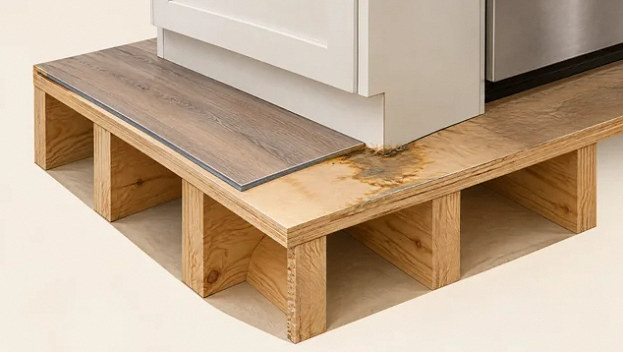
Water Under Vinyl, Tile, and Cabinets
A homeowner's guide to questions about concealed floor layers, cabinet areas, access, and the handoff from drying to repairs.
Read the guide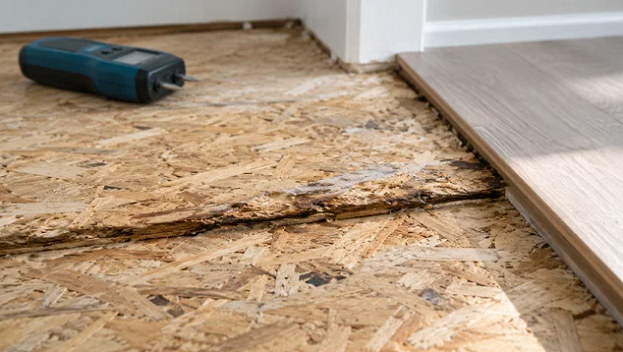
Materials and repairs · 3 min read
Wet Plywood, OSB, and Subfloors: Repair or Replace?
Separate moisture, surface swelling, structural condition, and flooring requirements when reviewing a water-damaged subfloor.
Read the guide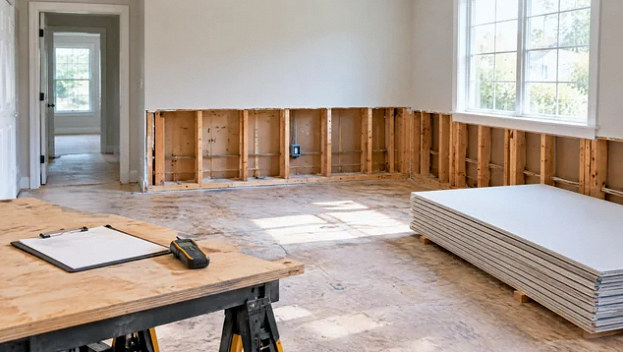
Materials and repairs · 5 min read
Before Rebuilding: How to Review the Drying Handoff
Ask for final material readings, remaining limitations, source-repair records, and a clear handoff before new finishes cover the work.
Read the guide