
Video & LED walls · Practical guide
Washed-Out Projection: Evaluate the Room Before Replacing the Projector
Compare ambient light, screen geometry, content and viewing positions before choosing a projector, screen or direct-view display.
YKCA Journal · 6 min read · Updated October 3, 2026
Start here
A brightness specification alone cannot establish a usable image in the actual room.
Observe the room when the problem happens
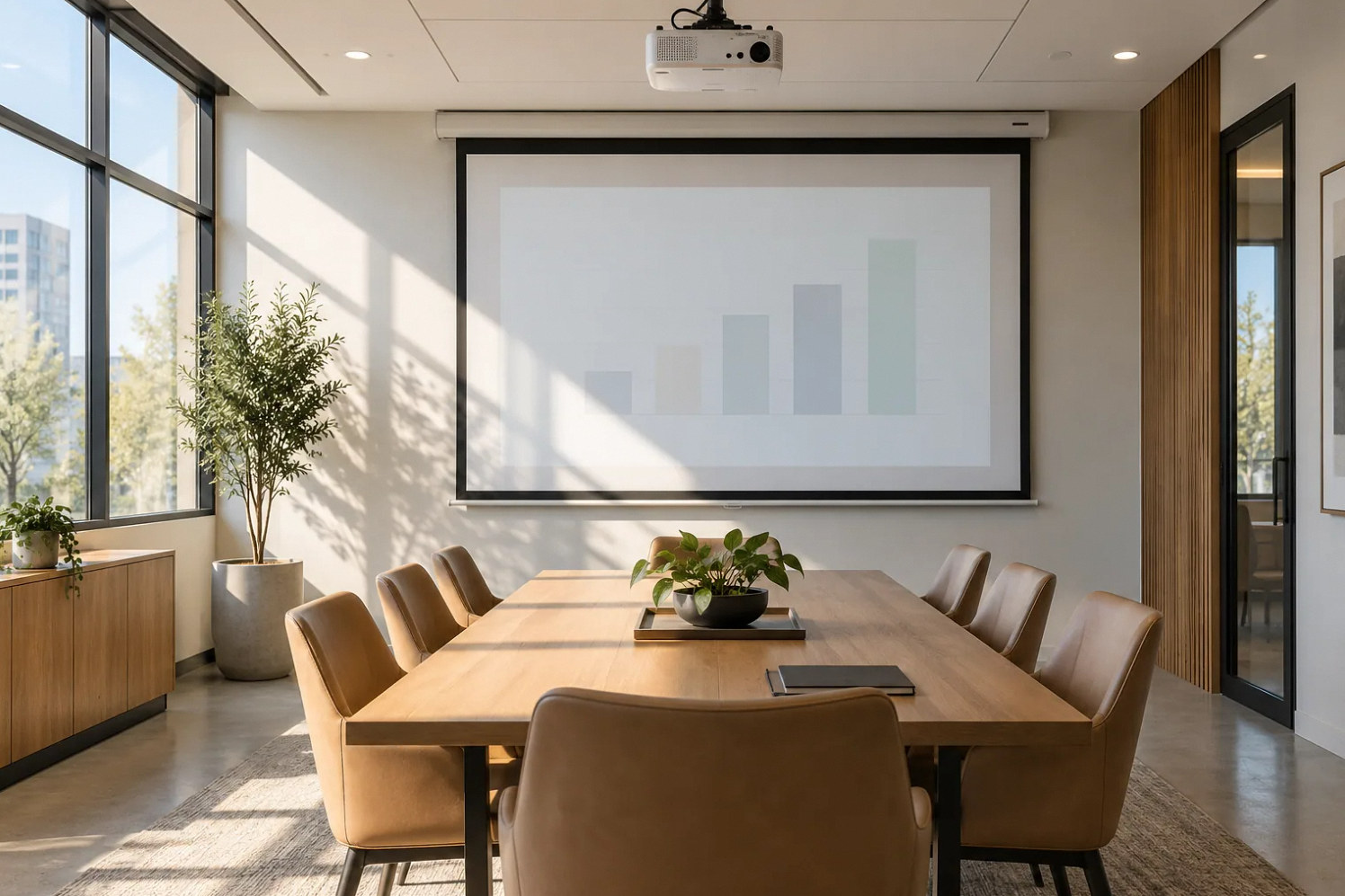
A projector demonstration after sunset may miss the reason people requested an upgrade. Visit during the difficult operating period and record the image size, window conditions, room-light settings and seating arrangement. Show representative content, including small text and dark image detail, rather than only saturated promotional video. Identify which lights people need for notes, movement and facial visibility. The owner’s first decision is which room conditions the new system must actually accommodate.
Distinguish brightness from contrast
Brightness helps make the projected image visible, but contrast concerns the difference between its light and dark regions. Epson’s guidance describes that distinction. A published projector contrast figure should not be treated as a measurement of the finished room. Da-Lite’s screen guidance adds viewing angle, gain and throw compatibility to the selection process. An ambient-light-rejecting screen directs different incident light differently; its performance depends on the geometry, rather than a promise to ignore all room light. Ask the designer to explain how the chosen screen and projector work together at the actual seating positions, including side seats and elevated rows.
Ask the designer to specify a target using AVIXA's Image System Contrast Ratio standard, V201.01:2021, for the kind of content people must interpret. Its scope includes different display technologies, so it supports a room-level comparison rather than a projector-only sales number. The acceptance record should identify the applicable viewing requirement and the method used to measure achieved system contrast under the agreed lighting conditions. A higher lumen specification cannot be directly substituted for that result.
Reference: Da-Lite: Projection Screen Academy, Ambient Light Rejection · Epson: Projector Guide, Contrast Ratio · AVIXA V201.01:2021 Image System Contrast Ratio
- Room light
- Image content
- Viewing geometry
- Demonstration
Map the practical alternatives
Possible changes include controlling selected ambient light, adjusting image dimensions, using a compatible screen, changing projection equipment or considering a direct-view display. Each choice affects operation. Closing every shade may conflict with the room’s intended use. Shrinking the image may help one problem while making text harder to read. A screen with different directional behavior may improve the center while disappointing side seats. A direct-view option changes mounting, access and infrastructure requirements. Ask for a comparison tied to the required content and room layout. Do not allow an equipment-only quote to conceal a major change to how occupants must use the space.
Reference: Da-Lite: Projection Screen Academy, Ambient Light Rejection · Epson: Projector Guide, Contrast Ratio
Run a daytime comparison
Suppose a training room needs readable worksheets while participants take notes with the lights on. A demonstration compares the existing setup with an appropriate screen sample and an alternate display arrangement during the troublesome daylight period. The test uses the same worksheet, the same image size where feasible and the same viewing positions. Observers record which content they can actually read rather than assigning a vague “looks brighter” score. If the preferred option requires different lighting settings, those settings become part of the scope and acceptance record.
Have the evaluator measure the ambient light reaching the screen, with the projector off, at the time of day associated with the complaint. Record that condition separately from the image-system contrast measurement. Then test the same small text and dark detail with the proposed configuration. Before replacing the system, also inspect maintenance condition, the selected image mode, and any lamp or filter service required by the particular projector. Record whether the existing picture deteriorated over time or has always failed under those room conditions; those histories lead to different next steps.
Reference: AVIXA V201.01:2021 Image System Contrast Ratio · Epson: Projector Guide, Contrast Ratio
Include installation and service constraints
A larger or different display must fit more than the visible wall. Review mounting support, access for maintenance, cable routes, power, heat and the permitted work window with the appropriate professionals. For projection, confirm lens and throw suitability using the selected equipment documentation. For an LED wall or large display assembly, include the necessary service approach and the owner’s expected content and camera use. Preserve sightlines and room functions in the review. Those considerations should be resolved before purchasing hardware, because a compelling image demonstration does not answer whether the proposed system can be safely installed and practically maintained in that location.
Accept the agreed room experience
The acceptance test should repeat the original difficult conditions as closely as practical. Use the approved lighting scene, representative daylight, intended content and marked seats. Record any environmental conditions that could not be reproduced and the follow-up needed. Have staff recall the normal room mode and restore it after a different event. Keep the selected display settings and lighting dependencies in the handoff. If the system performs well only under a restricted condition, state that condition clearly. The owner needs a reliable operating envelope, not an assumption that every future presenter and every possible daylight condition will produce the same result.
A commercial video display installation comparison should include operating assumptions next to each option. Write down whether shades must be closed, particular light rows must dim, the image must be smaller or certain seats fall outside the accepted view. Ask the owner to review those conditions with the people who schedule the room. A technically good picture may still be operationally unacceptable if every daytime event requires a complicated reset. Conversely, a simple, agreed lighting scene may solve a real use case without changing the whole display technology. Preserve a photograph of the demonstrated room arrangement and the test content, clearly labeled as evaluation evidence rather than an advertised example of finished client work.
Compare the next steps
A decision table for this problem
| Option | Potential benefit | Question to settle |
|---|---|---|
| Control screen-area light | Reduce unwanted illumination | Can occupants still use the room? |
| Change screen material | Improve suitable viewing geometry | Do side and elevated seats pass? |
| Change projector or lens | Match required image and throw | What is verified in the actual room? |
| Reduce image size | Concentrate projected output | Can the farthest viewer read content? |
| Use direct-view display | Different response to room conditions | Do access and infrastructure fit? |
Use this in the room
Your working checklist
Common questions
Is an ALR screen always the best upgrade?
No. Its suitability depends on projector geometry, unwanted-light directions and viewing positions. Test the proposed material in the relevant conditions.
Can a higher lumen rating guarantee success?
It cannot establish the complete room result alone. Image size, screen behavior, ambient light and the required content all matter.
Should we compare prices before a demonstration?
Budget constraints help narrow options, but compare complete scopes. An equipment price without the required mounting, access and room changes can be misleading.
Read the original guidance
Sources and discussion context
Research used primary documents and, where full text was unavailable, indexed excerpts from official sources. A citation does not mean the complete document was accessible. Product behavior depends on the actual model, configuration and documentation. Confirm the requirements for your venue before changing the installation.
- Da-Lite: Projection Screen Academy, Ambient Light Rejection↗
- Epson: Projector Guide, Contrast Ratio↗
- AVIXA V201.01:2021 Image System Contrast Ratio↗
Reader problems behind this guide
These Reddit discussions helped identify the practical question. They are individual experiences, not technical authority or a measure of how common the problem is. Examples and diagrams illustrate planning decisions; they are not records of completed YKCA projects or installation drawings.
- Need some projector recommendations.
A windowed sanctuary remained washed out with lights on despite projector adjustments and a replacement lamp.
Research access: search excerpt only.
Keep the whole system in view
