
Commercial & fleet charging · 6 min read
EV make-ready work: separate installed chargers from utility energization
Plan site design, utility capacity, property permissions, construction, inspections and activation as separate milestones for commercial charging.
YKCA Journal · Sources reviewed October 3, 2026
Explore the guide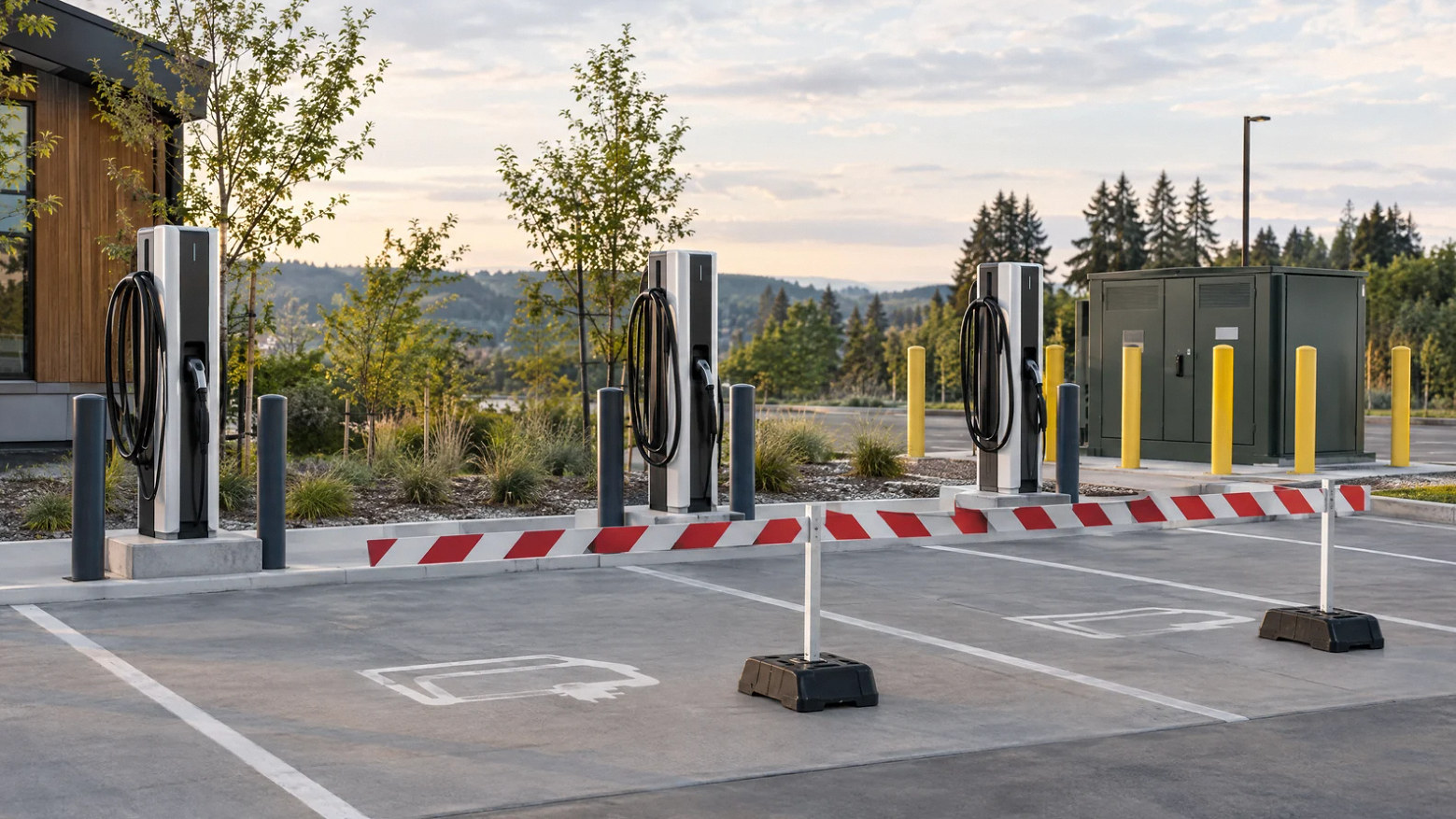
Commercial & fleet charging: browse all five guides ↗
The key decision
A charger standing in a parking lot is not an operating charging site. Confirm the utility and customer work, inspections and energization dependencies before tying vehicle delivery to an opening date.
Use operating readiness as the completion target
Commercial charging has several completion milestones. Equipment can be delivered, mounted and inspected while utility work or account activation remains open. Set the target as a commissioned site that supports the intended vehicles, not simply chargers installed. The project schedule should show how customer work and utility work converge at that result.
This matters when vehicle delivery or a business opening depends on charging. A missed activation date can leave purchased vehicles without the planned depot service. Identify that risk early enough to consider a phased deployment or another verified operating arrangement. Do not assume a construction crew can accelerate utility design or inspections simply because the customer equipment is ready.
Establish the scope before applying for service
Prepare a defined location, vehicle or user requirement, charger configuration, site plan and electrical load information. Include the first phase and a credible expansion plan, clearly distinguished. Ask the utility what information is required for the application and confirm who supplies it. Repeated changes to equipment or load can change the design and invalidate earlier schedule assumptions.
The utility needs to assess available capacity and the proposed connection, while the electrical design must assess customer-side infrastructure and existing loads. A nearby transformer does not establish available capacity for the project. A general hosting map is not a site-specific service commitment. Keep the application and design decisions documented so vendors, the landlord and the construction team are working from the same load and location.
Draw the line between utility and customer work
Make-ready is a useful planning term, but it does not tell you exactly who owns every component. Identify the agreed utility-side and customer-side boundaries for the actual project. The work may include service equipment, meter arrangements, pathways, trenching, distribution and chargers. Different programs and sites can divide those responsibilities differently.
PG&E’s fleet process distinguishes to-the-meter and behind-the-meter tasks, followed by activation and charger commissioning. Its roadmap also identifies land rights, permits and inspections as dependencies. Use that structure to build a responsibility list rather than copy a program-specific scope into an unrelated installation. Confirm who designs, constructs, inspects and maintains each part of your proposed arrangement.
Source: PG&E EV Fleet Electrification Process · PG&E Commercial Project Resources · PG&E EV Customer Roadmap
Property permissions can govern the route
A charging design may require access through common areas, a new equipment location, excavation or work affecting neighboring occupants. Obtain the landlord’s or site owner’s support for the defined scope, including access and outage requirements. If land rights or other property agreements are needed, identify the responsible party and milestone. A verbal agreement to install chargers may not cover the final utility route.
Coordinate the electrical layout with parking, accessible circulation, drainage, protection and site restoration. The relevant design professionals and enforcing agency determine applicable requirements for the actual site. Do not assume the only permit work is the charger circuit. The project team needs a complete picture of the site tasks that must be resolved before construction can proceed.
Illustrative scenario: the parking lot looks finished
Imagine a commercial site where chargers and protective posts are installed, and the owner expects immediate use. The customer electrical work is complete, but a utility equipment item and an inspection dependency remain outstanding. The visible site gives the impression of completion while the operating service is not available. A milestone schedule would have made those remaining tasks visible earlier.
The owner now tracks the required utility work, inspection release, service activation and commissioning as separate items with named owners. Vehicle deployment follows the verified operating stage rather than the appearance of the parking lot. This is an illustrative scenario, not a report about a particular utility job or a prediction of delay. Its lesson is that visible construction and electrical availability are different kinds of evidence.
Quote the interfaces and assumptions explicitly
The construction proposal should identify which work depends on approved utility design, which equipment is customer supplied and what inspections or site preparation must precede utility construction. Include excavation assumptions, restoration boundaries, access restrictions and any unresolved conditions. If the final service design is pending, state which parts of the price and schedule remain preliminary.
Ask for a schedule showing document preparation, design decisions, equipment procurement, customer construction, utility construction, inspections, activation and commissioning. Published program timelines can provide context, but they are not a promise for your site. PG&E describes its own fleet process as involving several stages and variable customer readiness. Use the job-specific status and responsible utility contact when setting business milestones.
Source: PG&E EV Fleet Electrification Process · PG&E Commercial Project Resources · PG&E EV Customer Roadmap
Distinguish delay causes before changing the plan
When progress stops, identify the exact open dependency: missing application documents, design revision, property agreement, equipment delivery, construction readiness, inspection or activation. A general statement that the utility is slow may hide work the customer can complete. Conversely, a contractor’s faster onsite schedule cannot resolve unavailable utility equipment. The remedy depends on the specific open task.
Maintain a short register with the dependency, owner, required evidence and next decision date. Use it at coordination meetings rather than repeatedly asking whether the project is almost done. If a phased installation is proposed, verify its independent supply and approvals instead of treating it as an informal workaround. Temporary charging or temporary service needs its own suitable design and authorized scope.
For each open item, keep the latest drawing revision, requested action and acknowledgment from the responsible party together. Do not leave an obsolete equipment schedule attached to an active application while a contractor is bidding from a newer one. A short document-control list is particularly useful when the owner, charger supplier, property manager and utility each maintain separate files. It lets the next coordination meeting resolve a specific mismatch rather than repeat a broad schedule discussion.
Commission the charging service after energization
Service activation is necessary, but it is not the last operational check. Verify the installed equipment with the intended vehicle types, the approved power-management configuration and any required authentication or payment system. Check communications, fault reporting and the operator’s administrative access. Record the actual configuration and any limitations at handover.
Bring the site plan, utility application status, equipment selections and operating deadline to YKCA’s commercial and fleet charging service. Ask for the customer electrical scope and its interfaces with utility work to be written clearly. The result should support an honest readiness report: designed, built, inspected, energized or commissioned. Those distinctions let the owner coordinate vehicle delivery and business operations with the stage that is actually verified.
Put it into practice
A decision table to keep handy
| Milestone | What it proves | What it does not prove |
|---|---|---|
| Utility design confirmed | Defined service approach | Construction or activation complete |
| Customer work installed | Onsite infrastructure built | Utility power available |
| Applicable inspections complete | Required inspection tasks satisfied | Equipment commissioned |
| Energized and commissioned | Verified charging operation | Unlimited future expansion |
Bring this to the conversation
Your next-step checklist
Common questions
Can installed chargers be unavailable for use?
Yes. Utility construction, inspections, service activation or commissioning may remain open after equipment is mounted.
Does a nearby transformer prove the project has capacity?
No. The utility must assess the proposed connection and available capacity for the actual load.
Can we use a published utility timeline as our opening date?
Use it as context only. The site-specific design, readiness, equipment and approval dependencies govern the project schedule.
The questions behind this guide
Problems people are trying to solve.
These public discussions illustrate reader concerns. They are not technical instructions, local survey results or evidence of work performed by YKCA.
- Utility companies' hookup time for charging stations is a disaster
Drivers observe installed but inactive sites and discuss utility equipment and inspection delays; selection focuses on visible installation versus actual readiness.
Check the original guidance
Sources & review date
Primary guidance and available source excerpts reviewed October 3, 2026. Requirements and program terms can change; verify the current instructions for your property and project before committing to work.
Continue with the next decision
Related guides
Ready to discuss work at your property?
Discuss this service with YKCA ↗