
Commercial & fleet charging · 6 min read
HOA EV charging: decide who owns the wiring and pays the operating costs
Compare assigned-space and shared charging while defining electrical boundaries, billing records, maintenance and future resident access.
YKCA Journal · Sources reviewed October 3, 2026
Explore the guide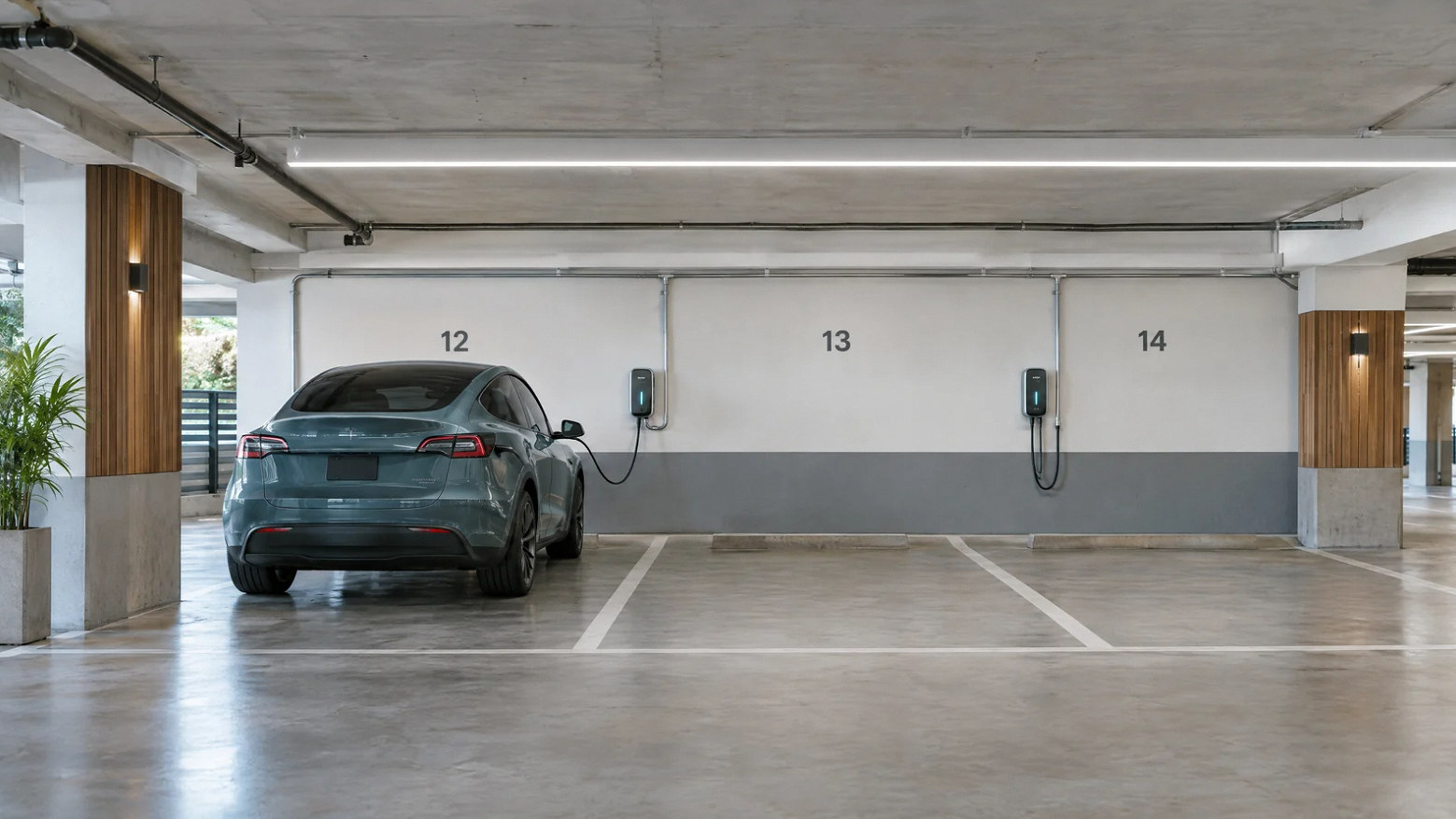
Commercial & fleet charging: browse all five guides ↗
The key decision
Choose the ownership and cost-allocation model before wiring the garage. A charger purchase alone does not decide who pays for electricity, shared infrastructure, software or future repairs.
Begin with a system the association can administer
An HOA charging project needs both an electrical design and an operating agreement. Before selecting chargers, decide who owns the infrastructure, who receives the utility bill and how users contribute to ongoing costs. The equipment’s payment feature cannot make those policy decisions for the association. A technically functioning garage can still create disputes if residents do not understand what the charging price covers.
Compare the long-term model, not just the first resident’s installation. Will charging occur in assigned spaces, at shared spaces, or through a combination? How will a new resident gain access? What happens when a unit changes owners or a charger fails? Bring parking rights and association documents into the planning meeting and have appropriate advisers review legal and governance questions for the actual property.
Draw the ownership boundary from supply to vehicle
Identify the electrical source and who owns each part of the path: building distribution, feeders, garage pathways, branch circuits, chargers and communications. A resident-owned charger connected through common infrastructure still depends on equipment the association controls. Conversely, an association-owned station may have operations performed by a third-party network. The agreement should make these boundaries understandable.
The Department of Energy’s multifamily guidance identifies ownership, metering and payment as planning considerations. Use those categories to ask practical questions rather than assume one national model suits the property. Include permission to access equipment, authority to schedule outages and responsibility for restoring disturbed finishes. Where the association plans shared pathways, decide how their capacity will be allocated and how later users contribute.
Source: DOE AFDC: EV Charging for Multifamily Housing · DOE AFDC: Procurement and Installation for EV Charging Infrastructure · DOE AFDC: Operation and Maintenance for EV Charging Infrastructure
Separate electricity from the other costs
The energy bill is only part of a charging program. Administration, network service, transaction costs, maintenance and replacement may also need funding. Decide which costs are recovered through user charges and which are treated as shared infrastructure expenditure. Residents should be able to understand the approved method without reading the vendor’s software contract.
A session total from a charger and a utility bill may measure different boundaries or periods. Account for the chosen metering arrangement and explain how discrepancies are handled. Have the billing model reviewed for the actual equipment, applicable requirements and association policy. Do not promise that a dashboard automatically constitutes an acceptable revenue meter or that a flat fee fairly fits every use pattern. Those are project-specific decisions requiring the relevant records.
Make the vendor demonstrate administration
Before choosing networked equipment, request a demonstration of user enrollment, session records, payment reporting and account permissions. Ask how billing questions are investigated and whether records can be exported. Identify what the association retains if it changes management companies or charging operators. Hardware ownership and software access should both be addressed in the handover.
Ask about behavior during network outages, the process for restoring service and the cost of changing providers. An open communications protocol can help interoperability, but the actual hardware and backend migration still need review. Require the vendor to describe the supported arrangement rather than rely on a generic OCPP claim. Keep resident personal information limited to what the operating process actually requires and assign responsibility for its administration.
Include repairs and future connections in the quote
The electrical proposal should identify the power source, route, capacity assumptions, load-management equipment, charger locations and any site-restoration work. Separately define the network agreement and maintenance arrangement. Ask who pays for damaged cables, failed equipment and replacement after warranty coverage ends. A product warranty alone does not establish who responds to a resident’s failed session.
For expansion, request a drawing showing proposed future connections and the limits of the first phase. Decide how access and contribution are handled for later residents before reserving all available capacity to early adopters. The first construction scope may include pathways without immediately installing every charger, but the design must state what has actually been prepared. Installed conduit is not the same as a complete available charging service.
Provide one clear resident explanation
At launch, residents need a concise explanation of access, pricing basis, parking rules and support. Name the contact for billing questions and the contact for equipment faults. Explain any charging limitations in terms people can use, such as shared power or time reservations. Avoid implying that every connected vehicle receives the maximum station output or that shared charging guarantees a full battery by morning.
YKCA’s commercial charging service can assess the electrical side of a garage project and coordinate the defined equipment scope. Bring the parking plan, association priorities, existing electrical information and the proposed ownership model. The association and its advisers retain policy and governance decisions. Aligning those decisions with the electrical design creates a project that can be maintained and expanded without reopening basic responsibility questions every time another resident buys an EV.
Put it into practice
A decision table to keep handy
| Decision | Assigned-space model | Shared-port model |
|---|---|---|
| Daily access | Resident’s usual parking position | Turnover and access policy |
| Electrical planning | Distributed pathways and allocation | Concentrated equipment and shared load |
| Cost recovery | Defined resident and common costs | User records plus shared program costs |
| Expansion | New connections within design limits | Additional ports or changed operating rules |
Bring this to the conversation
Your next-step checklist
Common questions
Is the utility energy rate the complete charging cost?
Not necessarily. The approved model may also address network fees, maintenance, administration and replacement. Make those categories explicit.
Can each resident simply install a charger?
The property’s electrical capacity, pathways, permissions and governing requirements need coordinated review before separate installations are assumed feasible.
Does OCPP guarantee we can change vendors without work?
It supports an open communications approach, but actual equipment support, configuration, contracts and migration need verification.
The questions behind this guide
Problems people are trying to solve.
These public discussions illustrate reader concerns. They are not technical instructions, local survey results or evidence of work performed by YKCA.
- HOA charging too much for L2 Chargers
Condo resident questions a shared charging price increase and opaque operating costs; demonstrates need for explicit allocation and billing rules.
Check the original guidance
Sources & review date
Primary guidance and available source excerpts reviewed October 3, 2026. Requirements and program terms can change; verify the current instructions for your property and project before committing to work.
Continue with the next decision
Related guides
Ready to discuss work at your property?
Discuss this service with YKCA ↗