
Reconstruction · 6 min read
When Replacement Flooring or Cabinets Do Not Match
Compare flooring and cabinet replacements using product records, samples, repair boundaries, and California matching guidance.
YKCA · References checked 2026-10-03
Start with the essentials
Three decisions to document
At a glance
Three things to keep in view.
Identify
Record product and material details.
Compare
Review samples and repair boundaries.
Agree
Document the selected scope before ordering.
The key point
Document the original product, the proposed substitute, and the repair boundaries before agreeing to a flooring or cabinet match.
Only the sink cabinet is visibly damaged, but the available replacement has a different door profile. Across the room, a proposed floor patch is a noticeably different shade. The useful question is how to restore a coherent damaged area using an evidenced repair method. Neither replacing everything automatically nor accepting the first available patch resolves that question.
Related service: Reconstruction questions and planning
Identify exactly what you are trying to match
For flooring, gather the manufacturer, product line, plank dimensions, thickness, finish, installation method, and any leftover pieces or packaging. For cabinets, photograph door profiles, hinges, finish, box construction, and labels. Take both room-wide photographs and detailed images. A single close-up can hide a mismatch that is obvious from the doorway.
Separate product identification from availability. The original product may have a familiar name but a changed profile or finish. Ask the supplier or fabricator to state which element is unavailable and what alternatives exist. Keep those responses with the sample photographs. An unsupported statement that “nothing matches anymore” does not explain the repair boundary.
A useful comparison sheet can contain three photographs: the original retained surface, the proposed sample placed beside it, and the view across the intended transition. Add the product identification and the date the supplier confirmed availability. If the product is discontinued, distinguish a supplier search still in progress from a confirmed lack of a suitable option. Ask whether an apparent color difference arises from a different product, aging, or a finish treatment that could be evaluated separately. This does not commit you to a repair attempt. It defines which question the trial or specialist inspection needs to answer before a larger replacement scope is selected.
Distinguish repair feasibility from appearance
A cabinet face may be repairable while its damaged box needs replacement. A floor patch may be technically installable but visually inconsistent. Ask the proposed contractor to describe both issues separately. The approach should account for access, adjacent surfaces, and components that need temporary removal, such as countertops or appliances.
For the illustrative sink cabinet, ask whether the retained doors can be used on a new box and what risks arise during removal. For flooring, ask where a transition would land and whether the proposed joint is appropriate for that system. A remote article cannot confirm salvageability, structural condition, or a matching result; those require inspection and a realistic trial.
Use California matching guidance carefully
The California Department of Insurance's 2026 guide reproduces the replacement-cost rule addressing a reasonably uniform appearance in the damaged area when replacement items differ in quality, color, or size. This is a specific standard to discuss with the adjuster, not an automatic entitlement to remodel every connected room.
Send the product information, sample comparison, and proposed repair boundary, then ask for a written explanation of the insurer's position. If the dispute concerns what counts as the damaged area or how the policy applies, obtain qualified claim or legal advice. A contractor can document installation and appearance constraints without promising a particular coverage outcome.
Sources for this section
California Department of Insurance: 2026 Property Claims Guide
Compare samples under ordinary conditions
Ask for physical samples when practical. View them next to the retained material in the room's normal daylight and evening lighting. Compare sheen, texture, pattern, and edge profile as well as color. Mark where each photograph was taken. Phone-camera processing and a tiny online sample can conceal differences that appear across a larger surface.
For custom finishing, agree on a test location or sample panel before the full run is treated. Record whether the sample represents the final application method. Do not accept a verbal assurance that paint will blend without discussing the actual surface boundaries. A sample review reduces surprises, although it cannot guarantee how an entire aged surface will respond.
Price coherent alternatives
Ask for a small number of clearly described options. One might retain cabinet fronts and replace the damaged box; another might replace a defined cabinet run. Flooring options might involve a local repair with an appropriate transition or replacement through a documented boundary. Each option needs quantities, access work, and finish work.
Separate necessary restoration from a preferred upgrade. If you want a new layout, wider planks, or premium hardware, request that cost separately. The comparison becomes more useful when both owner and adjuster can see what is required to address the damage and what reflects personal preference. Avoid treating the most expensive option as proof that the alternatives cannot work.
Record approval before materials are ordered
The contract should identify the selected product, color, finish, layout, and agreed boundaries. Attach the accepted sample description or photographs where useful. Specify who approves substitutions if the material is unavailable at ordering. California CSLB guidance emphasizes detailed product descriptions and written change orders when the scope or price changes.
Check the lead time and return conditions before authorizing custom fabrication. An insurer reviewing a matching question and a supplier requiring a nonreturnable order create separate decisions. Obtain enough clarity to understand the owner's financial commitment if coverage remains unresolved. Do not let a threatened delivery delay turn an uncertain substitution into an undocumented acceptance.
Sources for this section
Inspect the transition as a whole
At completion, view the repaired area from the usual entrance and at the positions where the original problem was documented. Review the actual transition, door alignment, trim, and adjacent finish, rather than only the center of the replacement surface. Compare the result with the agreed sample and written scope.
If there is a difference, describe it precisely and photograph it under repeatable lighting. “The replacement doors have a different profile” is more actionable than “the kitchen looks wrong.” Ask the contractor for a proposed correction and identify whether an insurer needs further evidence. Preserve product labels and leftover samples until the matching question is resolved; they can prevent another cycle of uncertain product identification.
Common questions
Does mismatched flooring mean insurance must replace the whole house?
No automatic conclusion follows. California replacement-cost rules address reasonably uniform appearance in the damaged area. Product availability, repair feasibility, the affected area, and the policy must be considered with the adjuster.
Sources for this section
California Department of Insurance: 2026 Property Claims Guide
What evidence is useful for a cabinet matching question?
Keep labels, door and box details, room-wide photographs, physical sample comparisons, supplier availability statements, and the contractor’s proposed repair method. Identify the exact difference and where the replacement would stop.
Sources and further reading
References checked 2026-10-03. Guidance depends on the loss, affected materials, scope of work and property conditions.
The homeowner question behind this guide
These public discussions informed the questions addressed here. Personal experiences and comments are not technical findings or proof of insurance coverage.
Discuss the next step for your property.
Share what happened, which areas are affected and the decisions you need help with.
Discuss reconstructionRelated decisions
Materials and repairs · 5 min read
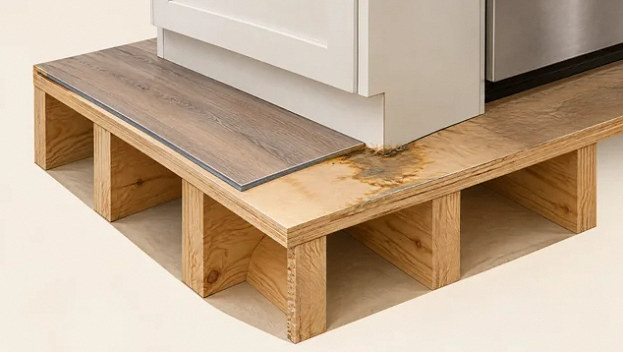
Water Under Vinyl, Tile, and Cabinets
A homeowner's guide to questions about concealed floor layers, cabinet areas, access, and the handoff from drying to repairs.
Read the guide
Materials and repairs · 5 min read
Hardwood Floor Cupping After Water Damage
What to ask before sanding or replacing a wet wood floor, including moisture through the boards, the subfloor, and repair options.
Read the guide