Retail Build-Outs · 8 min read
Retail Renovation Phasing: Protect Operations and Opening Day
Compare retail renovation phases, temporary closure and move-in timing while planning customer routes, dust control, vendor deliveries and opening readiness.
YKCA Journal · Sources reviewed October 3, 2026
Read the guide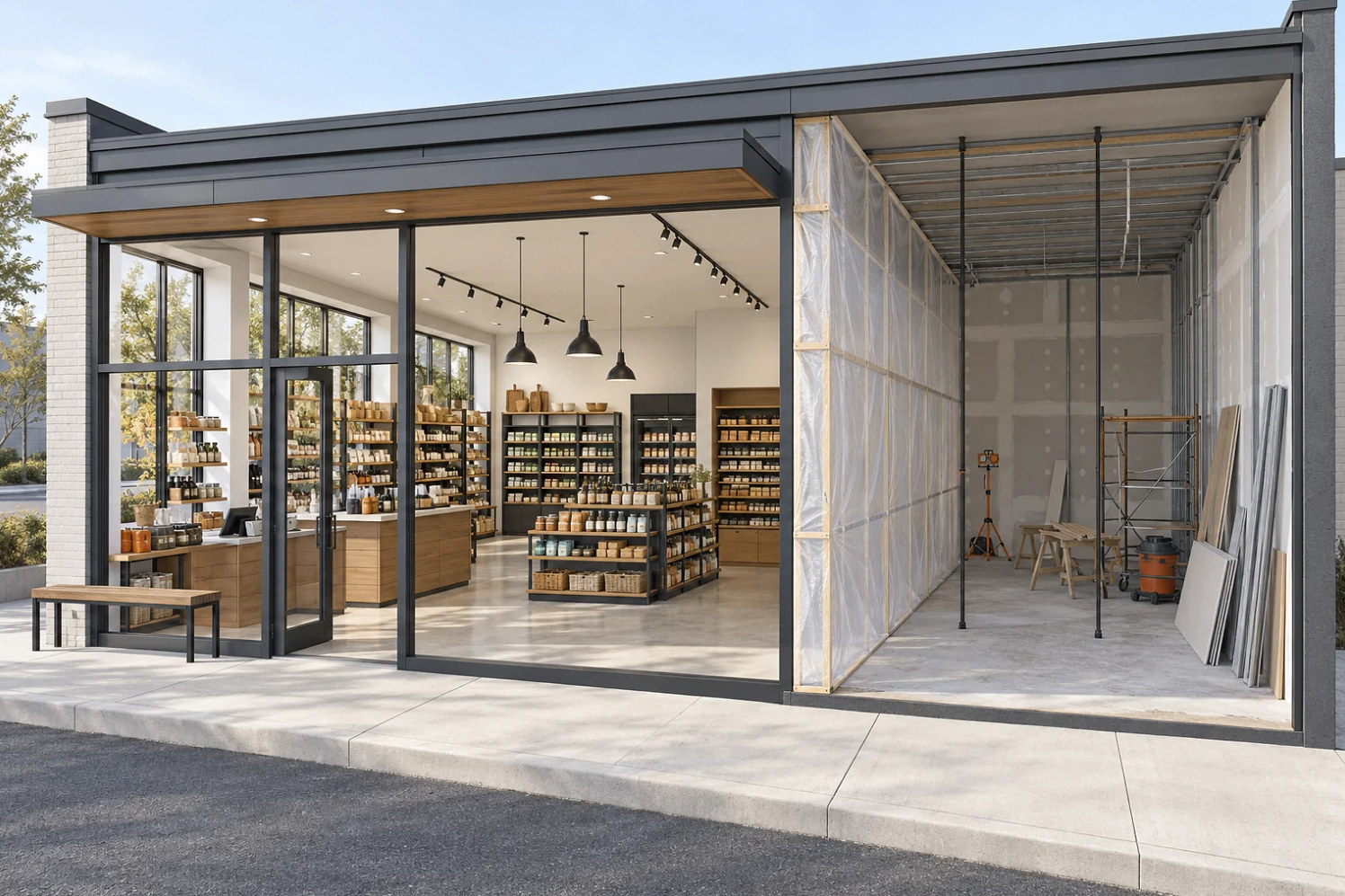
The key decision
Schedule retail construction around the movement of stock, fixture resets and the return of working checkout and security systems. A seasonal reopening needs a stocked, usable store and the required approvals, not only finished surfaces.
Define what must be sellable on the first trading day
Start with the store manager’s opening assortment: the products that must be available when customers return. Identify which departments need demonstrations, fitting, secure displays, special packaging or collection space. A smaller first phase may be commercially workable if it offers a coherent assortment and a functioning transaction process. It is less useful if customers can browse but cannot collect orders, return purchases or reach the products advertised for reopening.
For a seasonal business, record the useful selling window as well as the target construction date. Ask which merchandise loses value if it arrives after the promotion and which stock can wait. Use the owner’s actual buying commitments, not a generic holiday timetable. Then choose whether the work supports one reopening or several department releases. That operating decision gives the construction team a reason for the sequence and prevents a finished but empty sales area from being counted as a successful opening.
Give every stock move a destination and a record
Before work begins, count or otherwise reconcile the merchandise affected by the phase using the retailer’s normal inventory process. Assign each group a destination: retained sales area, protected back-room storage, approved off-site storage or return to the supplier. Keep goods being held for customers identifiable. Ask the manager how online availability will be handled while items are boxed or inaccessible, so staff do not promise collection from a construction area.
Label containers by department and destination, and name the person who releases stock back to the floor. Separate construction deliveries from merchandise receiving appointments. A pallet arriving at the wrong time can consume the only space available for fixture assembly or tempt staff to stack cartons in a protected route. California workplace exit rules require required exits to remain unobstructed. Include receiving and unpacking on the phase drawing so the plan works during stock movement, not just after the cartons have disappeared.
Sources: California DIR: Title 8 Section 3225, Maintenance and Access to Exits
Sequence fixtures, product placement and price labeling
Ask the merchandising team for a planogram, meaning a diagram of where products belong on the fixtures, or a simpler equivalent for a small store. Match fixture identifiers to the contractor’s phase plan. Confirm when each wall system, gondola or showcase is installed and ready for loading. Product-specific loading, stability and installation requirements come from the supplier and responsible designer. Staff should not begin filling a display merely because it has been moved into position.
Allow separate time for fixture acceptance, shelf placement, merchandise loading, price labels and customer-facing signs. If staff are moving the same goods repeatedly between phases, show that labor explicitly when comparing the options. A concentrated closure may be easier to operate than several incomplete department moves. The comparison belongs to this store’s sales and staffing plan. Do not assume continued trading is automatically preferable when the remaining assortment is confusing or when each phase forces the manager to rebuild the same displays.
Treat checkout and security relocation as a coordinated transition
List the point-of-sale, or POS, equipment needed to trade: payment terminal, scanner, receipt or label printer, network connection and the relevant inventory functions. Add the security devices affected by the layout, such as display protection, cameras or alarm contacts. Name the authorized vendor for each system and agree how temporary positions will be reviewed. A contractor can finish a counter while the store still cannot take payments or reconcile stock.
Schedule vendor checks before announcing that the department is operational. Use approved training or test procedures without unintended customer charges. Have the manager check scanning, receipt handling, returns and inventory updates appropriate to the business. The security vendor should confirm the accepted arrangement after fixtures move; staff should not assume the former coverage still suits a different display layout. Keep payment records and credentials out of construction documents. If a system fails its agreed check, identify which operation must wait and who can authorize recovery.
Coordinate fire protection and the construction boundary
Any planned interruption to sprinklers or fire alarms needs advance coordination with the property team, qualified fire-system contractor and local fire authority. An impairment means a system or part of it cannot perform its intended protective function. South San Francisco’s operational-permit guidance requires notification when systems become impaired and says a fire watch or other mitigation may be required. Ask the actual authority to establish notifications, protective measures and restoration verification for this work; a fire watch is not a universal substitute for an operating system.
Also identify any hot work, such as welding that can create ignition sources, so the responsible contractor and fire authority can determine applicable controls and permissions. Include stock and packaging in that discussion. Keep the public route and construction separation under the designer’s review as phases change. An accessible sales arrangement must remain usable with the intended counter and merchandise in place. A manager’s desire to retain one more rack cannot override the reviewed boundary, required exits or the conditions set for occupied work.
Sources: City of South San Francisco: Ongoing Management Requirements Applicable to Operational Permits · California DIR: Title 8 Section 3225, Maintenance and Access to Exits · U.S. Department of Justice: ADA Update, A Primer for Small Business
Protect merchandise from work inside and outside the unit
Ask the contractor to identify dust-producing or odor-producing work and the proposed containment, cleaning and handover conditions. Coordinate shared ventilation and corridors with the property representative, including construction by neighboring tenants. EPA’s school renovation guidance discusses source control and construction cleanup as general occupied-building practices; it is not a retail permit standard. The actual store needs its own appropriate plan. Closed doors alone do not establish that merchandise or occupied areas are protected.
Use the merchandise characteristics to plan handling: porous packaging, exposed fabrics, fragile finishes and products needing special storage may call for different arrangements. Let the owner and product supplier define any product-specific requirements. Agree how potentially affected goods will be isolated and assessed before being offered for sale. Do not leave that decision to a cleaning crew that has no product information. Schedule the cleaning check before restocking, and leave a clear route for the installer returning to adjust a fixture without reopening the whole receiving operation.
Sources: U.S. EPA: Renovation and Repair, Indoor Air Quality Design Tools for Schools
Use a seasonal launch decision before the advertising commitment
Before confirming a reopening promotion, review the remaining path to a stocked store with the contractor and manager. Confirm fixture deliveries, approved use of the premises, system testing, receiving staff and the time needed to merchandise. A missing feature may be deferrable only if the reduced operating arrangement is suitable and appropriately reviewed. The project team should distinguish that decision from simply covering unfinished work and opening around it.
For example, a fictional gift shop may have completed flooring while the display cases for its advertised collection are delayed. The owner can consider a later launch or a reviewed opening assortment that does not depend on those cases. The supplier’s delivery promise is not proof the stock will be ready. Check installation, secure storage, labels and staff preparation as separate tasks. Record who can revise customer communications and supplier appointments if the plan changes. No generic buffer guarantees a seasonal launch; the decision should follow the remaining dependencies.
Rehearse the stocked store before public reopening
Walk the finished merchandising arrangement as a customer and as an employee. Follow the route from entrance to a product, checkout and collection point. Check the intended return process and a normal restocking run. Review the required approvals and remaining restrictions with the project team; operational rehearsal does not replace inspections. Where lighting-control acceptance testing applies, arrange the required technician and documentation separately from visual adjustment of the displays.
Give the manager a concise release list covering each department, its accepted layout, usable systems and unresolved work. Assign return visits around the real stock and trading schedule so an installer does not arrive to find a newly filled showcase blocking access. Keep construction completion, merchandising completion and authorization for public use distinguishable in that list. Reopening becomes a decision supported by the actual store, with goods, staff and technology ready to work together, rather than the automatic event after the final contractor vehicle leaves.
Sources: California Energy Commission: Acceptance Test Technician Certification Provider
Compare the choices
A decision table for this project
| Retail transition | Manager and project team coordinate | Release evidence |
|---|---|---|
| Move stock | Count, label, destination and online availability | Inventory record and usable receiving route |
| Load fixtures | Installation acceptance and product placement plan | Supplier/design requirements resolved |
| Restore checkout and security | Vendor attendance and authorized system tests | Manager and vendor acceptance |
| Launch seasonal offer | Stock, labeling, approvals and staff readiness | Documented decision before advertising |
Prepare for the next step
Your project checklist
Common questions
Can a store remain open during a remodel?
Sometimes, when each phase supports an appropriate operating arrangement with required access, exits, utilities and separation. Compare that documented plan with a closure and include the cost of repeated setup, cleaning and reduced capacity.
When should inventory arrive for a new store?
Tie delivery to secure storage and construction readiness, not simply a target opening date. Coordinate fixture installation, dust-producing work and system verification first, then agree on staged receiving with the manager and vendors.
Behind this guide
Sources & review date
Sources reviewed October 3, 2026. Confirm current requirements with the agencies and design professionals responsible for your project.
Official guidance5 references
- California DIR: Title 8 Section 3225, Maintenance and Access to Exits
- U.S. Department of Justice: ADA Update, A Primer for Small Business
- City of South San Francisco: Ongoing Management Requirements Applicable to Operational Permits
- U.S. EPA: Renovation and Repair, Indoor Air Quality Design Tools for Schools
- California Energy Commission: Acceptance Test Technician Certification Provider
The questions behind this guide2 discussions
These Reddit discussions helped identify the concerns addressed here. They are individual experiences, not verified cost benchmarks or evidence of local demand. Technical guidance comes from the sources above.
- Almost open!!! Retail
Retailer nearing opening asks about POS ease, reliability and inventory; visible comments discuss inventory synchronization. Product claims and prices are not adopted. Access: post and relevant visible comments opened; not a claim that all collapsed replies were read.
- fixtures?
Indexed discussion distinguishes fixture delivery from initial merchandise delivery in seasonal-store setup. Employer-specific accounts, not a general schedule. Access: indexed search extract; direct open returned Internal Error; full thread not verified.
Apply it to your property
Plan your next step.
Retail Build-Outs
Bring your site information, equipment list and unresolved questions to the project conversation.
Continue with the next decision