Restaurant Build-Outs · 8 min read
Restaurant Opening Delays: Build an Approval-Based Schedule
Build a restaurant opening sequence around health inspections, hood and fire-system verification, grease review, working equipment and operating authorization.
YKCA Journal · Sources reviewed October 3, 2026
Read the guide
The key decision
Schedule the checks that release a working kitchen: food-facility inspections, hood and fire-system verification, grease requirements and operating authorization. A finished dining room does not establish readiness to serve.
Start with the kitchen release conditions
The date that a construction crew removes its tools is a poor substitute for a restaurant opening decision. The kitchen must have its accepted equipment in place, necessary utilities available, required inspections completed and the appropriate authorization to operate. The operator also needs a workable receiving, storage, preparation and cleaning routine. A dining room can be ready for photographs while an unfinished dishwashing connection still prevents the intended service.
Start an opening register with one row for each outstanding condition. Name the authority or vendor that can confirm it, the evidence required, the person arranging the visit and the work that must happen first. Keep health, building, fire and sewer questions separate even when one project coordinator manages them. This avoids the misleading status of final inspection booked when several different finals may be involved. Ask each reviewer which dependencies apply to this address and scope; the example below is a planning framework, not a guaranteed local inspection order.
Use a real health-inspection framework
Santa Clara County publishes three food-facility construction visits: preliminary for framing and plumbing, pre-final for finishes, and final after construction is complete with equipment operational. Its instructions say to discuss any food on site with the plan-review inspector during pre-final. They also identify remaining plan-review fees and operating-permit application and payment steps. These are county-specific gates, not a promise that passing one visit completes every approval.
Use that framework to ask useful scheduling questions before work starts. What must remain exposed at the preliminary visit? Which finishes need to be complete at pre-final? Does the final require a particular vendor demonstration or report? Who requests a correction inspection if one is needed? Keep the answers with the approved drawings. In another county, obtain that county's process rather than copying the names or number of Santa Clara visits. Booking a visit before the work is ready can consume a calendar slot without advancing the restaurant toward opening.
Sources: Santa Clara County: Submit plan review for restaurants and retail food storefronts
An illustrative sequence for a kitchen with a hood
Consider a planned restaurant with a ducted cooking line, dishwashing equipment and an existing grease interceptor proposed for reuse. First, resolve plan comments and secure the construction approvals required for the actual scope. Confirm the grease arrangement with the sewer authority while the plumbing design can still change. Next, coordinate health preliminary and applicable building or trade inspections before concealing work. Keep access to inspection points until the responsible inspectors release them; equipment delivery is not a reason to cover an unresolved connection.
Then complete the accepted food-area finishes and the health pre-final stage where required. Set and connect the specified equipment, arrange permanent utilities, and coordinate the ventilation and fire-protection specialists' verification. Ask the fire authority which inspection must follow those activities and whether other building finals are prerequisites. After correcting deficiencies, complete the required health final and obtain the relevant occupancy and operating authorizations. Some visits can overlap and some must be reordered. The coordinator should turn this example into an address-specific sequence agreed with the authorities, with each dependency visible.
Prepare a testable hood and cooking line
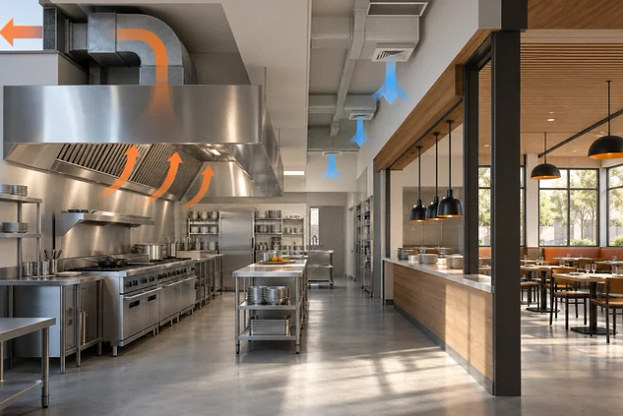
Before booking the hood-related visit, compare the installed cooking line with the accepted equipment drawing. A substituted appliance or moved cooking position needs review by the responsible designers and fire-protection contractor. Ask them which startup, air-balance and system-interface records are required and who supplies them. Santa Clara County lists hood air-balance testing among its plan-review resources. Assign the report as a deliverable instead of treating a fan that runs as a completed performance check.
Arrange a single coordination call among the hood supplier, mechanical installer, cooking-equipment vendor and fire-protection contractor. Establish which equipment and utilities must be ready, who attends a witnessed test and who can correct a problem. Ask the fire authority about the required acceptance of suppression, controls and applicable alarm interfaces. The operator should not conduct a discharge test or bypass controls to demonstrate the kitchen. Record any temporary limitation and keep affected operation on hold until the responsible professional and authority resolve it. This is a practical inspection-readiness conversation, not an owner-performed testing procedure.
Sources: Santa Clara County: Submit plan review for restaurants and retail food storefronts
Clear grease and sanitation questions before final
Grease-control review can involve a sewer or environmental-services authority outside the health department. San José's FOG program, for example, examines maintenance documentation and operating practices and can follow up on corrections. Its published FAQ says the FOG program itself has no permit or inspection fee. Ask the actual sewer authority which plan, device and operating records it needs; do not add an invented universal FOG permit to the opening schedule.
For the project register, distinguish accepted device design, completed installation where changed, and the operator's ongoing cleaning responsibility. Ask the plumber and property manager to resolve access to a shared interceptor and identify the service contractor. Separately, walk the food-area finish and equipment plan with the contractor: unsealed construction gaps, inaccessible cleaning areas or a substitute unit may need attention before the inspector arrives. Keep the vendor's product information and any accepted substitutions available. An invoice marked paid does not show that equipment matches the reviewed plan.
Sources: San José: Food Service Establishments and FOG Control
Time food deliveries and training to readiness
Give the operator a receiving plan tied to the approved opening process. Confirm when food can enter, where it can be stored and which refrigerators have been started and checked. Ask the health inspector how the facility should be presented for its final visit rather than following a forum suggestion to fill every cooler. A delivery booked to celebrate practical completion can become a storage problem if utilities, refrigeration startup or the operating process remain unresolved.
Split staff preparation into activities that can happen before the kitchen is released and activities that need a working, authorized food operation. Administrative orientation and ordering procedures have different dependencies from preparing food. Use the same distinction for supplier demonstrations and trial services. A soft opening is still a food-service event, so it needs the approvals applicable to that event. Keep perishable orders adjustable until the relevant gates are sufficiently certain. The owner should know who can postpone a shipment and what costs follow; the field crew should not inherit that business decision at the loading door.
Respond to a failed gate with specific actions
Suppose the kitchen reaches its planned inspection week, but the hood verification report is outstanding and the replacement dishwasher has not been accepted. A blanket message that construction is delayed hides two different problems. One needs a qualified specialist and completed system testing; the other needs model documentation and review. Give each issue its own owner, prerequisite and expected response, then identify which final visits depend on it.
Keep unrelated closeout work moving where access and approvals permit. Collect manuals, complete ordinary punch-list work and prepare staff procedures, but do not assume these activities release food service. Compare the actual cost of an approved equipment substitution with waiting for the original item, including design changes, installation and inspection availability. Update reservations, hiring and deliveries from the revised approval path. Avoid announcing a replacement opening date solely because a vendor promises to arrive tomorrow. The next dependable milestone may be acceptance of information rather than a completed site visit.
Retain a usable opening record
At the opening review, ask for the approval or inspection record behind each completed row. Record the accepted menu and equipment revision, unresolved restrictions, operating-permit status and the person who confirmed each authority's release. Separate cosmetic work allowed to remain from a condition that blocks operation. Preserve any legitimately approved temporary arrangement in writing with its limits; an informal conversation among trades is not an agency authorization.
Hand the operator an organized folder covering approved plans, final inspection records, equipment startup and maintenance information, hood-system records and grease-service responsibilities. Include contacts for unresolved vendor work. This folder is useful after the opening celebration: a future menu expansion, equipment failure or ownership change will raise many of the same questions. The restaurant can then explain what was accepted and what changed, instead of trying to reconstruct its kitchen from purchase receipts and the memory of its first week.
Compare the choices
A decision table for this project
| Illustrative gate | Readiness evidence | What it can hold up |
|---|---|---|
| Early plumbing and health review | Accepted grease approach and visible inspected work | Concealment and equipment placement |
| Food-area pre-final | Required finishes ready; inspector direction on food delivery | Final preparation and stocking |
| Hood and fire coordination | Required specialist reports, accepted appliance line and authority inspections | Cooking-system release and linked finals |
| Health final and operating release | Operational equipment, corrected findings and required authorizations | Public food service; a soft opening is not an exemption |
Prepare for the next step
Your project checklist
Common questions
Does passing the health final mean every opening approval is complete?
Keep health, building, fire and operating-permit records separate. Ask each relevant authority what remains for this project. A health visit does not automatically close another permit or replace the operator’s required authorization.
Should we schedule a soft opening before all required approvals?
No. A smaller event does not by itself remove approval requirements. Confirm what is authorized for the actual operation, then use a soft opening to test an already permitted and operationally ready service process.
Behind this guide
Sources & review date
Sources reviewed October 3, 2026. Confirm current requirements with the agencies and design professionals responsible for your project.
Official guidance2 references
The questions behind this guide2 discussions
These Reddit discussions helped identify the concerns addressed here. They are individual experiences, not verified cost benchmarks or evidence of local demand. Technical guidance comes from the sources above.
- Initial health inspection tips
Operator is preparing for health and fire-marshal visits before opening and is uncertain about last-minute readiness and refrigerator stocking. Article directs stocking decisions to the actual inspector instead of adopting contradictory replies. Access: Original post and visible comments opened in revision 1; not all collapsed replies verified.
- Struggling to get the health inspector
Poster helping a first-time operator reports an unresolved final health-inspection appointment while opening and income remain on hold. Supports named inspection dependencies; allegations about agency conduct and suggested shortcuts are not endorsed. Access: Official Reddit search-index text reviewed in revision 1; direct open failed; full thread not verified.
Apply it to your property
Plan your next step.
Restaurant Build-Outs
Bring your site information, equipment list and unresolved questions to the project conversation.
Continue with the next decision