
Emergency water extraction · 6 min read
Can a Shop Vacuum Handle Saturated Carpet Padding?
Assess electrical safety, water history, and carpet layers before deciding whether a wet/dry vacuum can address the job.
YKCA · References checked 2026-10-03
Start with the essentials
Three decisions to document
At a glance
Three things to keep in view.
Assess
Confirm safe access and water history.
Reach
Identify carpet layers and extraction limits.
Verify
Plan monitoring after accessible water is removed.
The key point
Tool size is only one part of the decision: assess the water history, carpet assembly, accessible liquid, and plan for the layers below.
A homeowner borrows a wet/dry vacuum after water reaches a carpeted room. The machine collects some water, but the carpet still compresses wetly underfoot and the owner starts shopping for a stronger motor. Before buying another tool, establish whether the job is safe, whether the source is controlled, and what layers actually hold the water.
Related service: Emergency water extraction questions and planning
Check safety before comparing equipment
Keep people out of an area where water may contact electrical equipment or where the source and conditions are uncertain. Do not enter standing water to reach a plug, switch, or breaker. Ask qualified help to establish safe access and power before using electrically powered removal equipment. Ordinary household vacuum cleaners are not a substitute for equipment designed for liquid pickup.
CDC's flooded-home guidance conditions electric water-removal equipment use on electrical safety and warns against operating tools while standing in water. A wet/dry label does not make the surrounding room safe. If the source involves sewage, storm flooding, suspected contamination, or a hidden hazard, the decision is not simply which vacuum has the strongest suction.
Sources for this section
Tell the assessor where the water came from
Record the discovery time, likely source, whether flow has stopped, and what the water crossed. If the start time is unknown, say so. A shallow edge of wet carpet after outside intrusion and a small recent clean-water spill have different assessment questions even when they look similar from above.
The Reddit discussion behind this article involved recurring basement intrusion and a borrowed vacuum with an unsuitable attachment. That is a useful example of equipment shopping distracting from the source. A stronger machine does not repair drainage or confirm the water is suitable for homeowner handling. Give the assessor the history rather than only the approximate wet area.
Identify the layers beneath the visible fibers
Ask whether the assembly contains pad, an attached cushion, a moisture-resistant backing, a slab, wood subfloor, or older flooring underneath. The visible carpet surface does not describe the full water reservoir. Doorways, edges, seams, tack strips, and adjacent walls may need assessment because the water can spread beyond the place you first noticed.
Do not pull up an entire carpet simply to discover its construction if doing so could disturb hazardous materials or create unsafe access. A restoration professional can propose an inspection method and explain its limits. Record what was actually inspected and what remains inferred. That difference matters when someone recommends retaining the assembly or removing part of it.
Ask what the proposed extraction method reaches
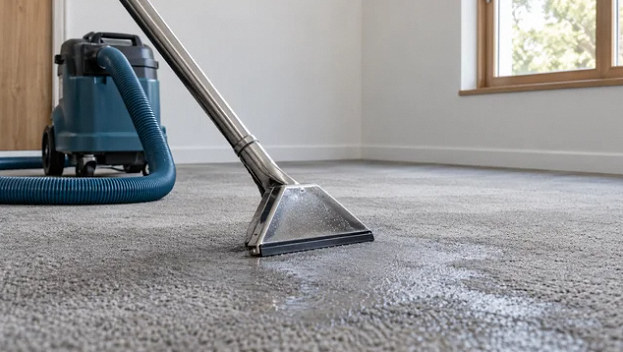
A useful equipment explanation connects the machine, attachment, and method with the material being treated. Ask what removable liquid is expected to be collected and how the operator assesses the result. Motor marketing, tank capacity, or a loud machine alone does not establish effective recovery from the pad and underlying assembly.
EPA's mold course discusses wet vacuuming and access to carpet, backing, and pad in its water-damage guidance. It does not provide a universal homeowner tool specification for every flooded carpet. Avoid copying forum instructions for filter removal or improvised attachments; follow the actual equipment manufacturer's directions and leave unsuitable or contaminated work to qualified professionals.
Sources for this section
Separate extraction from the drying decision
Once recoverable liquid is removed, the remaining moisture still needs a suitable drying plan. Ask how retained carpet layers and the substrate will be monitored, and what would trigger a revised approach. A vacuum tank that stops filling does not prove the whole assembly is dry, because moisture may remain where the tool cannot effectively reach it.
Likewise, installing a fan is not evidence that the lower layers are being assessed. Ask which surfaces are receiving airflow and which observations establish progress. The purpose is to understand the work, not to prescribe a drying layout from a photograph. A remote article cannot establish contamination, dryness, salvageability, or the correct equipment arrangement for your room.
Understand why pad and carpet decisions can differ
Ask the professional to evaluate the carpet, pad, and underlying surface separately. The recommendation may depend on exposure, condition, access, construction, and the feasibility of cleaning and drying. Retaining the carpet does not automatically mean retaining every layer below it, and recommending pad removal does not by itself explain a complete flooring replacement.
Request the reason for each material decision and photographs where safe. If the scope changes after an area is opened, have the new observation documented. Keep removed-material descriptions with the repair record so the eventual installer knows what must be restored. A clear layer-by-layer explanation is more useful than either a blanket salvage promise or a blanket demolition recommendation.
Define the service you are authorizing
Ask whether the proposed visit includes only water removal or also inspection, material decisions, cleaning, drying equipment, monitoring, and the eventual reconstruction handoff. Record what is excluded and what would require a separate approval. Equipment pickup and restoration completion are not necessarily the same date.
If comparing proposals, use the same rooms and source history. A low extraction-only price should not be compared directly with a scope including several days of monitoring and material work. Ask for an understandable description of the expected next decision. No general online price or arrival promise can establish the appropriate scope or availability for your specific property.
Use a stop point instead of endless vacuum passes
If liquid keeps returning, the carpet remains saturated, or a new wet boundary appears, stop treating repetition as a substitute for assessment. Tell the responding professional what changed and when. Continued inflow, trapped water, an unsuitable method, and moisture in a lower layer call for different responses.
For the illustrative room, the useful next step is an assessment of the pad and substrate with a source-control check, not automatically purchasing the largest shop vacuum. Keep a short record of the water removed, areas treated, and remaining observations. That helps a professional understand the work already attempted without assuming it resolved conditions the homeowner could not see.
Common questions
Does a larger shop vacuum guarantee dry carpet padding?
No. Electrical safety, water history, assembly construction, access, extraction method, and the remaining drying work all matter. Ask what the method reaches and how the lower layers will be assessed.
If the vacuum stops collecting water, is extraction complete?
It may have removed accessible liquid, but that does not prove every layer is dry or that the source has stopped. Ask for an assessment of retained materials and the next monitoring step.
Sources and further reading
References checked 2026-10-03. Guidance depends on the loss, affected materials, scope of work and property conditions.
The homeowner question behind this guide
These public discussions informed the questions addressed here. Personal experiences and comments are not technical findings or proof of insurance coverage.
Discuss the next step for your property.
Share what happened, which areas are affected and the decisions you need help with.
Discuss emergency water extractionRelated decisions
Drying and equipment · 3 min read
Why Water Extraction Comes Before Structural Drying
See what pumping, extraction, and drying each accomplish, and what to ask when standing water has disappeared.
Read the guide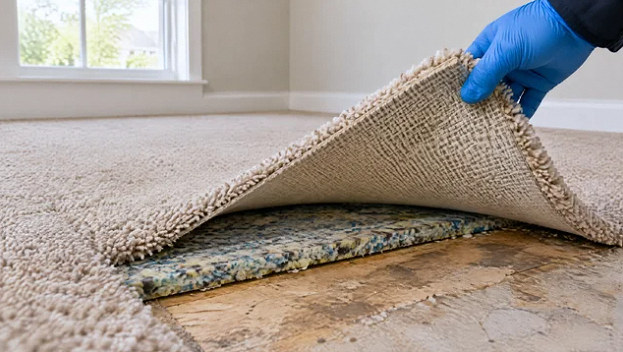
Materials and repairs · 5 min read
Wet Carpet and Padding: What Can Be Saved?
How to discuss carpet salvage after water damage, including the water source, padding, supporting floor, and repair expectations.
Read the guide