
Water damage restoration · 6 min read
A Plumber Referred a Restoration Company: Is the Demolition Necessary?
Evaluate a water damage referral by checking the leak history, moisture map and reason for each proposed opening before authorizing demolition.
YKCA · References checked 2026-10-03
Start with the essentials
A referral should lead to evidence
At a glance
Three things to keep in view.
Separate the jobs
Stopping a leak and assessing affected materials are different tasks.
Ask for evidence
Locate the readings and the materials behind each proposed opening.
Define the next step
Authorize a specific inspection or removal with a clear purpose.
The key point
A referral is a lead, not proof of damage. Ask the restoration assessor to show which material is affected, how that was confirmed and what opening it will accomplish.
A plumber fixes the leak, recommends a water damage restoration company, and the next person proposes opening walls, removing tile and running several days of equipment. The jump in scope can feel alarming. A plumbing repair may genuinely leave concealed moisture behind, but the referral itself does not establish what needs to be removed.
You need an explanation connecting the observed problem to each proposed action. That conversation can happen while necessary stabilization proceeds. It should not require you to become a restoration technician or accept a blanket warning that everything will become moldy unless you sign immediately.
Related service: Water damage restoration questions and planning
Separate source repair from damage assessment
Ask the plumber for a short record of the failed component, repair performed and verification used. A leaking supply fitting, an overflow gasket and a drain connection can send water through different routes. Discovery time also matters: write down what you actually observed rather than allowing an uncertain start time to become an assumed long-term leak in the estimate.
The restoration assessor has a different question to answer: where did water travel and what condition did it leave? A plumber may not have inspected insulation or flooring. Conversely, a restoration company may not be qualified or contracted to repair the source. Clarify both roles so a completed plumbing invoice is not mistaken for a complete assessment, or a drying proposal for a leak repair.
Have the assessor draw the proposed boundary
Request a simple room sketch with affected surfaces and measurement points. Ask to see the connection between the original leak, the visible damage and the proposed openings. The sketch should distinguish confirmed wet areas, suspected areas and places that could not be inspected. Those categories should not silently become one large demolition zone.
For each opening, ask what it will achieve: remove material that cannot be retained, access trapped moisture, inspect an unknown layer, or reach plumbing. These are different reasons with different limits. A targeted exploratory opening may answer a question; it is not permission to expand across the room without recording the new condition and explaining the next decision.
Sources for this section
Understand what the instrument does and does not show
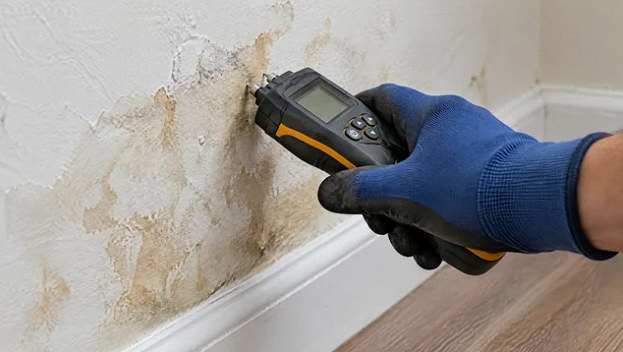
Ask the assessor to identify the meter, mode and scale. Some measurements are relative indications; others use a wood-calibrated scale on another material. A number presented as a percentage can be misunderstood if those details are missing. Protimeter also identifies metal behind surfaces as a possible influence on noninvasive readings. That limitation matters around corners, tile lath and hidden components.
Request a comparison on an appropriate unaffected area and confirmation where the initial reading is uncertain. This is not a reason to dismiss every high reading. It is a reason to avoid turning one unexplained display into proof that the entire assembly is saturated. Let the assessor choose a suitable confirmation method without drilling or probing hidden utilities yourself.
Sources for this section
Protimeter: Moisture meter scales, limitations and metal interference
Ask how material condition changes the options
The relevant choice is not always simply dry or demolish. A material may be structurally damaged, contaminated, inaccessible for cleaning, or still usable if it can be dried and verified. Ask which of those conditions applies to each item. Staining alone and a loss of physical integrity are not the same observation, and the explanation should distinguish them.
If mold or contamination is suspected, ask what was observed and how that affects the scope. EPA recommends experienced professional help when water damage involves sewage or other contaminated water. A general mold warning does not identify contamination at your property, while the absence of a visible patch does not establish that a concealed cavity is clean. Record the limits of the inspection.
Sources for this section
Compare assessments on the same facts
A second opinion is most useful when the second assessor has the original leak report, the same room access and the first measurement map. Ask them to state where they agree, where they disagree and what additional evidence would resolve the difference. Two totals with no scope comparison are difficult to interpret: one may include repairs or testing that the other leaves out.
Avoid asking only whether the first company is overcharging. Ask whether each proposed removal has an explained purpose and whether a narrower step would safely answer the unresolved question. If active water is still spreading, prioritize source control and necessary stabilization while obtaining the comparison. A second opinion should help define work, not create an unmanaged delay.
Put the agreed scope into words before cutting
The authorization should identify the affected rooms, planned openings, included monitoring and how additional work will be approved. Confirm what is excluded, especially replacing finishes, disconnecting plumbing, moving cabinets and handling suspect older materials. If an insurer is involved, share the evidence and ask how the proposed work will be evaluated. An adjuster's involvement does not replace your understanding of the agreement.
Keep photographs before and after each opening and retain the explanation when the scope changes. If the contractor will not explain the connection between findings and work, that is a meaningful reason to seek a clearer assessment. If the evidence supports more work than you expected, use it to plan the repair rather than relying on the original puddle's size as a damage limit.
Sources for this section
California Department of Insurance: Residential Property Claims Guide
Common questions
Does a referral mean the plumber gets a fee?
You cannot tell from the referral alone. Ask both businesses whether there is a financial relationship. Whatever the answer, evaluate the proposed work using documented conditions and written scope rather than treating the referral as either a guarantee or proof of wrongdoing.
Does a high meter reading prove that all the tile must go?
No single reading establishes the complete repair boundary. The instrument mode, material, comparison area and possible interference matter. Request confirmation of the affected assembly and an explanation of why the proposed removal is needed.
Sources for this section
Protimeter: Moisture meter scales, limitations and metal interference
Sources and further reading
References checked 2026-10-03. Guidance depends on the loss, affected materials, scope of work and property conditions.
The homeowner question behind this guide
These public discussions informed the questions addressed here. Personal experiences and comments are not technical findings or proof of insurance coverage.
Discuss the next step for your property.
Share what happened, which areas are affected and the decisions you need help with.
Discuss water damage restorationRelated decisions
First decisions · 4 min read
Hidden Moisture: What Meters and Thermal Cameras Can Tell You
Learn how to read a moisture report, distinguish instrument scales, and ask useful questions about concealed walls, floors, and ceilings.
Read the guide
Materials and repairs · 3 min read
Lead and Asbestos Before Water Damage Demolition
Why damaged older finishes may need assessment before cutting walls, lifting flooring, or sanding restoration areas.
Read the guide
Documentation · 3 min read
Before You Sign a Water Damage Work Authorization
Clarify the initial scope, payment responsibility, equipment charges, changes, and handoff before restoration work begins.
Read the guide