
Insurance documentation support · 6 min read
When a Restoration Claim Stops Moving: Document the Missing Decision
Identify the decision delaying your claim, organize the correspondence, and prepare a focused request or escalation.
YKCA · References checked 2026-10-03
Start with the essentials
Three decisions to document
At a glance
Three things to keep in view.
Identify
Name one missing decision.
Document
Create a dated evidence and response history.
Escalate
Send the concise issue to the responsible reviewer.
The key point
Turn a stalled claim into a dated record of requests, evidence, replies, and the specific decision still needed.
The contractor says it is waiting for the adjuster, the adjuster asks for a revised scope, and the homeowner receives no clear answer about what happens next. Repeated calls add frustration but little clarity. Start by identifying the missing decision and the exact document or inspection needed to make it.
Related service: Insurance documentation support questions and planning
Name the blocked decision
Write one sentence identifying what cannot proceed: approval of a newly exposed wall repair, clarification of temporary housing, explanation of a declined invoice line, or confirmation that documents were received. Avoid describing the problem only as “insurance is taking forever.” A precise issue can be assigned to the correct person.
Check whether the apparent delay belongs to the insurer, contractor, supplier, lender, or building department. These processes may run at the same time. If the builder is awaiting a material selection, another call to the adjuster will not solve it. A short dependency list separates claim handling from project scheduling and gives you a practical next action.
Before escalation, check the delivery route once. Confirm that you used the current adjuster address or portal, that attachments opened, and that the message did not exceed an upload limit. This does not excuse an unexplained delay, but it can expose a simple transmission problem. Keep proof of receipt where available and identify any re-sent document as a duplicate of the earlier submission. If a new adjuster takes over, provide the chronology and document index rather than starting the factual narrative from memory. Ask the new contact to identify the outstanding decision so the transfer does not silently reset the project discussion.
Build a short chronology from original records
List date reported, inspections, estimate versions, requests for information, your submissions, and responses. Link to the actual email, portal receipt, letter, or call note. Mark an unanswered request as unanswered; do not describe it as denied unless the insurer actually made that decision.
For calls, record who participated and summarize the facts and requested action. Send a courteous written recap when a verbal conversation materially changes the next step. Keep originals and later revisions. The chronology should be short enough that a new reviewer can understand the blockage without reading your entire text-message history or asking you to repeat the loss narrative.
Use California response rules without oversimplifying them
CDI's 2026 guide describes a general 15-calendar-day response requirement for claimant communications reasonably expecting a response, and a general 40-calendar-day accept-or-deny period after proof of claim, subject to the regulations' exceptions and extension provisions. These are not a universal promise that every repair will be funded within 40 days of the leak.
Ask which information remains necessary and why additional time is needed. If you raise a timing concern, connect it to the actual communication and receipt dates. Coverage disputes, investigation requirements, and procedural rules require the real file. This article cannot determine a violation from a few unanswered messages or substitute for advice on your particular rights.
Sources for this section
California Department of Insurance: 2026 Property Claims Guide
Send one organized request
Use the claim number and a specific subject identifying the unresolved issue. State the action requested, the date you previously supplied the evidence, and a short attachment index. Ask for confirmation of receipt and a written explanation of any remaining information needed. Make it easy to answer without reconstructing the entire project.
If you attach a revised estimate, highlight what changed. If the question is about a payment calculation, show your arithmetic and ask which input differs. Avoid accusatory language unsupported by the documents. A clear request preserves your position and gives a supervisor a usable record if ordinary follow-up does not resolve the issue.
Escalate to the appropriate contact
If the assigned adjuster cannot resolve the question or remains unavailable, ask for the supervisor or designated claim contact. Share the concise chronology and the unanswered request. Ask what the next review step is and who will provide the response. Document that answer without accepting a vague promise as a completed decision.
The California Department of Insurance provides consumer assistance and a complaint route for claim-handling concerns. A complaint should identify the insurer, issue, dates, and supporting correspondence. It is not a substitute for responding to valid information requests or meeting applicable deadlines. If policy interpretation or legal rights are disputed, seek appropriately qualified professional advice.
Sources for this section
California Department of Insurance: Residential Property Claims Guide (2025)
Keep the property and schedule from becoming secondary problems
Ask the contractor which protective measures and unaffected work can continue while a disputed item is reviewed. Keep opened assemblies, disconnected fixtures, and stored materials managed under a clear plan. Do not direct unsafe work or conceal evidence simply to demonstrate progress.
Update the temporary-housing and storage contacts if the project date changes, and ask the insurer about their treatment. Record the reason for each delay as accurately as possible. That record can support a focused discussion about consequences without claiming every additional cost is automatically payable. A stalled decision should have a containment plan as well as a correspondence trail.
Know what counts as resolution
Resolution might be a written explanation, a scheduled inspection, a corrected estimate, an identified missing document, or an explicit coverage decision. Record the result and the next action. A callback alone does not resolve the issue if no one can say what changed.
For the illustrative repair, success may mean the contractor resubmits one revised wall quantity with photographs and the adjuster identifies a review step. If the parties still disagree, the documented question is now specific enough for further help. Preserve the file and deadlines while seeking that help; do not assume a complaint or escalation automatically extends any contractual or legal time limit.
Keep deadlines stated in insurer letters in a separate calendar while the dispute continues. Ask for written clarification of ambiguous dates rather than assuming an unanswered email suspends a requirement elsewhere in the file.
Common questions
Does California require every water claim to finish within 40 days?
No. The general decision period is tied to receipt of proof of claim and is subject to regulatory exceptions and extension provisions. It is not a guaranteed construction or payment timeline for every loss.
Sources for this section
California Department of Insurance: 2026 Property Claims Guide
What should I include in a complaint about no response?
Provide a short dated chronology, the specific unanswered request, evidence of submissions, and relevant correspondence. Explain the decision you need and distinguish insurer handling from contractor or lender delays.
Sources and further reading
References checked 2026-10-03. Guidance depends on the loss, affected materials, scope of work and property conditions.
The homeowner question behind this guide
These public discussions informed the questions addressed here. Personal experiences and comments are not technical findings or proof of insurance coverage.
Discuss the next step for your property.
Share what happened, which areas are affected and the decisions you need help with.
Discuss insurance documentation supportRelated decisions
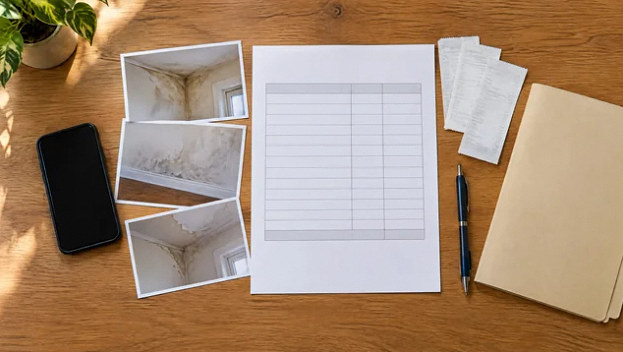
Documentation · 5 min read
Water Damage Estimates: Understand the Work and Keep Clear Records
Review emergency authorization, equipment charges, scope changes, and insurance documentation without assuming every cost is covered.
Read the guide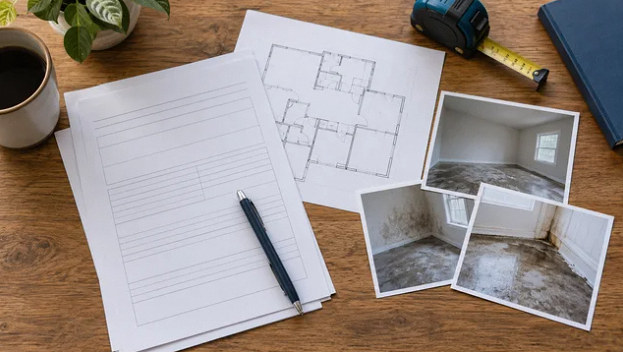
Documentation · 3 min read
Before You Sign a Water Damage Work Authorization
Clarify the initial scope, payment responsibility, equipment charges, changes, and handoff before restoration work begins.
Read the guide