Warehouses & Production Spaces · 8 min read
Warehouse Renovation While Operating: Plan Shutdowns and Restart
Plan warehouse construction around production, shared utilities, traffic and restart checks, with clear shutdown windows and responsibility boundaries.
YKCA Journal · Sources reviewed October 3, 2026
Read the guide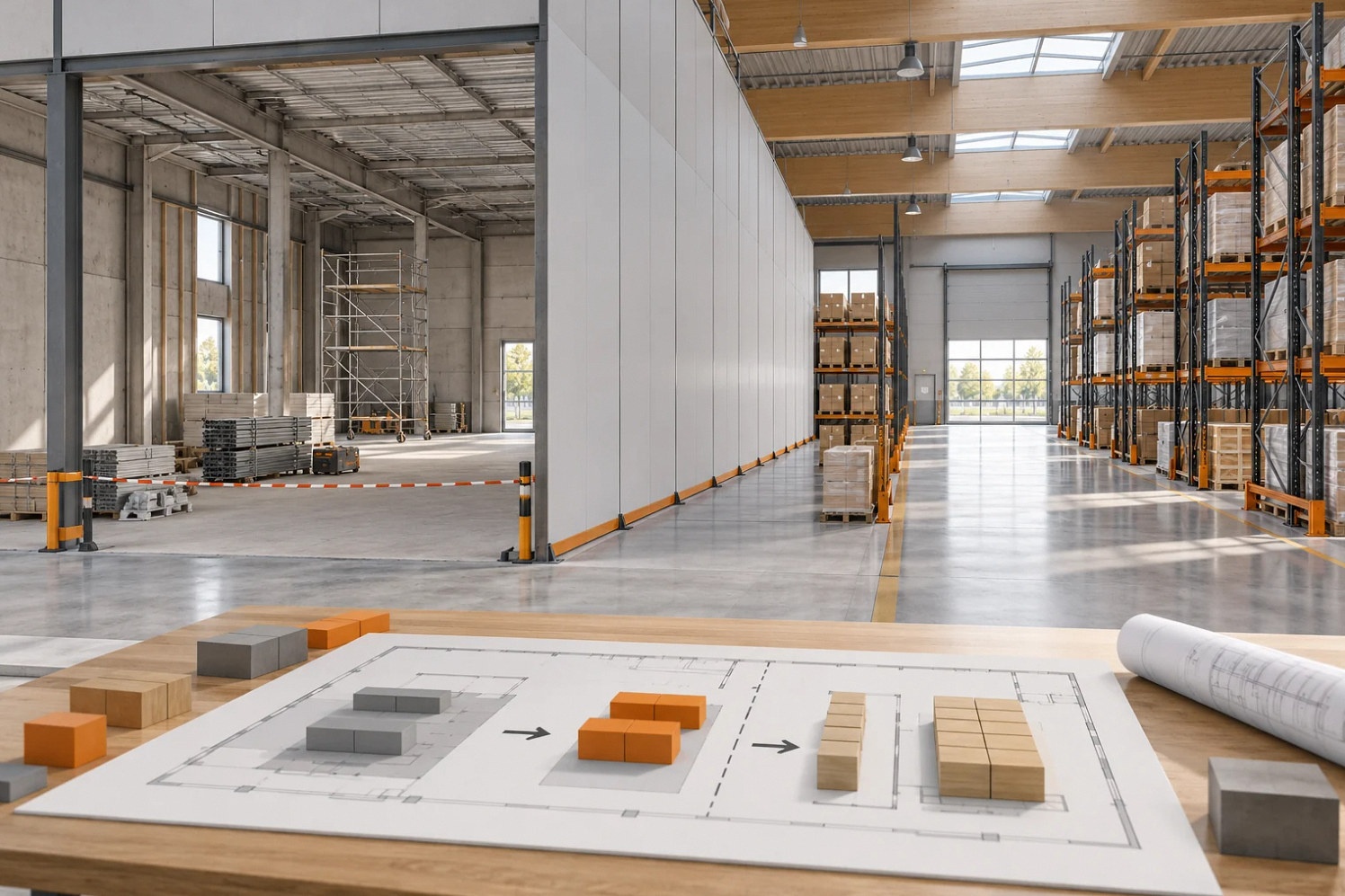
The key decision
Continued operation requires a defined work boundary and a tested interruption plan; the time needed to restart can matter as much as the time needed to install the improvement.
Start with the operation that cannot stop
Identify the activities the business must preserve during renovation: receiving, a production line, shipping, inventory access or a critical support process. Then identify the people, equipment and building systems each activity depends on. A project can leave the production machines untouched and still stop output by blocking material delivery or interrupting a shared support system. Build the phasing plan around those dependencies rather than dividing the floor into equal rectangles.
Ask the operator to define acceptable interruptions and the consequences of exceeding them. Distinguish a preferred weekend window from a hard business constraint. The contractor needs a realistic explanation of what must return by the agreed time. Compare partial operation, planned closure and temporary relocation of selected activities. Staying open can be useful, but it should remain a choice whose complete scope and risks are visible, not a promise made before the operation has been studied.
Map shared services and movement conflicts
Have qualified project personnel identify services crossing the proposed work boundary and determine how interruptions affect occupied areas. Include electrical supply, controls, data and process support where applicable. A line drawn between old and new work does not make those systems independent. Ask the operations team to identify informal arrangements, shared equipment and undocumented dependencies that may not appear on the available building drawings.
Also map lift-truck routes, pedestrians, receiving, waste removal and construction deliveries. OSHA's warehouse guidance highlights the importance of material-handling and vehicle hazards. The temporary arrangement should receive the same operational attention as the final layout. A route that works for one trade's cart may fail when a lift truck arrives with a full load. Assign approved staging and access areas rather than expecting workers and warehouse staff to negotiate space every morning.
Prepare an interruption package for each shutdown
Create a short package identifying the work, systems affected, authorized participants, planned duration, prerequisites and restart checks. Add the latest point at which the team can cancel or postpone without leaving the operation in an unusable condition. Confirm access, materials, equipment and vendor availability before the shutdown begins. A missing component discovered during a critical interruption can matter more than several days of ordinary construction delay.
Include the operator's affected staff in the pre-shutdown discussion. Explain which areas and functions will be unavailable and who communicates changes. If several contractors participate, establish a single coordination contact without blurring each party's technical responsibility. The plan should make dependencies clear: which installation must be accepted before another task starts, and which check must pass before the operator resumes production. Avoid using the general phrase all work complete as the only restart criterion.
Coordinate hazardous-energy responsibilities with the employer
For work involving existing machinery or hazardous energy, the employer and qualified contractors must coordinate the applicable energy-control arrangements. Cal/OSHA Section 3314 addresses written procedures, outside servicing personnel and continuity during personnel changes. This is a management and planning responsibility; it is not a reason for an unqualified owner to perform isolation or testing based on a checklist found online.
Name the people responsible for the safe work arrangements and for communication with affected employees. Include non-electrical energy and connected equipment in the qualified review where relevant. Do not schedule simultaneous activities solely because they are on opposite sides of a room; shared systems or interacting equipment can connect their hazards. If the proposed sequence changes, return to the responsible parties for review. A schedule revision must not silently invalidate the procedure under which the work was approved.
Sources: Cal/OSHA: Title 8 Section 3314, Control of Hazardous Energy
Resolve fire-protection interruptions before releasing the shutdown
A sprinkler or alarm interruption needs its own coordination before work starts. Have the responsible fire-protection contractor, facility representative and actual fire authority establish the affected area, required notifications, temporary precautions and conditions for restoring service. Southern Marin's official guidance illustrates that a fire official can require a fire watch when a life-safety system is out of service. It does not establish one universal watch duration or staffing rule for every warehouse.
Include any planned welding or other hot work in that discussion, particularly where storage or packaging remains nearby. Ask the responsible team which authorization, permits, protection measures and supervision apply to the exact work and location. Do not assume that a production shutdown makes hot work acceptable while fire protection is impaired. If required arrangements are unresolved, keep that work outside the released shutdown scope.
The interruption package should identify who confirms that affected fire-protection systems are restored, who receives that confirmation and what restrictions remain until then. Operations should not treat the end of the contractor's shift as permission to resume storage or production in an affected area. Carry these conditions into the restart meeting alongside equipment and process checks, so a completed mechanical connection cannot hide an unresolved building-safety limitation.
Sources: Southern Marin Fire Protection District: Fire Watch
Compare a single closure with repeated small phases
Small phases can preserve more daily activity but require repeated setup, barriers, mobilization and restoration. They may also leave temporary routes in use longer. A single planned closure can simplify access and reduce repeated interfaces, while concentrating the business interruption. Ask the contractor to price the actual sequence for both options when they are feasible. The operations team should evaluate the corresponding inventory, staffing and customer commitments.
For a hypothetical assembly business, replacing a shared support service in three weekends appears less disruptive than a longer closure. The review reveals that each weekend requires the same vendor restart and operational checks. One coordinated interruption may therefore reduce repetition and uncertainty. A different facility might benefit from truly independent phases. The example is a decision framework, not a promised schedule: the correct choice follows the actual systems and restart requirements of the operation.
Define restoration and restart before the work begins
List the conditions needed for the building work to be complete, then list the additional conditions for production. The contractor may finish its assigned installation while equipment startup, process verification or operator training remains outstanding. Have the vendors and operations team define their acceptance activities and expected participation. Reserve time to correct an issue found during testing rather than assuming the first restart will automatically be the final one.
Prepare a fallback decision before entering a critical interruption. Identify what can be restored, what would require additional work and who is authorized to decide. Do not promise a rollback that the installation sequence cannot support. When work reaches a point where restoration is no longer simple, that fact belongs in the shutdown briefing. A realistic contingency can be a delayed restart with an agreed business response; it does not always mean returning instantly to the original configuration.
Set the decision point for postponing a shutdown
A useful shutdown plan includes an explicit readiness review before the operation stops. Identify the materials, approved information, specialist attendance and access conditions that must be confirmed. If one is missing, the operator and project team should decide whether to postpone while the existing system is still available. Starting an interruption in the hope that a delivery or technician will arrive can turn a manageable delay into lost production.
Set this decision point early enough for the business to adjust staffing and customer commitments. Record who can authorize proceeding and what evidence they need. For complex work, distinguish prerequisites that are essential from minor items that can be completed later without affecting safety or restart. The purpose is a reasoned go-or-postpone decision based on the actual sequence, rather than pressure to begin merely because the shutdown date has been on the calendar for several weeks.
Use a daily interface meeting and a controlled handover
During active work, review the next shift's movements, affected services, protection arrangements and outstanding decisions with the operator. Keep the meeting brief and specific. Update the work boundary and access plan when activities change. Repeated informal exceptions, such as allowing a delivery through a closed zone, are signals that the plan needs review. Resolve the underlying conflict rather than allowing an exception to become the unnoticed standard arrangement.
At handover, record completed checks, remaining limitations and the final system information. Give the facility manager the drawings and contacts needed for future work. Review the first operating period with the responsible team to identify functional issues related to the improvement, without claiming that a construction walkthrough validates every production process. The project is ready for the intended operating stage when the relevant parties have accepted their responsibilities and the business understands any limits, not merely when the trades leave the floor.
Compare the choices
A decision table for this project
| Milestone | Required decision | Responsible participants |
|---|---|---|
| Before interruption | Are access, materials and people ready? | Contractor, operator and vendors |
| During work | Are boundaries and safe work arrangements maintained? | Assigned qualified parties |
| Before restart | Have installation and equipment checks passed? | Trades, vendors and operator |
| After release | What limitations or follow-up items remain? | Facility manager and project team |
Prepare for the next step
Your project checklist
Common questions
Can a weekend shutdown guarantee Monday production?
Only a project-specific plan can establish whether that target is realistic. Include installation, inspection where required, vendor startup, operational checks and time to address failures before making the commitment.
Is working around the running equipment always faster?
No. Access restrictions, protection and repeated restoration can extend the work. Compare a realistic occupied sequence with an intentional closure, including the business effects and safety requirements of each.
Behind this guide
Sources & review date
Sources reviewed October 3, 2026. Confirm current requirements with the agencies and design professionals responsible for your project.
Official guidance3 references
The questions behind this guide2 discussions
These Reddit discussions helped identify the concerns addressed here. They are individual experiences, not verified cost benchmarks or evidence of local demand. Technical guidance comes from the sources above.
- Anyone working on anything fun this shutdown?
Thread opened during research. Participants describe shutdowns with parts of the plant still operating and a repair blocked by shared isolation dependencies. Used as qualitative evidence of operational coordination friction; no technical advice adopted.
- What’s the most ridiculous cause of downtime you’ve ever seen?
Thread opened during research. Maintenance participants report undocumented control changes, poor handoff and postponed maintenance causing downtime. Anecdotes are unverified and do not establish engineering procedures or local prevalence.
Apply it to your property
Plan your next step.
Warehouses & Production Spaces
Bring your site information, equipment list and unresolved questions to the project conversation.
Continue with the next decision