
Home EV charging · 7 min read
Two EVs at home: specify power sharing before adding a second charger
Two charging stations can share an approved limit only through a supported design. Charger-to-charger sharing and whole-home load monitoring answer different capacity questions.
YKCA Journal · Sources reviewed October 3, 2026
Explore the guide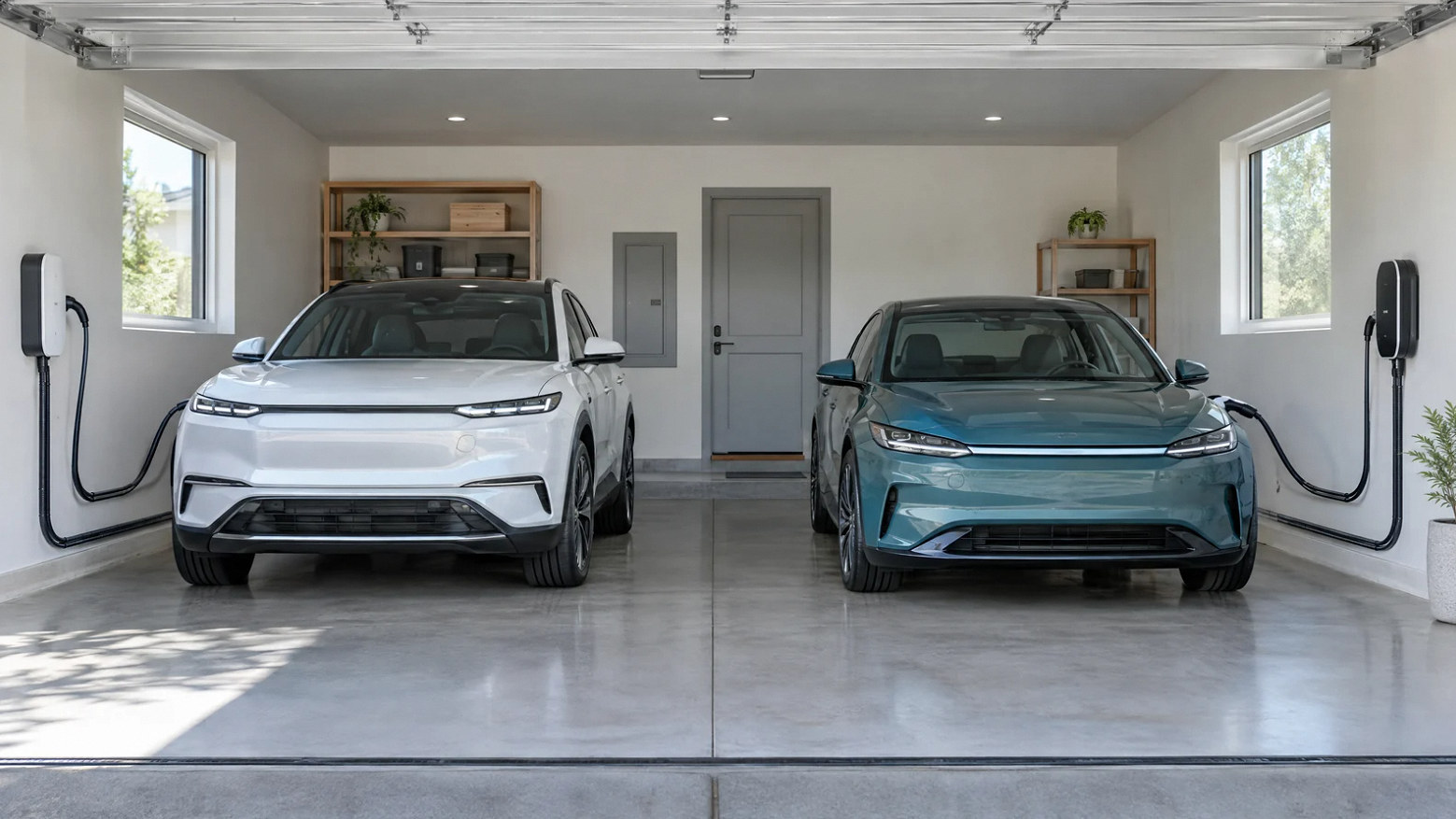
Home EV charging: browse all five guides ↗
The key decision
Two charging stations can share an approved limit only through a supported design. Charger-to-charger sharing and whole-home load monitoring answer different capacity questions.
A second station is a design change
Before adding a second home charger, ask what electrical limit both stations must respect and how the proposed equipment will enforce it. Two independent stations with similar app schedules are not necessarily a supported sharing system. A separate breaker for each station also does not establish that the upstream service or garage feeder can support both operating together.
Start with both vehicles, their parking positions and their departure times. The household may need simultaneous access more than maximum output at both connectors. One station used sequentially, a supported sharing arrangement or revised distribution can each solve a different practical problem. The best option is the one that meets the actual routine within a reviewed design. Do not purchase a second matching-looking charger and assume it will join the first.
Sharing between chargers is not whole-home monitoring
Group power sharing distributes a defined allowance among supported stations. Dynamic household-load management varies a charging allowance using measurements from the electrical supply. The first can limit a group of chargers without accounting for changing noncharging loads, unless the complete system explicitly provides that additional function. The design must address the real upstream constraint.
Tesla currently states that Gen 3 Wall Connectors can participate in Group Power Management, while its Dynamic Power Management is available for a single Wall Connector installation and cannot be used across multiple Wall Connectors. Its group feature also does not accept other charger brands. These product-specific restrictions show why the exact combination matters. A brochure containing both group and dynamic features is not evidence they can be combined in the arrangement you want.
Source: Tesla: Wall Connector Power Management · Department of Energy: Charging Electric Vehicles at Home
Identify every constrained part of the route
A home can have adequate service capacity and a limited garage feeder, or enough garage distribution space but an upstream capacity problem. Ask the contractor to map the path from the reviewed supply to both stations. A new garage subpanel provides distribution; it does not create additional upstream capacity. The assessment should state which limit the selected control protects.
Existing garage loads matter too. Include lighting, door openers, workshop equipment and any planned appliance that shares the garage supply. Their exact treatment belongs in the electrical design. Do not infer available capacity from how rarely a tool is used or from the sum of breaker labels. The homeowner can provide a use inventory and equipment information without opening electrical equipment or choosing conductor sizes.
Source: Tesla: Wall Connector Power Management · Department of Energy: Charging Electric Vehicles at Home
Write a two-car operating plan
Record which car arrives first, which leaves first and whether either driver has an unusually short charging window. Include normal cable reach, reversed parking and whether guests will use a station. If both cars stay parked overnight, a supported shared allocation may provide adequate access. If one vehicle needs energy soon after arriving, the household may need a supported priority method or a different arrangement.
Ask the installer how the selected system allocates power when both cars request charging and what happens when one car finishes. These behaviors depend on the product and configuration. Avoid a promise that every dual-station system automatically maximizes each vehicle’s charging rate. Vehicle acceptance, schedules and the shared limit still matter. The handover should describe the intended routine and any owner action needed.
For illustration, suppose the two cars need 12 kWh and 24 kWh respectively and are both available for a nine-hour window. Their combined 36 kWh requires an average of 4 kW delivered to the vehicles during that window, before allowing for charging losses. This does not specify a circuit or prove that a particular product can share power. It helps distinguish an energy-through-the-night requirement from an assumption that both cars must charge at maximum output simultaneously. A late arrival or early departure changes the calculation for that vehicle.
Compare equipment compatibility before features
Compatibility covers more than the vehicle connector. Ask whether the exact stations, controller, communications links and firmware arrangement are supported together. If the first station is an older generation, it may not participate in the sharing feature of a newer unit. A contractor should identify any replacement required instead of assuming a familiar product name guarantees compatibility.
Keep communications and physical-route scope visible. A detached garage, separated parking spaces or unreliable wireless coverage can affect the proposed arrangement. Do not add unsupported splitters or power strips to obtain two charging points. If a dual-output product is considered, have the installer assess that actual product and supply design. Its existence does not mean the current circuit is approved for reuse without review.
An illustrative two-driver scenario
Imagine two drivers who leave at different times. The first car returns in the afternoon and normally needs a modest top-up; the second returns late and leaves early. The existing charger is beside the first parking space. The household asks for a second connector because moving vehicles after dinner is inconvenient, not because both cars need maximum output all night.
The contractor compares one-station access, a supported group arrangement and any supply changes. The owner evaluates cable reach and the late-arriving vehicle’s window. A demonstrated shared session, followed by one vehicle completing, helps show whether the selected behavior matches expectations. This is an illustrative household scenario. Its lesson is that convenient access and a verified shared limit should be specified together.
Make both commissioning and future changes part of scope
The proposal should identify both stations, the shared allowance, the upstream assessment and the supported control arrangement. Include mounting, routing, any communications work, circuit changes, permits and commissioning. If the first station remains, state what is being verified rather than calling it automatically reusable. Ask whether the contractor demonstrates both stations charging together and documents the configuration.
Also specify what the owner may change in the app. A user schedule is different from the installed group limit. Record what happens if a station or communication link fails and whom to contact if one car repeatedly misses its target. When either vehicle or station is replaced, check that the new combination still fits the supported arrangement. Adding a third car is another design review, not an app-only expansion.
What to send with the assessment request
Send both vehicle models, current station model, normal parking photos from a safe position and any available garage-feeder records. Explain the departure-time problem and whether simultaneous charging is required. Separate a confirmed second EV from a possible future purchase so the contractor can present a current design and an optional preparation scope.
Use the EVEMS and Load Management service page to request a two-vehicle assessment. Ask specifically whether the recommendation addresses charger-group demand, household demand or both. A clear answer may reveal that an advertised feature cannot solve the supply constraint you have. That is useful before equipment purchase. The acceptance goal is a supported arrangement that both drivers can use, with documented limits and a handover that remains understandable after the first month.
Put it into practice
A decision table to keep handy
| Situation | Decision to resolve | Evidence to request |
|---|---|---|
| Two cars, one long overnight window | Compare sequential use and supported sharing | Arrival/departure routine |
| Limited garage feeder | Protect the actual upstream limit | Supply assessment and monitored boundary |
| Existing older or mixed-brand stations | Verify supported group compatibility | Exact model documentation |
| Need household monitoring plus group sharing | Check complete combined architecture | Manufacturer-supported arrangement |
Bring this to the conversation
Your next-step checklist
Common questions
Do two separate breakers mean both chargers can run at maximum?
No. Separate circuits do not establish the capacity of the upstream feeder or service. The complete design must account for both stations and other relevant loads.
Can two different brands share power?
Only if the selected system explicitly supports that combination. Matching connectors and Wi-Fi access are not proof of charger-to-charger compatibility.
Can I schedule one charger after the other instead?
Sequential use may meet the household routine, but the schedule must not substitute for the electrical assessment or any control arrangement required by the design.
The questions behind this guide
Problems people are trying to solve.
These public discussions illustrate reader concerns. They are not technical instructions, local survey results or evidence of work performed by YKCA.
- 2x EVs in One Garage Dilemma
A household with two EVs is told its detached-garage supply cannot support its former two-charger arrangement.
Check the original guidance
Sources & review date
Primary guidance and available source excerpts reviewed October 3, 2026. Requirements and program terms can change; verify the current instructions for your property and project before committing to work.
Continue with the next decision
Related guides
Ready to discuss work at your property?
Discuss this service with YKCA ↗