
Odor removal & duct cleaning · 5 min read
Thinking About Ozone for Smoke or Pet Odor? Review the Source First
Understand ozone limits, source-removal questions and the evidence to request before buying an odor treatment.
YKCA · References checked 2026-10-03
Start with the essentials
Decisions before approving work
At a glance
Three things to keep in view.
Find the source
Identify remaining materials and conditions before choosing a device.
Review the limits
Understand ozone hazards and reject occupied-home use.
Define the result
Require documented work and appropriate assessment, not a smell-only test.
The key point
Identify remaining materials and conditions before choosing a device.
A persistent odor makes a machine promising a one-day fix sound appealing. Online advice may suggest placing an ozone generator in the house, running the HVAC fan and returning when the smell seems gone. That is not an adequate safety or restoration plan. EPA warns that ozone can harm the lungs and may create harmful reaction products. This article explains how to assess an odor proposal without providing a homeowner ozone operating recipe.
Related service: Odor removal & duct cleaning questions and planning
Identify the original odor problem
Write down the known event and affected materials. A recent house fire, old tobacco exposure and pet-related contamination are different histories, even when each produces a stubborn smell. Note where the odor is strongest and whether cleaning, removal or replacement has already occurred. Keep treatment dates and product names if available.
Avoid diagnosing the source solely by the odor description. Ask an appropriate professional to inspect the actual materials and building conditions. If the smell could indicate an immediate gas, combustion or electrical hazard, leave the area and contact the appropriate emergency service or utility. A consumer deodorizing device is not a way to investigate an urgent safety concern.
Ask what source remains after cleaning
Request a list of the material and equipment already inspected, cleaned, removed or left unresolved. EPA's indoor-air guidance prioritizes controlling pollutant sources. That framework makes a practical question possible: what is the next treatment expected to change if the likely source has not been identified or addressed?
For a room with returned belongings, distinguish the building from the contents. For a complaint that changes with system operation, request the appropriate equipment assessment. This prevents a whole-house treatment from becoming a substitute for locating one overlooked cabinet, object or building condition. A treatment may change an odor observation without proving that the physical source was removed.
Understand why ozone is not ordinary filtration
Ozone is a reactive gas, not a filter collecting debris. EPA reports that concentrations within public health limits are generally ineffective at removing many indoor contaminants. Do not interpret that limitation as a reason to increase output or treatment time yourself. Higher exposure presents hazards, and the reactions in a furnished home can be difficult to predict.
The label “activated oxygen” does not make the process equivalent to fresh air. Ask sellers to identify the actual technology and the evidence supporting their claim. Do not accept a smell-based re-entry rule or an assurance that a strong odor proves effective treatment. Smell is neither a reliable exposure measurement nor a complete restoration acceptance test.
Keep people and household decisions out of experiments
Do not operate an ozone generator in an occupied home. Household members, visitors and pets should not become part of a trial based on an online timing recipe. If a machine has already been used and you have exposure or symptom concerns, obtain appropriate medical or emergency advice rather than relying on a contractor's general reassurance.
For a proposed specialized unoccupied treatment, ask who controls access, what instructions apply and how re-entry is determined. Those questions need an actual written plan from a competent provider. They are not answered by leaving a window open for an arbitrary period or waiting until a fragrance seems weaker. This guide cannot establish a safe dose or return time remotely.
Require an explanation of the professional proposal
Ask the provider to state the objective, target materials, prior source-removal work and limitations. Request the equipment or product information and what may be affected by the process. Identify the responsible person for execution and the procedure for documenting the result. Separate the treatment fee from any additional cleaning or replacement that may still be needed.
Ask what happens if the original complaint remains. A second treatment should not be automatic merely because the first was unsuccessful. Require a review of the source assessment and an explanation of what new information supports the next action. A defined failure plan is more useful than an open-ended promise to keep running equipment until you stop noticing the smell.
Compare alternatives by their actual purpose
Source removal, appropriate surface cleaning, ventilation and filtration address different parts of an indoor-air problem. A particle filter does not capture every gas, and ventilation depends on outdoor conditions and building constraints. Ask the assessor which measures fit the identified source and what each is expected to accomplish.
If activated-carbon or other gas-phase media are proposed, ask for the device's relevant performance information and maintenance requirements. Avoid treating a small filter insert as proof of whole-room odor control. The same discipline applies to any technology: identify the contaminant or source, explain the mechanism and state the limitations. Buying a different machine without a clearer question can repeat the original mistake.
Accept the work on a defined basis
Document completed cleaning or removal and compare the result with the original complaint. Record inspection conditions and unresolved items. If environmental testing is proposed, establish its purpose and interpretation before it is performed. A changed smell or a consumer particle reading cannot answer every question about gases, residues or personal exposure.
Keep the final record with product and equipment information. Seek healthcare advice for symptoms rather than asking a restoration company to certify medical safety. The practical objective is an identified source, justified work and a reviewable result. An odor treatment should earn its place in that sequence through evidence, rather than replace the sequence with an appealing machine demonstration.
Common questions
Can I use an ozone generator while people are home?
No. EPA warns that ozone can harm the lungs. Do not use an ozone-generating air cleaner in an occupied home, and do not rely on smell or an online timer to determine safe exposure or re-entry.
If ozone removes the odor, does that prove the source is gone?
No. A changed odor does not demonstrate removal of contaminated material or establish complete indoor-air safety. Review source correction, cleaning records and any defined assessment separately.
Sources and further reading
References checked 2026-10-03. Guidance depends on the loss, affected materials, scope of work and property conditions.
The homeowner question behind this guide
These public discussions informed the questions addressed here. Personal experiences and comments are not technical findings or proof of insurance coverage.
Discuss the next step for your property.
Share what happened, which areas are affected and the decisions you need help with.
Discuss odor removal & duct cleaningRelated decisions
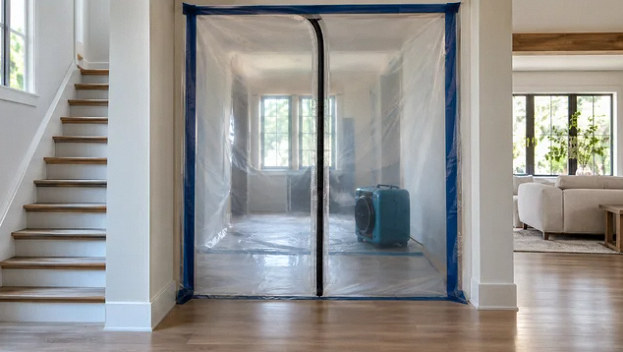
First decisions · 3 min read
Containment and Air Filtration During Restoration
Understand drying barriers, containment, HEPA filtration, and the household arrangements that keep work areas controlled.
Read the guide
Documentation · 3 min read
Choosing a Water Restoration Contractor: What to Verify
Compare qualifications, inspection methods, documentation, and repair responsibility before choosing restoration help.
Read the guide