
Mold remediation · 6 min read
Mold Fogging and Paint: What the Invoice Does Not Prove
Evaluate a spray or coating proposal by asking what contamination is removed, how moisture is corrected and what can be inspected.
YKCA · References checked 2026-10-03
Start with the essentials
Decisions before approving work
At a glance
Three things to keep in view.
Read the verbs
Separate product application from documented cleaning and removal.
Trace the water
Find the actual correction and evidence it was completed.
Review the gaps
Use records and a defined assessment before further treatment.
The key point
Separate product application from documented cleaning and removal.
You receive an invoice saying an attic was fogged and coated. It may have been done before a home purchase or as a cheaper response to a visible problem. The invoice proves a service was billed; it does not fully describe the condition before work, the removal performed or the result afterward. The useful next step is to reconstruct that missing information. This guide does not diagnose hidden mold or declare that every chemical application is inappropriate.
Related service: Mold remediation questions and planning
Identify exactly what was promised
Read the proposal and invoice together. Highlight the verbs: inspect, remove, clean, apply, coat, repair and verify. If the only verbs describe applying products, ask what cleaning or removal occurred before those applications. A product's advertised purpose does not tell you whether the work at your property followed an adequate site-specific plan.
Ask for dates, locations and the names of the companies involved. “Whole attic” needs clarification if the work record contains no photographs or quantities. Do not assume missing detail means no work occurred, but do not supply the missing evidence yourself. Request the contractor's contemporaneous records and separate them from explanations created after a complaint.
Ask what material physically left the space
Request a description of removed material, collected debris and cleaning of retained surfaces. EPA explains that dead mold can still cause allergic reactions, so killing mold alone does not replace removal. That principle gives you a focused question: what part of the job addressed the contamination rather than its appearance or viability?
For retained framing or sheathing, ask how the surface was evaluated after cleaning and before coating. For porous materials, ask why they were retained or removed. Avoid prescribing a universal abrasive or chemical method from an online comment. The suitable process depends on the assembly and conditions, and aggressive work can introduce other hazards if the material has not been assessed.
Reconstruct the moisture correction
Identify the moisture source the contractor believed was responsible, the evidence supporting that conclusion and the specific correction performed. If a bathroom exhaust was redirected, request the final route and completion record. If a roof repair was outside the scope, find the separate repair record. An invoice for “mold treatment” cannot establish that either task happened.
Ask whether ongoing conditions were checked after the correction. A brief visit on a dry day may not answer a rain-related question. A fan that operates audibly may not demonstrate that its route is correct. The point is to identify the remaining uncertainty so the next assessment is targeted, instead of repeating the same treatment on the same assumption.
Understand the coating's intended role
Request the product name, instructions and the contractor's explanation of why it was used on that substrate. Ask whether the coating is intended for appearance, a specified restoration purpose or another function. Those goals should not be blurred into an undefined promise that the area is now “safe.” EPA advises against painting over moldy material without appropriate cleanup and drying.
A coating also changes what can be seen afterward. Ask for pre-coating photographs and any inspection record. If none exists, an independent assessor should decide what can still be evaluated and what limitations remain. Do not remove coatings yourself to investigate; the access method and any material hazards need their own plan.
Review chemical claims with the actual label
If a contractor relies on an antimicrobial claim, request the exact product and label relevant to the proposed use. Ask how the application, surface, exposure controls and occupancy instructions fit the job. Terms such as “natural,” “hospital grade” or “professional strength” do not answer those questions. Do not mix products or copy a chemical recipe from a discussion thread.
Also ask whether the treatment is optional or essential to the proposed scope and why. You can request an explanation without choosing the chemistry yourself. If an alternative is proposed, compare its effect on the identified problem and its limitations. A longer treatment duration or broader application is not evidence of a more complete remediation by itself.
Define the independent review narrowly
An independent review is most useful when it has a clear assignment: assess remaining moisture, evaluate accessible treated materials and identify missing evidence that affects the next step. Give the assessor the original report, photographs, invoices and product information. Avoid asking for a universal certificate that no mold exists anywhere in the building.
Discuss whether any testing would change the decision and how it would be interpreted. Agree on access needs before the visit, especially if coatings or finished surfaces obscure relevant areas. The assessor may be able to reach a limited conclusion rather than a sweeping one. A candid limitation is more useful than certainty unsupported by the available evidence.
Turn missing evidence into specific next actions
Create a list with three categories: verified work, unresolved condition and missing documentation. Request documents first where they can answer the question. Use inspection where the physical condition remains uncertain. Reserve additional treatment for a defined finding, rather than purchasing another whole-house application because the first invoice was vague.
If you are buying or selling the property, keep restoration findings separate from negotiation and legal advice. The physical assessment can describe what is known; it cannot determine every contractual obligation. The immediate goal is a defensible condition record and a specific work plan. That is a stronger basis for your next decision than either accepting the invoice at face value or assuming the whole building must be redone.
Common questions
Can fogging alone establish that mold remediation is complete?
No. Ask what contamination was removed, how the moisture source was corrected and what inspection demonstrates the result. A record of product application alone leaves those questions unanswered.
Does paint over an old mold area mean all the wood must be replaced?
Not automatically. Request pre-coating records and a qualified assessment of the material and remaining conditions. A coating may limit inspection, so the evaluator should explain both the findings and what cannot be confirmed.
Sources and further reading
References checked 2026-10-03. Guidance depends on the loss, affected materials, scope of work and property conditions.
The homeowner question behind this guide
These public discussions informed the questions addressed here. Personal experiences and comments are not technical findings or proof of insurance coverage.
Discuss the next step for your property.
Share what happened, which areas are affected and the decisions you need help with.
Discuss mold remediationRelated decisions
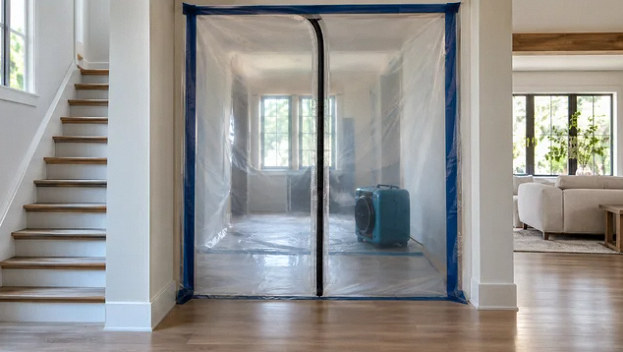
First decisions · 3 min read
Containment and Air Filtration During Restoration
Understand drying barriers, containment, HEPA filtration, and the household arrangements that keep work areas controlled.
Read the guide
Documentation · 3 min read
Choosing a Water Restoration Contractor: What to Verify
Compare qualifications, inspection methods, documentation, and repair responsibility before choosing restoration help.
Read the guide